The Side of Coming to America Many African Immigrant Children Are Rarely Prepared For
Javits Frimpong's death has adults who arrived as African immigrant children recalling the bullying and racism nobody warned them about in America.
 Black News
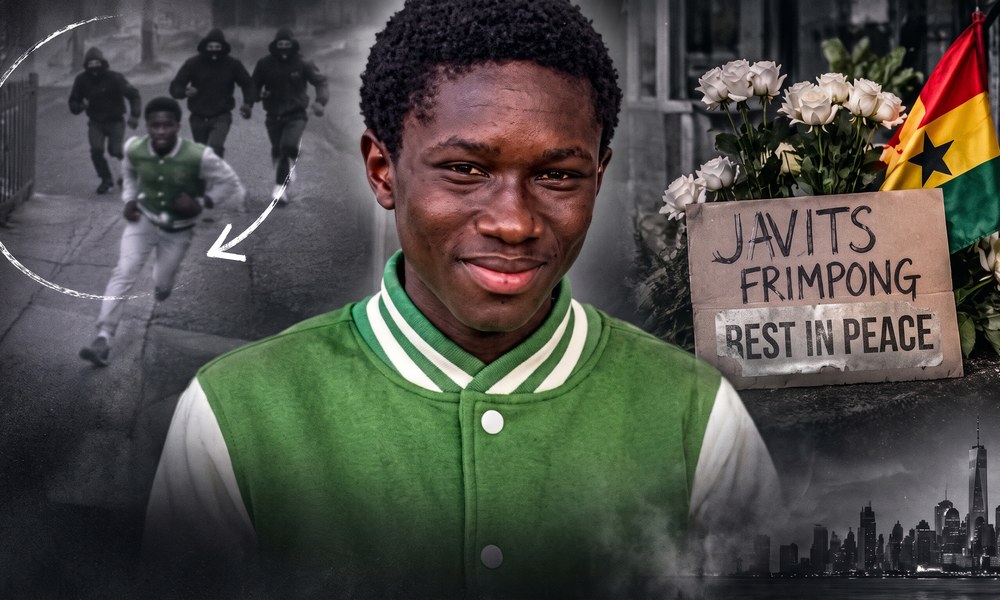
Javits Frimpong had been in the United States for one year and a day when he was shot on his way to school in the Bronx. The 15-year-old came from Ghana in 2025 to live with his father. On the morning of Thursday, October 29, he was found near East 171st Street with a gunshot wound to his stomach, and he died at St. Barnabas Hospital, according to Gothamist.
Surveillance footage shows him running down the sidewalk in a brown hoodie, followed by someone dressed in black. Police are searching for three masked teenagers, ABC7 New York reports. As of Saturday, no one had been arrested.
His father, Thomas Frimpong, says his son had been complaining about a classmate. “Dad, anytime I am going to lunch, that guy keep on bullying me,” he recalled Javits telling him, in an interview with CBS New York. Three days before the shooting, he says, the principal at DreamYard Preparatory School called to say two students had been suspended for a week, and that Javits was not to blame.
The father believes the killing is connected. Police have not said so, and they have not named a motive. What happened on East 171st Street is for investigators, and eventually a court, to establish.
Ghana’s government has taken up the case. Foreign Affairs Minister Samuel Okudzeto Ablakwa spoke with Thomas Frimpong and pledged to pursue justice, Adomonline reports, and staff from Ghana’s Permanent Mission in New York visited the family.
His family has also asked for help. A GoFundMe for funeral, burial and other expenses, organized by his cousin Tracy Boampong with his father as the beneficiary, had raised more than $754,000 from over 23,000 donors by Saturday.
Something else has happened in the days since, and it does not depend on what the investigation finds. Adults who arrived as African immigrant children have started telling their own stories. Many are about school. Many are about how they sounded. And underneath many of them is what it meant to arrive Black in a country that already had its own ideas about that.
What African Immigrant Children Walk Into
The pattern is familiar to anyone who came young. You arrive with good grades, a school-uniform habit and an accent shaped by Accra, Lagos, Douala or Nairobi. Within weeks, the accent is the first thing classmates hear and the first thing they mock.
Then come the jokes about your name, the lunch your mother packed and whether you lived with animals.
Maba Ba, who grew up in Dakar and went to college in Virginia, wrote about it in an essay published the day after Javits died. One classmate, he writes, asked him “whether I had swum to America.” The same classmate wanted to know if he had lived around “Hyenas. Monkeys.”
Ghanaian-American comedian Michael Blackson, who has talked about being bullied after arriving young, reacted bluntly: “This has to stop,” GhanaWeb reports.
The research backs up what people describe, even if it is thinner than it should be. A national study of school-aged immigrant youth, drawing on 2009-2010 survey data, found that Black immigrant students were significantly more likely than US-born Black students to report being bullied. The data did not separate out African-born children, which is part of the problem. They are often counted, if at all, inside larger categories.
Smaller studies fill in the detail. A 2021 study in Multicultural Education Review that followed African immigrant students in US urban schools describes pressure to change how they dressed and spoke, and to stop speaking their own languages. Research on refugee-background students in Perspectives on Urban Education found some were picked on specifically for speaking English with a non-American accent.
The Accent Was Never the Problem
Many African children arrive speaking English as a first or second language, often alongside two or three others. In a classroom in Kumasi or Enugu, that English was a mark of achievement.
In an American hallway, it becomes evidence that you do not belong.
A 2020 paper in The Excellence in Education Journal describes accent discrimination as systemic, reaching from classrooms to faculty offices. Children respond in a handful of ways. Some go quiet. Some sand their voices down until they sound “American” by the end of the first year, and answer their parents in English at home. Some fight back and get disciplined for it.
Thomas Frimpong has described his son the same way, more than once. “My son is always quiet, always,” he told Gothamist. A school bus aide who knew Javits called him, to CBS New York, “an honorable student that just came from Ghana.”
Who Did the Bullying Is a Harder Conversation
Online, some people have been quick to say who they believe is responsible. Police have released nothing about the race or nationality of the suspects, and nothing about the two students who were suspended. Any claim about who they are is, for now, speculation.
The wider conversation it has opened is real, though, and it is uncomfortable. Many African adults say the taunting they faced came largely from other Black children, including slurs aimed at African kids specifically. Others say it came from fellow Africans. In Maba Ba’s essay, the classmate who made monkey noises at him was born in America to Kenyan parents.
He also describes what he has watched happen online since Javits died. “People are reaching for old grievances,” he writes, “collecting evidence against entire communities.”
Both experiences can be true without turning a grieving family’s loss into a verdict on Black Americans. Plenty of African immigrant children were also defended, befriended and taken in by Black American classmates. And Black American children in the same under-resourced schools face their own bullying, violence and neglect. As Maba Ba puts it: “An African accent can become a target. So can being African American.”
Black in America, Before Anyone Explains What That Means
The hallway is only one front. An African child who lands in the Bronx, Houston or Minneapolis also walks into America’s racial history, usually before anyone has explained it.
In Accra or Douala, most children do not think of themselves as Black. They are Asante or Bamileke, a good student, somebody’s son. In the United States, race is often the first thing people see, before they hear the accent or the name. Many new arrivals end up Black and different at the same time: too foreign for some classmates, and to a police officer, a store guard or a stranger, simply Black.
That second part carries its own risks. In February 1999, four plainclothes NYPD officers fired 41 shots at Amadou Diallo, a young man from Guinea, in the doorway of his Bronx apartment. He was unarmed. The officers said they mistook his wallet for a gun, and a jury acquitted them the following year. People in the Bronx still gather to mark the date.
In April 2022, Patrick Lyoya, a 26-year-old refugee from the Democratic Republic of Congo, was shot in the head by a Grand Rapids, Michigan, police officer after a traffic stop. The officer’s murder trial ended in a hung jury in May 2025, and the county prosecutor decided not to retry him.
The data points the same way. In a 2023 KFF and Los Angeles Times survey, 55% of Black immigrants said they had been treated worse than US-born people in at least one setting, including stores, housing and dealings with police. A 2016 report by the Black Alliance for Just Immigration and NYU Law found Black immigrants made up about 7% of noncitizens but about 20% of those facing deportation on criminal grounds. For a teenager without citizenship, one arrest can carry consequences a US-born classmate never faces.
None of this means families should stop sending for their children. Many of those children go on to thrive. But this is the country they enter. Most parents who came as adults learned it slowly. Their children tend to learn it faster, and harder.
What Parents Are Rarely Told
For many families, bringing the children over is the goal for years. A parent goes ahead, builds a life, files the papers and finally sends for them. The planning is about visas, flights and school enrollment. The emotional side is rarely part of it.
Harvard researcher Carola Suárez-Orozco and her colleagues found that long separations are close to the norm in immigrant families. In one Family Process study of 385 early adolescents, 85% had been separated from one or both parents for long periods, and separation was linked to higher depression scores. That sample did not include African families, but the shape of the story will be familiar to many of them.
A child can arrive to a parent they have not lived with in years, in a neighborhood they did not choose, at a school where nobody can find Ghana on a map. Nobody prepares them for the hallway. Often nobody prepares the parent to ask about it, either.
What Would Actually Help
Parents and schools can start with the basics:
- Ask specific questions. “How was school?” gets “fine.” “Who do you sit with at lunch?” and “Has anyone said anything about how you talk?” get answers.
- Take the first report seriously. Javits told his father he had reported the classmate several times. Children who have just arrived often report once, see nothing change and stop.
- Push schools for a plan, not just a suspension. A week out of school removes a bully for a week. It does not cover the walk to school when the week is over.
- Find the community early. Churches, mosques, hometown associations and Ghanaian, Nigerian or Cameroonian student groups give a new arrival people who sound like them.
- Explain race in America, police included. Many Black American families have “the talk” with their children about what to do in a police stop. Many African immigrant families do not realize they need to, until something happens.
- Tell them before they land. The accent will be noticed. It is not a flaw. Children who expect the taunt handle it differently from children blindsided by it.
None of this would necessarily have saved Javits Frimpong. We do not yet know why he was killed. But the stories his death has unlocked belong to thousands of children who lived, and who carried that first year with them long after their accents faded.
His mother, Doris Adu Gyamfi, is in Kumasi. She sent her son to America for a better life. The people now sharing their stories are asking the question underneath that hope: did anyone tell him what the first year would really be like?