Airbus explores investment to develop Colombia’s aviation sector
The Toulouse-based aircraft manufacturer will send representatives to Bogotá next week as the De la Espriella government looks to attract industrial investment and strengthen the country’s role in aviation. BOGOTÁ — Colombia is seeking a place in the global aerospace supply chain as Airbus prepares to explore investment opportunities in the country, opening discussions that […]
 Black News
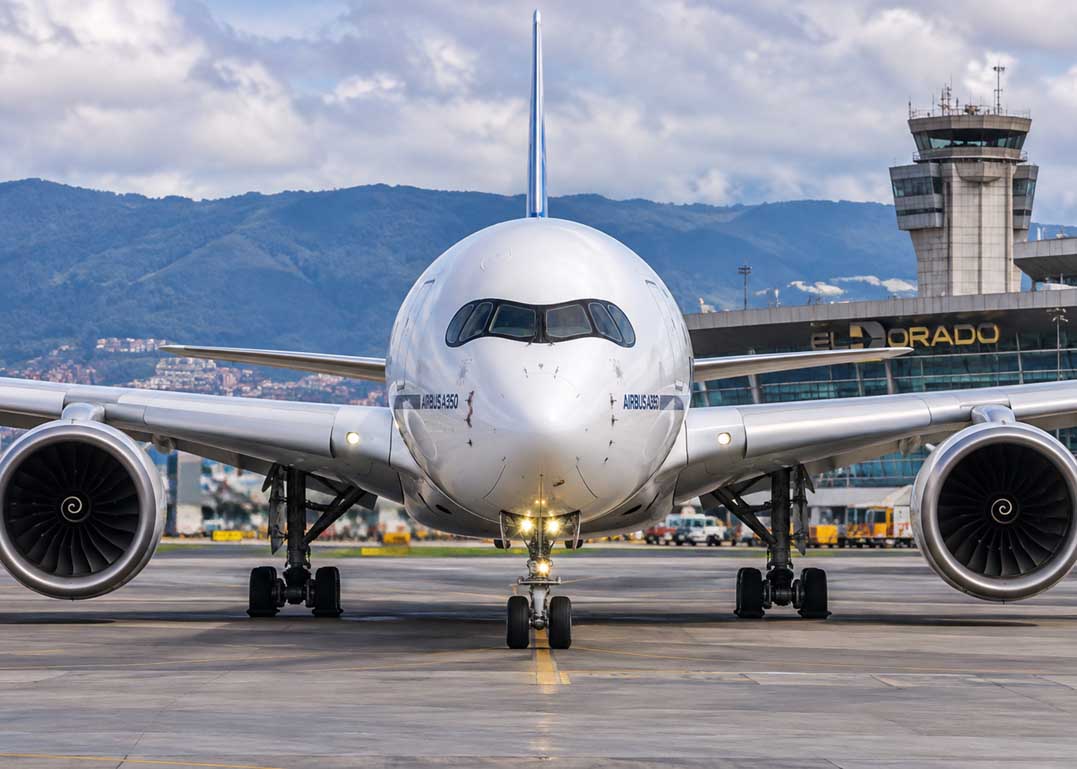
The Toulouse-based aircraft manufacturer will send representatives to Bogotá next week as the De la Espriella government looks to attract industrial investment and strengthen the country’s role in aviation.
BOGOTÁ — Colombia is seeking a place in the global aerospace supply chain as Airbus prepares to explore investment opportunities in the country, opening discussions that could extend the European manufacturer’s relationship with one of Latin America’s important aviation markets beyond aircraft sales.
The announcement followed a meeting in Madrid on November 4 between Vice President José Manuel Restrepo, Commerce, Industry and Tourism Minister Mauricio Gómez Amín and Arturo Barreira, Airbus president for Latin America and the Caribbean, during the government’s Investment Week in Spain.
Airbus representatives are expected in Bogotá next week for meetings with the Ministry of Commerce, Industry and Tourism (MinCIT). The discussions will assess potential investment over the next four years and examine the conditions needed to develop a Colombian industrial supply chain for aeronautical and aerospace equipment.
No investment value, manufacturing facility or specific project has been announced. The immediate objective is to determine whether Colombian companies could become suppliers within Airbus’s wider industrial network, a prospect requiring investment in technical capabilities, skilled labour, certification and production standards.
Restrepo said the talks reflected the government’s effort to attract foreign capital while expanding the domestic industrial base. “It is very valuable that they are considering Colombia as an option for developing this industrial supply chain. We will explore that possibility next week. The principle here is how to attract more investment into our country, develop a supply chain and, through that, grow as a nation,” highlighted the vice president.
Airbus already has a presence in Colombia. The company says it has operated in the country for more than 40 years and opened its Bogotá corporate office in 2015, becoming the first aerospace manufacturer to establish direct operations locally.
More than 160 Airbus aircraft operate with Colombian airlines, alongside around 25 helicopters and 18 military aircraft. Airbus says its products account for more than 85 per cent of Colombia’s in-service commercial aircraft fleet, making the country its third-largest commercial aviation market in Latin America, after Brazil and Mexico.
Barreira underscored the importance of the market and the company’s intention to expand its presence. “Colombia is an extremely important country for Airbus. More than 85 per cent of the aircraft flying in Colombia are our brand, and we are committed to continuing to grow in Colombia alongside the current government”.
A supplier network could encompass components, aeronautical equipment, engineering, maintenance and specialised services. Participation would depend on local companies meeting international requirements for quality, safety, traceability and reliability.
The initiative comes as the country’s largest airline group pursues a major fleet strategy. Avianca, Colombia’s flag carrier, operates Airbus A319 and A320-family aircraft on domestic and regional routes, giving the manufacturer an established commercial relationship with the country’s airline industry.
There is also a longer-term wide-body dimension. Abra Group, the holding company that controls Avianca and GOL, disclosed an order in October 2025 for five Airbus A350-900 aircraft, alongside 50 additional A320neo aircraft.
The A350 is Airbus’s long-range wide-body aircraft, designed for intercontinental and ultra-long-haul services. Its range and fuel efficiency make it a potential option for airlines seeking to expand routes linking Latin America with Europe and other distant markets.
The order, however, is held by Abra Group, not Avianca individually. The group has said the aircraft will be integrated into its airlines in the coming years according to operational and commercial requirements. No decision has been announced assigning the A350s to Avianca or confirming that they would be based at the flagship’s hub, El Dorado International Airport. Their eventual deployment could nevertheless create possibilities for the group’s expanding network to more destinations within Europe.
The distinction matters: Colombia’s opportunity with Airbus is currently an industrial exploration, while Abra’s A350 order is an existing fleet commitment at group level. Together, they illustrate the breadth of the relationship, but do not amount to a confirmed manufacturing investment or a new Avianca route announcement.
The discussions form part of the De la Espriella administration’s Misión Crecer, an international initiative intended to attract investment, strengthen productive capacity and create opportunities for Colombian industry.
The meetings in Bogotá will indicate whether the proposal can advance from exploratory talks to concrete partnerships. For Colombia, the challenge will be to translate its position as an Airbus customer into the technical skills, supplier capacity and industrial credibility required to join the company’s global aerospace ecosystem.