
MTBPS 2026: SHORT-TERM RELIEF FOR A LONG-TERM CRISIS
The extension of the Social Relief of Distress (SRD) grant to March 2028 provides continued support to millions of unemployed people, but reflects a lack of political will to make it permanent, alongside job creation, to address the crisis of unemployment. The grant amount remains a meagre R370 a month, far below what people need ... Read more The post MTBPS 2026: SHORT-TERM RELIEF FOR A LONG-TERM CRISIS appeared first on Black Sash.
 Black News
The extension of the Social Relief of Distress (SRD) grant to March 2028 provides continued support to millions of unemployed people, but reflects a lack of political will to make it permanent, alongside job creation, to address the crisis of unemployment. The grant amount remains a meagre R370 a month, far below what people need to meet their basic needs. Black Sash continues to call for the grant to become permanent Basic Income Support as part of a comprehensive Social Protection Floor: the minimum income security and access to essential services that everyone needs to live with dignity.

The SRD reaches people aged 18 to 59 with little or no other income. At less than half the Food Poverty Line of R868 a month, the grant cannot meet even basic nutritional needs. Its extension offers temporary relief, but leaves recipients facing continued uncertainty about the adequacy and long-term future of this essential support.
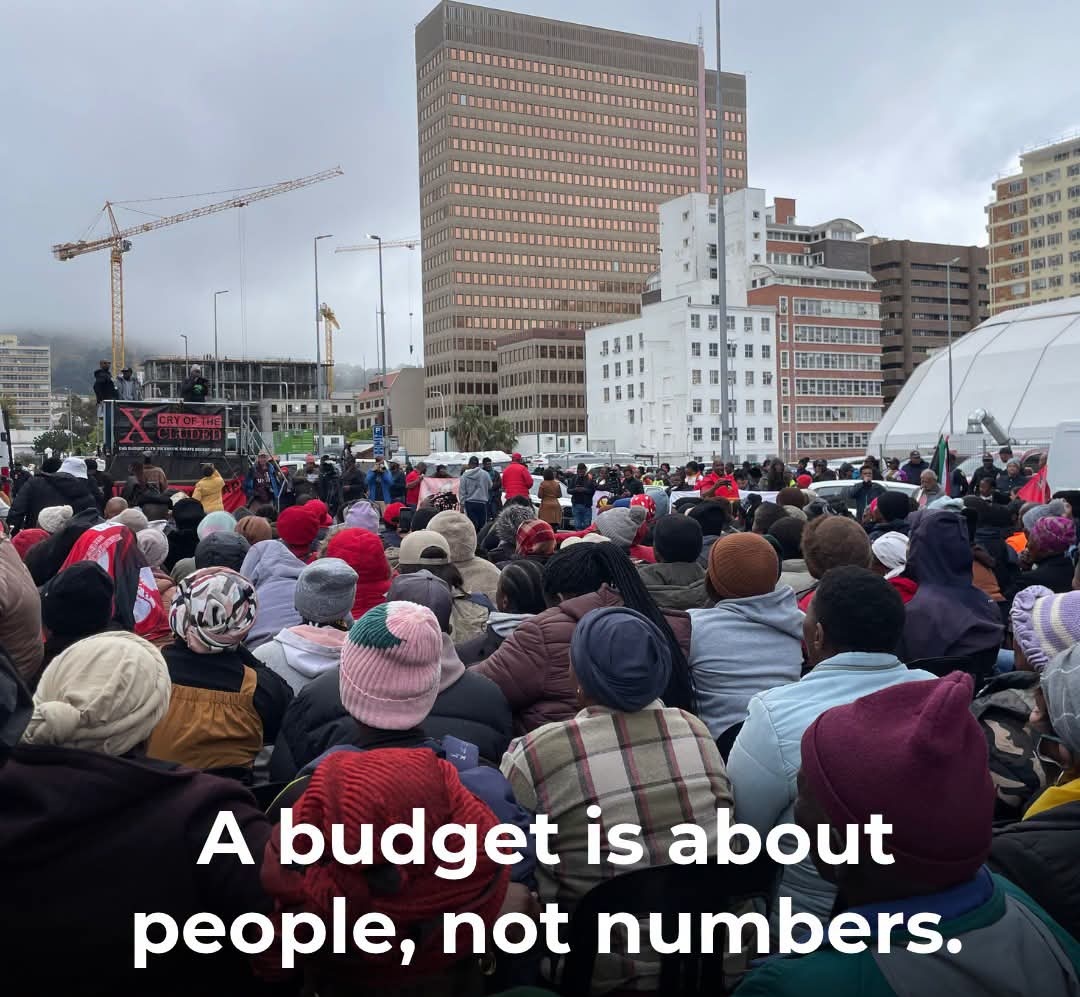
Ahead of the MTBPS, Black Sash joined civil society organisations, trade unions and community groups gathered outside Parliament to highlight the lived impact of the cost-of-living crisis, unemployment, underfunded public services and inadequate social protection.
“Communities came to Parliament demanding a budget that responds to unemployment, poverty and the erosion of public services. The extension of the SRD provides some buffer, but not enough to survive,” said Hoodah Abrahams-Fayker, National Advocacy Manager at Black Sash.
“A Social Protection Floor is not a cost: it is the investment that allows people to eat, care for their families, look for work and participate in society with dignity. Government must move beyond yearly extensions and provide a permanent, adequate income floor for all who need it.”
Short-term relief cannot address a structural crisis
The MTBPS includes temporary fuel-levy relief, but this is a short-term intervention in a deep and ongoing cost-of-living crisis. Relief that ends in early January cannot replace sustained investment in income security, public services and decent work. A budget that offers short-term relief while leaving social protection temporary and inadequate does not address the structural causes of poverty.
The MTBPS also identified R13 billion in savings associated with reducing fraud in social grants through the grant review process, including R6.8 billion linked to the SRD over the medium term.
Black Sash supports accountability and action against genuine fraud, but savings attributed to grant reviews must be examined alongside their impact on people entitled to social assistance.
Black Sash’s helpline has received calls from beneficiaries distressed by SASSA’s review process. Many concerns relate not to fraud, but to administrative problems, including unclear communication, difficulty resolving queries and the risk of grants being suspended while people try to navigate the process.
With the transition to digital biometric verification systems, verification must remain accurate, transparent and accessible. People need clear reasons for suspension, practical assistance to resolve queries, and accessible appeal and reinstatement processes. Savings cannot come at the expense of eligible people’s access to social assistance.
A basic income and digital access must include everyone
The MTBPS says government will continue working to integrate the SRD with labour-market activation, skills development and enterprise support, including linking beneficiaries to opportunities through MzansiXchange. It also allocates R150 million to develop MyMzansi, a single digital platform through which people will access government services.
Black Sash supports meaningful pathways into employment, training and economic participation, but access to a basic income must not depend on participation in work-search or activation programmes. Such requirements risk excluding unpaid carers, women carrying primary responsibility for care, people in rural areas, people with limited mobility or documentation, and older job-seekers.
“A basic income should provide the security people need to seek work, pursue training, care for their families and participate in society. It should not make access to essential income support conditional on opportunities that may not be available to them,” said Abrahams-Fayker.
As social grants, identity and payments move online, MyMzansi will shape how millions of people reach the state. Digital systems can make services faster, but they can also lock people out. MyMzansi must be developed transparently, with public consultation, strong data protection, independent oversight and offline routes for people without smartphones, data or digital skills.
Gender is central to the Social Protection Floor
Black Sash acknowledges the MTBPS allocation of R3.8 billion for more than 3,500 social workers to strengthen gender-based violence prevention and response, alongside investments in forensic capacity, sexual offences courts and Thuthuzela Care Centres. These are important, but do not address the economic precarity and unpaid care burdens that make it difficult for women to leave violent and abusive situations.
Secure income, childcare, safe housing and reliable transport give women more options to seek help and rebuild their lives. Permanent Basic Income and care infrastructure are therefore part of preventing gender-based violence.
The MTBPS also allocates R1.6 billion over the medium term to pre-birth care and the first 1,000 days of life. Preventing stunting, however, also requires adequate household income, nutritious food, clean water, sanitation and childcare.
Basic services and the 4 November elections
The MTBPS adds R21.8 billion to the local government equitable share to cover the rising costs of free basic water, sanitation, electricity and refuse removal. With local government elections on 4 November, voters should ask every candidate how they will make sure these services reach the households entitled to them.
Social protection must be treated as an essential part of building a society in which everyone can live with dignity. A permanent basic income, adequate child support, accessible public services and care infrastructure are not optional extras. They are the foundation of a fairer, safer and more inclusive South Africa.
END
The post MTBPS 2026: SHORT-TERM RELIEF FOR A LONG-TERM CRISIS appeared first on Black Sash.