Kristina Rozhkova’s scatty, confronting portrait of captivity
Gut Feeling — The Russian artist’s 2024 arrest and subsequent detention opened her eye towards the omnipresent dynamics of power and control. Her new photobook is a stark exploration of being trapped.
 Black News

Gut Feeling — The Russian artist’s 2024 arrest and subsequent detention opened her eye towards the omnipresent dynamics of power and control. Her new photobook is a stark exploration of being trapped.
On June 19, 2024, Kristina Rozhkova was arrested in Russia alongside three others – Anna Panteleeva, Yaroslava Guminaya, and Sergey Evstyukhin. First, they were taken to a temporary detention centre (IVS), before Rozhkova was transferred to a pre-trial detention (SIZO) facility for two months. For the next year and a half, she had to attend “endless” court hearings.
It came after a photoshoot they had organised in a Russian Orthodox cemetery. “There were no victims, no damaged property and no physical evidence,” she says. “It featured elements of shibari [Japanese rope bondage], which was a technique I frequently incorporated into my work. We wore structured outfits, and the focus was entirely aesthetic rather than overtly political – there was nothing vulgar or inherently provocative.”
But Rozhkova claims that the group were the targets of a co-ordinated attack from a group known as Muzhskoye Gosudarstvo, which translates to ‘Male State’, who reported them to the authorities, even though none of the final photographs had been published. It came after one of the models in the shoot had publicly called out a male artist for sexual assault prior to the shoot.
The only thing that had surfaced in public was a leaked screenshot of a behind the scenes video. “It was terrible. Being in SIZO at first was completely unbearable – those two months were genuinely agonizing,” she recalls. “My cellmates used to tell me that the first two months are always the hardest period to survive, and after that, it gradually becomes easier to manage month by month.”
House arrest was hardly easier. “At first, house arrest felt like absolute paradise – you sleep in a normal bed, watch movies, read and focus on hobbies,” she continues. “But after two months, I realised it was its own form of hell. I couldn’t go for a walk or step outside, and I had to watch my life pass me by without understanding why.”
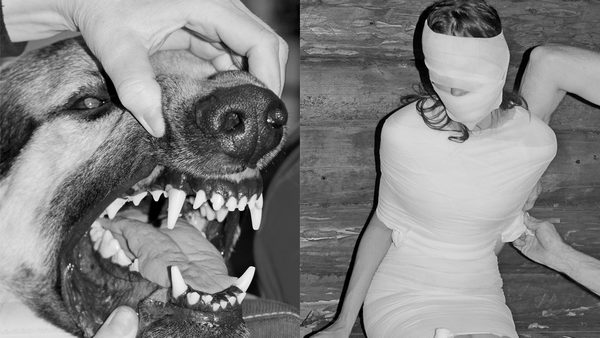
That period, which ultimately consumed two years of her life, without considering the long-term mental effects since, inspired her to create her series and newly published photobook Gut Feeling. Its photographs – which are scatty, disquieting and occasionally even violent – explore the physical experience of being trapped with no control or way out. Photos with chains and ropes are sequenced alongside people physically holding others down – one shot sees a person squatting, with their feet obscuring a man’s face.
Animals also play a key theme in the book. There are mice in jars, a goose being restrained, and references to horses and dogs throughout. Growing up, Rozhkova was surrounded by them – her mother was a dog breeder, and she regularly attended dog shows. Her first friend was a bull terrier, and she described her childhood as Mowgli-like. Her arrest brought back many of those memories and sharpened her focus on the relationship between animals and humans.
“Being confined created a very specific physical and psychological feeling – one I later tried to recreate in my work – of being a trapped animal in a tiny cage,” Rozhkova explains. “Imagine putting vastly different species into one tight space. If you keep animals of the same kind together under proper conditions, they might get along, like getting a second dog so the first one isn’t lonely. But SIZO was a forced mixing of completely incompatible human lives in atrocious conditions. The environment was so wretched that everyone became overwhelmed by aggression, rage and sickness. It was utterly inhumane.”
Yet Rozhkova’s arrest didn’t come in isolation. The past decade and a half have seen the Russian authorities increasingly clamp down on dissenting voices and artists in particular – notably beginning with the arrest of punk group Pussy Riot in 2012, but intensifying in the wake of Russia’s full-scale invasion of Ukraine in February 2022. According to Human Rights Watch, as of July 2026, there were 1,715 political prisoners in the country, which was up by 997 from a year before.
“Before COVID-19, things in the country felt relatively normal – neither I nor my circle felt any heavy pressure,” she says. “The turning point came after the pandemic, but the real nightmare began when the full-scale war started. From then on, literally with every passing month and day, the circle was tightening faster and faster. Authorities started raiding art exhibitions, closing entire museums and controlling art fairs to remove specific works. It became glaringly obvious how impossible it was for artists to truly express themselves.”
The photographs ultimately speak to more than just her arrest, but the array of power dynamics that dominate human existence on earth. Whether it’s parents with their children, husbands and wives, rich and poor, governments with populations, people and pets, or the livestock industry at large, there are structural imbalances that govern our everyday lives.
“I see the project as universal. It can be interpreted through everyday, intimate, sexual or deeply personal lenses,” she says. “Totalitarian frameworks and mechanics of control exist everywhere – within medical institutions, schools and universities.”
Like many other young, creative people of her generation, Rozhkova now lives outside of Russia. Around 1,000,000 people are believed to have emigrated since February 2022, mostly under the age of 45. Yet while she hopes the future holds an end to the war and a free Russia, her life has been changed forever.
“Before I was arrested, I could never have imagined that something like this would happen to me, or how brutal the reality of it is,” she continues. “Once you’ve been through it, you can no longer trust the world in the same way. It fundamentally shatters your trust in society, in authorities, and in safety itself.”
Gut Feeling by Kristina Rozhkova is published by VOID.
Isaac Muk is Huck’s digital editor. Follow him on Bluesky.
Buy your copy of Huck 83 here.
Enjoyed this article? Follow Huck on Instagram and sign up to our newsletter for more from the cutting edge of sport, music and counterculture.