Kizza Besigye, Lukwago and missing Kivumbi stun court
The questions hanging over Uganda’s courts last week extended well beyond legal arguments. One opposition politician never made it to court because no one could say where he was. Another refused to embrace lawyers assigned by the state. A third pleaded for specialist medical treatment as his case was sent to the High court. Together, […] The post Kizza Besigye, Lukwago and missing Kivumbi stun court appeared first on The Observer Media Ltd.
 Black News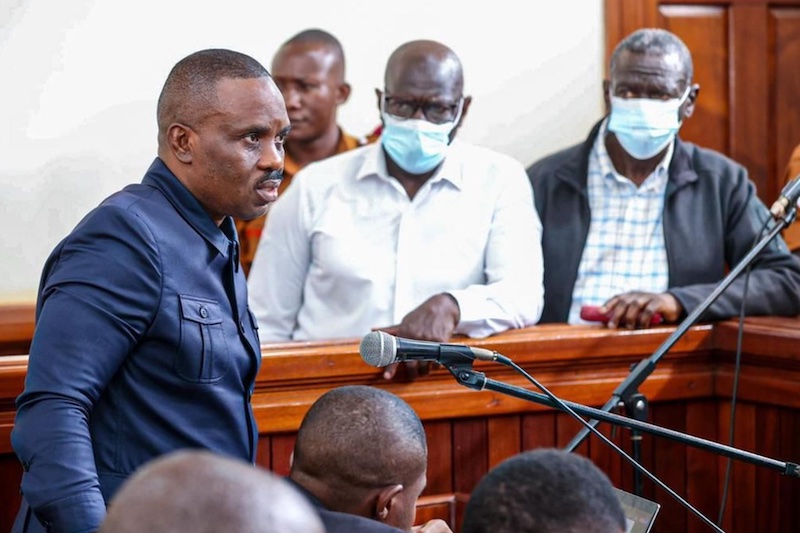

The questions hanging over Uganda’s courts last week extended well beyond legal arguments.
One opposition politician never made it to court because no one could say where he was. Another refused to embrace lawyers assigned by the state. A third pleaded for specialist medical treatment as his case was sent to the High court.
Together, the cases exposed not only the personal struggles of the men involved but also broader questions about due process, the rights of accused persons and the role of the courts when legal proceedings collide with claims of disappearance, illness and political contestation.
MUWANGA KIVUMBI SKIPS COURT
The most striking mystery surrounded Muhammad Muwanga Kivumbi, the former Butambala County MP and National Unity Platform deputy president for Buganda. When his terrorism case came up last week, Kivumbi was absent.
What made the hearing extraordinary was that neither the prosecution nor his own lawyers could tell the court where he was. Kivumbi had secured bail on July 10 after spending nearly five months in prison.
But just a day later, he was reportedly arrested by armed security personnel in Mpigi while returning from Butambala. Since then, his whereabouts have remained publicly unknown.
State Attorney Salam Nabbosa told the court that even the prosecution could not confirm where Kivumbi was and asked the magistrate to issue criminal summons compelling him to appear. His defence lawyers, Samuel Muyizzi and Kenneth Paul Kakande, objected.
They argued that it made little sense for the state to seek criminal summons against a man it admitted it could not locate, particularly when government security agencies were widely believed to be responsible for his disappearance.
The court agreed. Magistrate Ssejjemba rejected the prosecution’s application for criminal summons and adjourned the matter until August 20. Kivumbi’s legal team has since indicated it will file a habeas corpus application before the High court in Kampala, seeking an order compelling the authorities to produce him, dead or alive.
LUKWAGO BEGS FOR SPECIALISED TREATMENT
Another politically sensitive case unfolded at Makindye Chief Magistrate’s court, where former Kampala Lord Mayor Erias Lukwago appeared before being committed to the High Court for trial on charges of misprision of treason.
Before the case was transferred, Lukwago urged the court to first address what he described as his deteriorating health. He told the court that while on remand at Luzira Upper Prison, he was receiving only routine monitoring, including checks on his vital signs, yet his condition continued to worsen.
He said he struggled to sleep and feared his health would deteriorate further without specialist treatment. Through his lawyer, Medard Lubega Ssegona, Lukwago asked to travel to India for treatment under security escort, arguing that he could remain in lawful custody throughout the medical process before returning to prison afterwards.
The application relied on recommendations from specialists at Mulago National Referral Hospital, who advised that he be reviewed by spine surgeons in India who had previously carried out his cervical disc replacement surgery.
Lukwago also told the court that doctors had advised him to stay in a well-ventilated environment because of respiratory complications, conditions he said were incompatible with life in prison.
The magistrate, however, held that the court no longer had jurisdiction once the case had been committed to the High court. The Criminal Division later issued a production warrant directing Luzira Upper Prison authorities to produce Lukwago before Justice David Matovu on July 24. While those cases centred on physical liberty, another focused on legal representation.
COURT PRESSURED BESIGYE TO ACCEPT STATE LAWYERS
The High court gave veteran opposition politician Dr Kizza Besigye and his co- accused, Hajj Obeid Lutale, two weeks to decide whether to accept lawyers provided under the State Brief Scheme.
Justice Emmanuel Baguma had earlier ruled that the treason trial would proceed whether or not the accused retained lawyers of their own choosing. If they failed to do so, the court would appoint counsel at government expense.
Besigye has resisted that arrangement, telling the court he had been brought from Luzira Prison against his will and had refused to participate because he had been denied access to his preferred legal team.
At last week’s hearing, Justice Baguma directed the accused to choose lawyers from a list of 786 advocates accredited under the State Brief Scheme after prosecutors confirmed they had disclosed all the evidence they intended to rely on, including witness statements, documentary exhibits and electronic material.
The judge also ordered prison authorities to facilitate meetings between the accused and prospective lawyers before the case returns on July 29, when Besigye and Lutale are expected to inform the court whether they have accepted state-funded representation.
COURT DISMISSES NUP’S IPOD BID
Away from the criminal courts, the High court handed the National Unity Platform a significant setback in its attempt to restore government funding. The party had challenged a directive issued by the minister of Justice and Constitutional Affairs withholding public funding from political parties that declined to join the Inter-Party Organisation for Dialogue (IPOD).
NUP argued the directive was unlawful because the statutory instrument required to operationalise the law had not yet been enacted and because the party had not been consulted.
The Attorney General and Electoral Commission countered that Parliament had already made IPOD membership a mandatory condition for funding through the Political Parties and Organisations (Amendment) Act, 2025, which took effect after presidential assent on June 15, 2025.
Justice Collins Acellam ruled that although the directive could be reviewed by the court, the funding restriction flowed directly from Parliament’s legislation rather than from an unlawful ministerial decision.
He held that legitimate expectation “cannot override an express statutory provision” and dismissed the application in its entirety, with each party bearing its own costs because of the novel legal questions involved.
COURT RULES SCHOOL LIABLE FOR CANING OF PUPIL
The week’s final major decision came in a case that had been before the courts for more than a decade. The High court ruled that Sir Apollo Kaggwa Primary School was legally responsible for the unlawful caning of former pupil Naswif Katongole by two teachers, even though it declined to award compensation for the medical injuries the family claimed resulted from the assault.
Katongole and his mother, Babirye Lilah, had argued that severe caning in September 2011 left the boy with mobility problems and psychological trauma. She told the court she eventually left her job with the United Nations to care for her son and spent substantial sums on treatment, including medical care in South Africa.
The school denied responsibility, arguing that the teachers had acted independently and that a previous settlement barred further legal action. Justice Simon Peter Kinobe disagreed on the settlement, finding it legally unenforceable because it imposed additional obligations on the plaintiffs without fresh consideration.
However, he concluded that the family had failed to prove the caning caused the boy’s medical condition, accepting defence medical evidence that the spinal symptoms were more likely linked to a viral infection than physical trauma.
Even so, the court found the punishment itself unlawful under the Children Act, which prohibits corporal punishment in schools.
Justice Kinobe held the school vicariously liable for the actions of its teachers, awarded Katongole Shs 5 million in general damages, together with six per cent interest from the date of judgment until payment, and ordered the school to pay costs.
By the end of the week, Uganda’s courts had dealt with far more than technical questions of law. They had confronted unresolved disappearances, contested constitutional rights, the treatment of prisoners, political financing and the limits of institutional responsibility, issues that continue to shape public confidence in both the justice system and the rule of law.
The post Kizza Besigye, Lukwago and missing Kivumbi stun court appeared first on The Observer Media Ltd.