George E. Johnson Changed Black Beauty — and Black History
From Chicago's South Side to the American Stock Exchange, George E. Johnson built one of the nation's most influential Black-owned businesses. His impact reached beyond commerce, changing how Black Americans saw themselves and investing in one of Black culture's defining television shows. The post George E. Johnson Changed Black Beauty — and Black History appeared first on Word In Black.
 Black News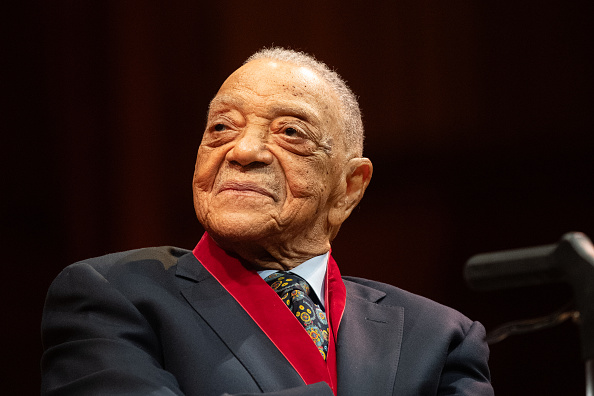

He parlayed a $250 personal loan into a business empire and, in the process, gave Black America a self-esteem boost. A beauty-products pioneer, he broke Wall Street’s color barrier and later helped catapult a locally televised Chicago music show into a national pop-culture touchstone.
And, for the better part of a century, the name George E. Johnson became inseparable from Black hair care in America, at a time when the beauty industry treated Black consumers as little more than an afterthought — if they thought of them at all.
The legendary founder of Johnson Products Co., Johnson died Monday at his home in downtown Chicago. He was 99.
‘Visionary Business Leader’
His son, John Edward Johnson, told The Chicago Sun-Times that his father died of natural causes. The New York Times, citing Johnson’s second wife, Madeline Murphy Rabb, reported the cause as a respiratory illness.
“George was a visionary business leader who built a hair care empire, broke barriers on Wall Street, and helped fuel the fight for civil rights,” his family said in a statement. “Above all, he was a devoted family man whose example inspired generations.”
Johnson founded Johnson Products in 1954 with his first wife, Joan Johnson, on Chicago’s South Side. Within six years, the company controlled nearly 80% of the Black hair care market. In 1971, it became the first Black-owned company listed on the American Stock Exchange, now NYSE American.
George was a visionary business leader who built a hair care empire, broke barriers on Wall Street, and helped fuel the fight for civil rights.
Statement, Family of george e. johnson
Though his business made him a very wealthy man, Johnson’s accomplishment was arguably more meaningful for Black America. In building an empire on curl kits and jars of conditioner, he also helped a generation see itself as beautiful.
For the first time, Black consumers could walk into a beauty supply store, open a magazine or turn on a TV and see attractive, well-groomed people who looked like them — styled by a company a Black man had created from scratch.
Small Investment, Big Payoff
Johnson’s millions later bankrolled “Soul Train,” making him the show’s exclusive sponsor. The cash infusion helped the show’s founder, Chicago deejay Don Cornelius, turn it into appointment viewing for Black households across the country.
Born in 1927 in Richton, Mississippi, Johnson moved to Chicago as a child with his mother, Priscilla Johnson Howard, and his brothers. Growing up poor on the South Side, Johnson shined shoes, hawked newspapers, and worked as a waiter before dropping out of high school to sell cosmetics door-to-door for Fuller Products, an earlier Black-owned beauty company.
There, Johnson came upon the idea that would make him a fortune: a barber’s concept for a safer hair straightener that his employer had turned down. Working with chemist Herbert Martini, Johnson developed the formula himself, then set out on his own.
The origin story he told for decades — and later wrote into his 2025 memoir, “Afro Sheen: How I Revolutionized an Industry With the Golden Rule, From ‘Soul Train’ to Wall Street” — involved a white loan officer who wouldn’t give him money for a business but approved $250 when Johnson said it was for a family vacation.
Changing Times and Tastes
Though it cornered the Black beauty market for decades, Johnson’s business struggled in recent years.
Johnson Products Co.’s dominance gradually waned as cosmetics giants, including Revlon, saw its success and elbowed their way into a market that the Chicago entrepreneur had essentially all to himself. Meanwhile, as Afros, relaxers, and Jheri curls gave way to locs, box braids, and natural hairstyles, many of Johnson’s products fell out of favor with Black consumers.
After George and Joan Johnson divorced, ownership of the business changed hands several times before a Black-led investment group acquired it from the global conglomerate Procter & Gamble in 2009.
Joan Johnson died in 2019. George Johnson is survived by his wife, Madeline Murphy Rabb; his children, grandchildren, and great-grandchildren.
The post George E. Johnson Changed Black Beauty — and Black History appeared first on Word In Black.