

CAROLINA ANTÓN: THE WOMAN BEHIND LATIN MUSIC’S IMMERSIVE SOUND REVOLUTION
Award-winning Mexican audio engineer Carolina Antón discusses breaking barriers for women in sound, pioneering immersive Dolby Atmos mixing in Latin music, and why the future of music lies in innovation, collaboration, and fearless creativity. The post CAROLINA ANTÓN: THE WOMAN BEHIND LATIN MUSIC’S IMMERSIVE SOUND REVOLUTION first appeared on Visión Music Magazine.
 Black News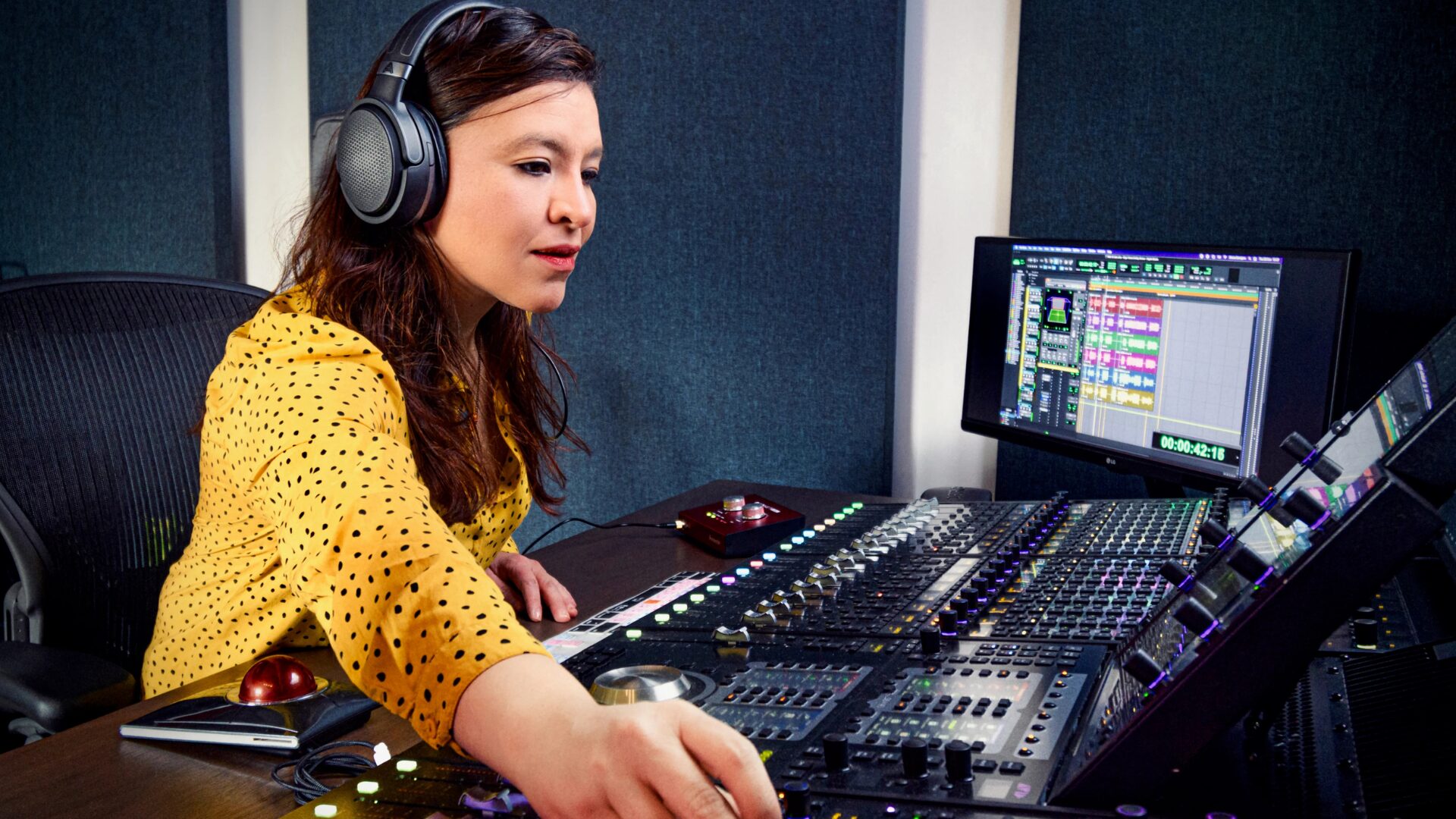
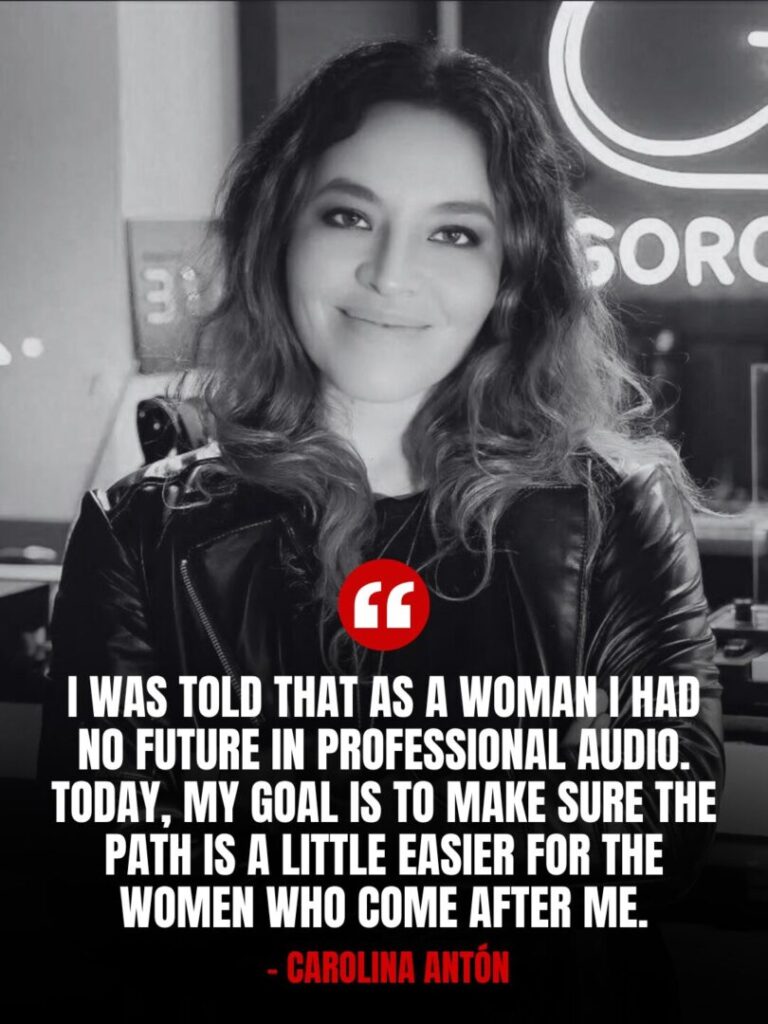
For decades, the world behind the mixing console has remained overwhelmingly male, with women often forced to prove their talent twice over before being given a chance. Carolina Antón knows that reality firsthand. Early in her career, she was told that women didn’t belong in professional audio, that they couldn’t carry equipment, survive life on the road, or earn the respect of crews and artists. Rather than accepting those limitations, the Mexican producer and audio engineer turned every obstacle into fuel, building a career that has made her one of the most respected names in immersive audio and live sound today.
Recently recognized by the Latin Recording Academy® for her work as the immersive mixing engineer on Christian Nodal’s Latin GRAMMY®-winning album ¿Quién + Como Yo?, Antón represents a new generation of creators redefining how music is heard. From mixing legendary artists such as Kool & The Gang, Gloria Gaynor, Natalia Lafourcade, Mon Laferte, and León Larregui, to pioneering Dolby Atmos and immersive sound in Latin music, she has helped shape a sonic landscape that is as innovative as it is emotionally powerful. As one of the first women in Mexico to specialize in these emerging technologies, her success has become more than a personal achievement, it has become a symbol of possibility for others entering the field.
In this interview, Carolina reflects on the evolution of immersive audio, the creative future of Dolby Atmos, and the responsibility of pushing music beyond traditional listening experiences. But perhaps more importantly, she speaks about resilience, representation, and the importance of making space for more women in sound. Her story is a reminder that every breakthrough is heard long before it is seen, and that changing an industry sometimes begins with refusing to turn down your own voice.
MAKING NOISE WHERE WOMEN WERE ONCE TOLD TO STAY SILENT
As an audio engineer, you’ve worked across a wide range of musical genres, from Natalia Lafourcade and Vivir Quintana to your recent Latin GRAMMY® recognition for Christian Nodal’s ¿Quién + Como Yo?.
I’ve been fortunate to work with many incredible artists. I’ve collaborated with Natalia, Ximena, and international artists like Gloria Gaynor. I’m also very happy to have received this recognition for Christian Nodal’s album, which won at last year’s Latin GRAMMYs. It has been incredibly rewarding to meet, collaborate with, and work alongside some of the most talented artists in both the Mexican and international music industries.
I also came across your work with SoundGirls, the organization that supports women in audio. You once mentioned that after attending an event in the United States, you realized Mexico needed something similar, and that’s how you started this initiative. Could you tell us a little more about it?
SoundGirls is a nonprofit organization based in Los Angeles. Its co-founder, Karrie Keyes, is Pearl Jam’s front-of-house engineer. Around that time, Solid State Logic invited me to represent the brand from the perspective of women working in live sound consoles. Through them, I traveled to the United States and visited Red Sound, another highly respected company. Suddenly, I found myself surrounded by women talking about faders, compressors, touring, and the live music business, but also sharing everyday conversations as friends. It was an incredible feeling because it was the first time I had experienced anything like that. In Mexico, I literally didn’t know another woman working in professional audio. That’s when the idea of bringing SoundGirls to Mexico was born, and this year we celebrate ten years.
What has it been like to create and open those spaces for other women?
It’s been amazing. What I enjoy the most is sharing knowledge and making the path a little easier for more women, and even for men. The industry has changed a lot over the 25 years I’ve been part of it. It used to be much more closed off and hostile. It still has its challenges, but it’s definitely better than it was.
For women, it’s encouraging that the environment has become more welcoming, although I still think there’s a lack of awareness about the fact that the glass ceiling hasn’t disappeared. Women continue to face significant obstacles. Even though we’ve made the journey more accessible and a little less intimidating, there’s still so much work to do. I’m simply grateful that I can contribute my small part to the industry, to Latina women, and to women everywhere.
How do you see today’s music industry? Do you think the digital world has made these opportunities more accessible, or what are some of the barriers you’ve had to face?
It’s a bit of both. Today it’s much easier for people to discover your work because digital platforms allow independent artists to release music without needing a record label. You can build your own career and decide who you want to work with, whether that’s producers, engineers, or collaborators.
At the same time, it’s become incredibly competitive. Think about how many songs are released every single Friday. Hundreds. So yes, it’s easier to put music out into the world, but the real question becomes: how do you stand out among those hundreds of new releases? That’s where strategy comes in, as well as the creative fusions we’re seeing today.
As for music itself, I love that there’s much more openness and experimentation. Things aren’t as rigid or traditional as they once were. I think Latin music, in particular, is living through a fascinating moment.
Today’s audiences have incredibly eclectic tastes. How have you incorporated new sounds into your mixes and productions, especially when working with artists rooted in traditional styles?
Something wonderful happened recently. A friend of mine, Mireia Ramos, called and said, “I have this mariachi… well, actually it’s a ranchera EP with seven songs, and we need to finish it quickly.” They recorded everything in New York over two days, sent me all the stems and tracking files, and I mixed the entire project in about two days. She came to listen, loved it, approved it, and it’s being released this Sunday, so I really hope everyone listens to it.
She told me, “It’s a ranchera record, but I’d love to give it a more contemporary feeling.” I immediately said yes. We started experimenting with reverbs, effects, and sound design, without giving away too many surprises. She described it as if Billie Eilish and Rosalía met traditional ranchera music. Her voice has such a unique color that the result became this beautiful fusion, deeply Mexican and emotional, yet filled with atmospheric textures that make it feel completely fresh.
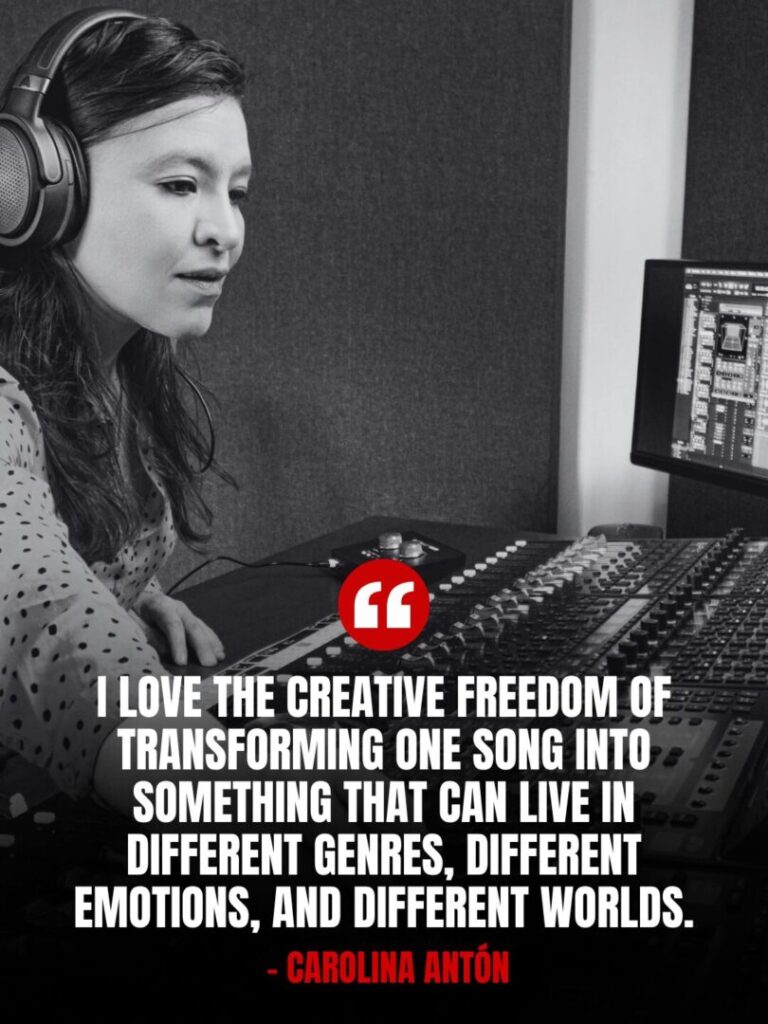
That’s what I love about production, the creative freedom to transform a single song into something that evokes entirely different genres and emotions. The EP is called Besos y Copas, and I highly recommend it.
Have you ever experienced a “happy accident” in the studio that ended up becoming part of the final version of a song?
Absolutely. There have been many. One that comes to mind happened while I was mixing Christian Nodal’s music in immersive Dolby Atmos. I made a move completely by accident, I think my finger just slipped, and suddenly I loved the result. The funny thing was thinking, “Now I can’t recreate that exactly.”
Those happy accidents happen during recording, too. On Mireya’s record, she told me, “We recorded the ‘one, two, three’ count-in just to give the musicians the tempo. I also started humming to find my pitch before singing. Take all that out.” I said, “No way. That’s the best way to begin the song.” We even built on those spontaneous moments, and they became part of the final production. I absolutely love when those unexpected moments happen.
You’ve spoken about empowering other women in music by creating opportunities for Latina professionals. Throughout your career, was there someone who helped you overcome obstacles? If so, what advice stayed with you?
Thankfully, I’ve had many people who have cared for me, supported me, and stood by me through some very difficult moments, both personally and professionally. Their advice might sound simple, things like “Don’t give up,” “You can do this,” or “Keep going.” But more important than the words themselves was knowing that someone truly believed in me.
Whenever I faced a challenge, I knew I had people I could rely on. That feeling of being supported, of having genuine friendship, love, and encouragement behind you, has meant everything. More than any specific piece of advice, that’s what has helped me push beyond my own limits.
Why do you think it’s important to have more women in the industry, not only as artists, but also as producers, songwriters, tour managers, and audio engineers? What does that bring to music and to the way we hear it?
I think women make incredible teammates. You can see it in the way we organize, communicate, and collaborate. We naturally bring balance. It’s nothing mysterious or extraordinary, it’s simply human. When you have both feminine and masculine perspectives working together, the creative energy feels more balanced.
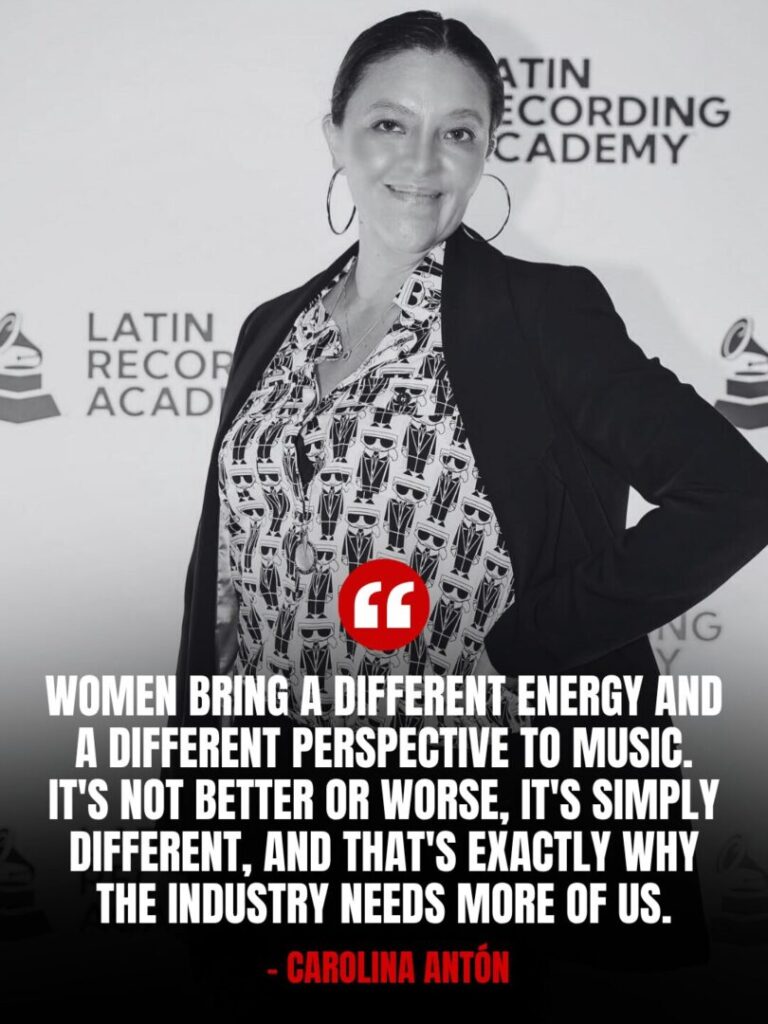
From a sonic perspective, I do think we bring a different vibe and a different emotional sensitivity. It’s not better or worse, it’s simply different. Certain genres and projects benefit from that perspective, not only sonically but visually and emotionally as well. It changes the mood, the atmosphere, and the energy of a project.
One of my favorite experiences was touring with Vivir Quintana, where we formed the first all-women touring crew. Every single person, musicians, engineers, producers, was a woman. Living that experience was beautiful. It truly changed the energy, and it showed what becomes possible when women are given the opportunity to create together.
TURNING UP THE VOLUME FOR WOMEN IN SOUND
If you had to describe your mixes, your sound, in three words, what would they be?
I would say intention, art, and madness. I love to experiment, and I love bringing a strong sense of purpose to everything we create. Above all, we should never forget the music itself, the artistry of the lyrics, and everything that makes music what it is. Sometimes we get so focused on the technical side or everything surrounding it that we forget the music. For me, that’s something you should never lose sight of.
What’s one thing you would never change in a mix?
I always try to preserve the authenticity of the original recording. I love using vintage microphones because they capture a warmer, more analog character. From there, we can build the entire processing chain, but the recording itself should always remain as faithful as possible.
Have you ever worked with unconventional instruments?
Absolutely. I worked with Zoé for many years, and when we recorded their MTV Unplugged, we had everything from a birdcage and a suitcase used as a bass drum to an old-fashioned mechanical typewriter. We brought an entire collection of objects that became instruments. It was like having a toy box full of sounds.
What advice would you give to other women who want to start a career in audio engineering but don’t know where to begin?
I’d tell them to find people who are just starting out too, maybe a band that’s forming or musicians who are beginning to play live, and grow alongside them. As that band develops over the years, you’ll grow together. You’ll learn together, build experience together, and create opportunities together.
BREAKING THE SOUND BARRIER, CAROLINA ANTÓN ON INNOVATION, INCLUSION, AND IMMERSIVE AUDIO
As immersive audio continues to reshape the future of music, Carolina Antón remains at the forefront of its evolution. While she’s keeping many of her upcoming projects under wraps, her passion for crafting new listening experiences is unmistakable. Fans can already hear her latest work on Christian Nodal’s newly released EP, where the Dolby Atmos mixes elevate every detail of the production, offering an immersive experience that reflects both technical precision and artistic sensitivity.
For Carolina, every project is another opportunity to challenge the way audiences connect with music. Although she hints that more exciting collaborations are on the horizon, she’s content to let the work speak for itself when the time is right. If her journey has proven anything, it’s that she’s not simply following the future of sound, she’s helping create it, one mix at a time. Follow her journey on Instagram @kroanton.
The post CAROLINA ANTÓN: THE WOMAN BEHIND LATIN MUSIC’S IMMERSIVE SOUND REVOLUTION first appeared on Visión Music Magazine.