Another African nation joins NASA’s Moon programme as 72nd country to sign Artemis Accords
Djibouti has joined NASA’s growing international coalition for lunar exploration, taking the number of African countries signed up to the Artemis Accords to eight.
 Black News

Djibouti has joined NASA’s growing international coalition for lunar exploration, taking the number of African countries signed up to the Artemis Accords to eight.
- Djibouti became the 72nd country and the 8th African nation to sign the Artemis Accords on September 14, 2026.
- The Artemis Accords establish principles for safe, transparent, and peaceful cooperation in lunar and space exploration.
- Djibouti's participation follows recent progress in its own space program, including the launch of two satellites in 2023 and 2024.
- Eight African nations (Nigeria, Rwanda, Angola, Senegal, Morocco, Botswana, Mauritius, Djibouti) are now signatories.
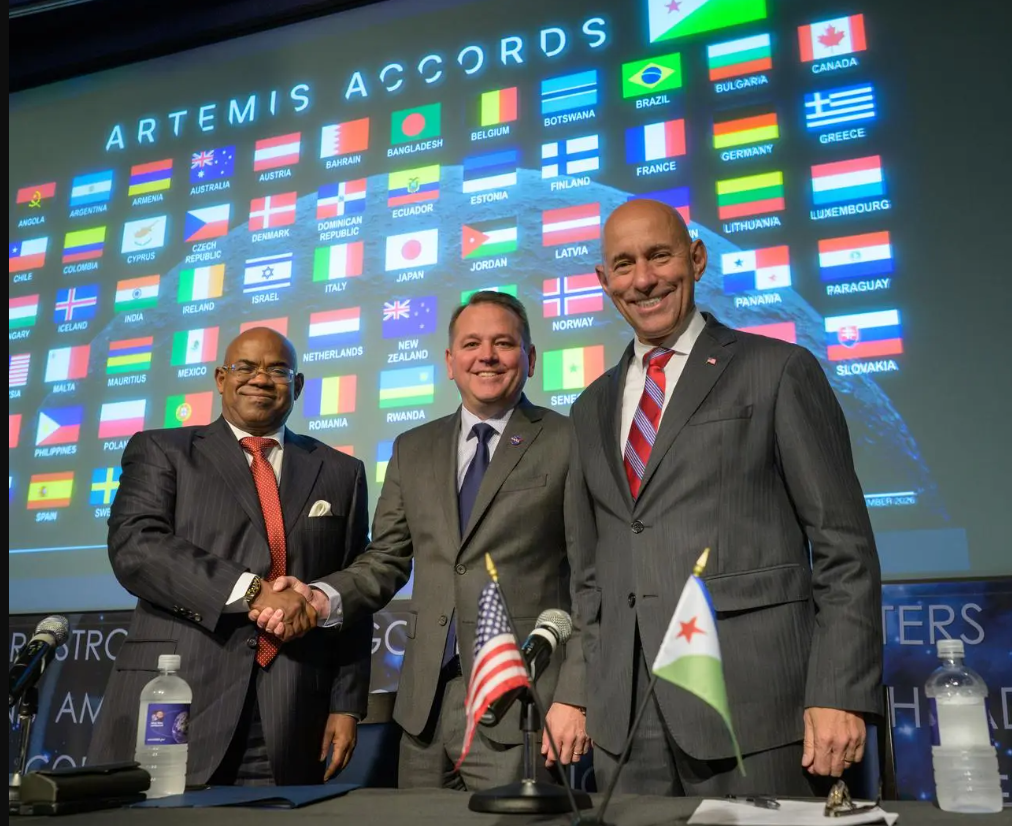
Djibouti became the 72nd country globally and the eighth African nation to sign the Artemis Accords on September 14, 2026, during a ceremony at NASA headquarters in Washington. The agreement establishes principles for safe, transparent and peaceful cooperation in the exploration of the Moon, Mars and beyond.
“Djibouti joins this coalition of like-minded nations at an important time,” said NASA Deputy Administrator Matt Anderson.
Djibouti’s Ambassador to the United States, Mohamed Siad Douale, signed the accords on behalf of the country.
DON'T MISS THIS: Botswana becomes latest African nation to join US-led Artemis Accords as Africa's space ambitions grow
“By joining the Artemis Accords, Djibouti seeks to deepen its partnership with the United States and with the growing community of nations committed to peaceful space cooperation,” Douale said. “We look forward to building partnerships in scientific research, satellite applications, education, and technical training.”
The signing adds to the country’s emerging space ambitions after it launched its first satellites, Djibouti 1A in 2023 and Djibouti 1B in 2024, both aboard SpaceX Falcon 9 rockets from Vandenberg Space Force Base in California.
Eight African countries are now part of the Artemis Accords
Africa’s participation began in December 2022, when Nigeria and Rwanda became the continent’s first signatories. Angola followed in 2023, while Senegal joined in 2025. Four more African countries have signed in 2026: Morocco, Botswana, Mauritius and now Djibouti.
DON'T MISS THIS: Senegal shoots for the moon with historic NASA agreement
The eight African signatories are therefore Nigeria, Rwanda, Angola, Senegal, Morocco, Botswana, Mauritius and Djibouti.
For Africa, the value of the framework extends beyond putting national names on a list of countries involved in lunar exploration. NASA says Artemis Accords nations could contribute scientific payloads, CubeSats, technology demonstrations and other capabilities to future missions.
The framework also promotes open scientific data, interoperability, emergency assistance, responsible use of space resources, protection of historic sites and measures to prevent harmful interference between space activities.
For African countries still developing their space industries, these principles can provide a pathway to partnerships in satellite technology, scientific research, engineering, education and technical training.
DON'T MISS THIS: The U.S.A welcomes Angola as the 33rd Artemis Accords signatory
Djibouti has already identified some of these opportunities, saying its membership could deepen cooperation in scientific research, satellite applications, education and technical training while creating opportunities for students, researchers, engineers and entrepreneurs.
The growing African membership also gives the continent a larger collective presence as rules and partnerships around future lunar activity take shape.
The immediate benefit is greater access to a framework for cooperation, while the longer-term gains will depend on whether African countries turn membership into research partnerships, technology projects, satellite missions and participation in future Artemis activities.