

Why Nigeria Must Return to Indigenous Cattle in Solving Farmer-Herder Clashes.
Historically, the image of a typical Southern Nigerian farmer was never complete without the muturu cattle breed grazing quietly behind the homestead. It was often tethered at the back of the house, chewing calmly on cassava peels and fresh grass cut by the owner or housed in a simple pen during rest. The muturu is an indigenous cattle breed characterized by diverse coat colour patterns and unique adaptation to the humid, tsetse-infested environments of West Africa, where it has traditionally provided meat, manure, and cultural value to rural communities. Today, this native breed has virtually disappeared. Its decline has left […] The post Why Nigeria Must Return to Indigenous Cattle in Solving Farmer-Herder Clashes. appeared first on African Arguments.
 Black News
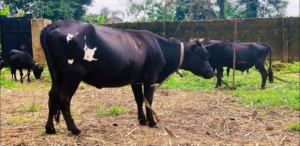
Muturu cattle, the indigenous Southern Nigerian breed, tethered in a homestead compound.
Historically, the image of a typical Southern Nigerian farmer was never complete without the muturu cattle breed grazing quietly behind the homestead. It was often tethered at the back of the house, chewing calmly on cassava peels and fresh grass cut by the owner or housed in a simple pen during rest. The muturu is an indigenous cattle breed characterized by diverse coat colour patterns and unique adaptation to the humid, tsetse-infested environments of West Africa, where it has traditionally provided meat, manure, and cultural value to rural communities. Today, this native breed has virtually disappeared. Its decline has left Southern Nigeria increasingly dependent on cattle supplied from the North while also removing a locally adapted production system that once reduced the need for long-distance livestock movement. Together with population growth, climate pressures, changing land use, and weak governance, this shift has added another layer to the complex dynamics shaping farmer-herder relations.
In communities across Southeastern Nigeria, farmers managed muturu cattle alongside crop production as household assets providing manure, occasional meat and a form of livelihood. A 2022 survey in Southern Nigeria found very small herd sizes averaging just 4 animals. This decline has been widely attributed to indiscriminate crossbreeding with exotic breeds, driven by selection for higher growth rates and increased carcass yield. As the muturu declined across Southern Nigeria, larger commercial breeds such as the white Fulani gradually became more dominant. Unlike the muturu, which was integrated into the predominantly smallholder farming systems of Southern Nigeria, these larger herds required substantially more grazing space and greater mobility, contributing to intensified conflicts among farmers and herders.
The livestock system in Nigeria has historically created critical regional connections that link the Northern and Southern parts of the country through production systems, trade, and consumption. For instance, Northern Nigeria currently supplies the overwhelming majority of the country’s cattle, while southern markets provide much of the demand. In a country where history has often made interregional trust fragile, competition over land access, livestock mobility, and resource use has transformed this connection into a source of tension. The relationship between the two regions is now more than an agricultural issue. It is a test of how well different regions can manage economic interdependence while balancing competing claims over land, livelihoods, and national unity.
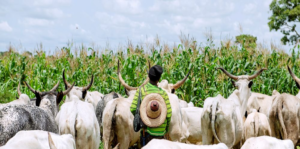
The competition over land and grazing routes has contributed to thousands of deaths and widespread displacement. In the first half of 2018 alone, farmer-herder violence claimed more than 1,300 lives according to the International Crisis Group. Behind these statistics are farming communities struggling to hold on to their livelihoods. In interviews we conducted with farmers in Nimbo, Enugu State, in 2021, five years after the 2016 attack, many suggested reducing the land they cultivated because of persistent insecurity, while younger people increasingly left agriculture in search of safer livelihoods. The recent attack in Yelwata, Benue State, which claimed more than 100 lives, is a stark reminder that farmer-herder violence continues to affect the security and livelihoods of ordinary Nigerians.
In 2024, the Federal Government of Nigeria established the Federal Ministry of Livestock Development, a longoverdue attempt to treat livestock as an economic sector deserving its own vision. However, this Ministry must first solve the farmer-herder clashes ravaging the country for years. By September 2025, the ministry unveiled a bold fifteen‑year transformation plan, placing modern ranching at the centre of its strategy to end open grazing and reduce conflict. And in June 2026, it took another step by moving to centralize livestock data, hoping to finally understand who owns what animals, where they move, and how to manage them sustainably. These reforms represent important efforts toward rebuilding a fragmented livestock production system. However, none of these interventions will achieve their full potential if a more fundamental question remains unaddressed: “What happens when a nation abandons the cattle that once fed its lands?”
Reviving indigenous breeds such as the muturu is not a silver bullet for ending farmer-herder conflict. But it could become an important part of a broader livestock strategy by restoring locally adapted production systems that reduce dependence on long-distance cattle movement. Historically, the breed thrived on crop residues, household wastes, fallow vegetation, and cut and carry forage systems, allowing livestock production to be integrated into existing farming landscapes rather than competing with them. Restoring indigenous breeds would therefore align cattle production with the ecological realities of Southern Nigeria while reducing the need for long distance livestock movement across multiple states, reducing grazing pressure on surrounding landscapes and lowering the risk of overgrazing and land degradation.
If the country is serious about ending these clashes, then modern ranching must go hand in hand with reclaiming the breeds that once fit our land, our farming systems, and our way of life. In the rush to modernize, Nigeria may have forgotten that development is not always about replacing the old with the new. Sometimes, it is about recognizing the value of what was abandoned and adapting it to contemporary realities. The muturu is more than a cattle breed. It represents one part of a broader solution to rebuilding a livestock system that is productive and ecologically compatible, one that balanced livestock, crops, people, and land with far less conflict.
This his article was co-authored by David Okoronkwo, a Schwarzman Visiting Fellow at the Centre on Contemporary China and the World, University of Hong Kong, where he researches international agricultural cooperation. A former UN World Food Forum Youth Policy Delegate, he has worked with Nigeria’s Federal Ministry of Agriculture as well as multinational agricultural firms including Syngenta and Limagrain. David hails from Nigeria.
The post Why Nigeria Must Return to Indigenous Cattle in Solving Farmer-Herder Clashes. appeared first on African Arguments.