Sudan’s three-year war has pushed 8 million children out of school as UN warns of a lost generation
Sudan’s more than three-year civil war is creating a crisis that could outlast the fighting itself, with millions of children missing years of education just as the country faces the enormous task of rebuilding an economy battered by conflict.
 Black News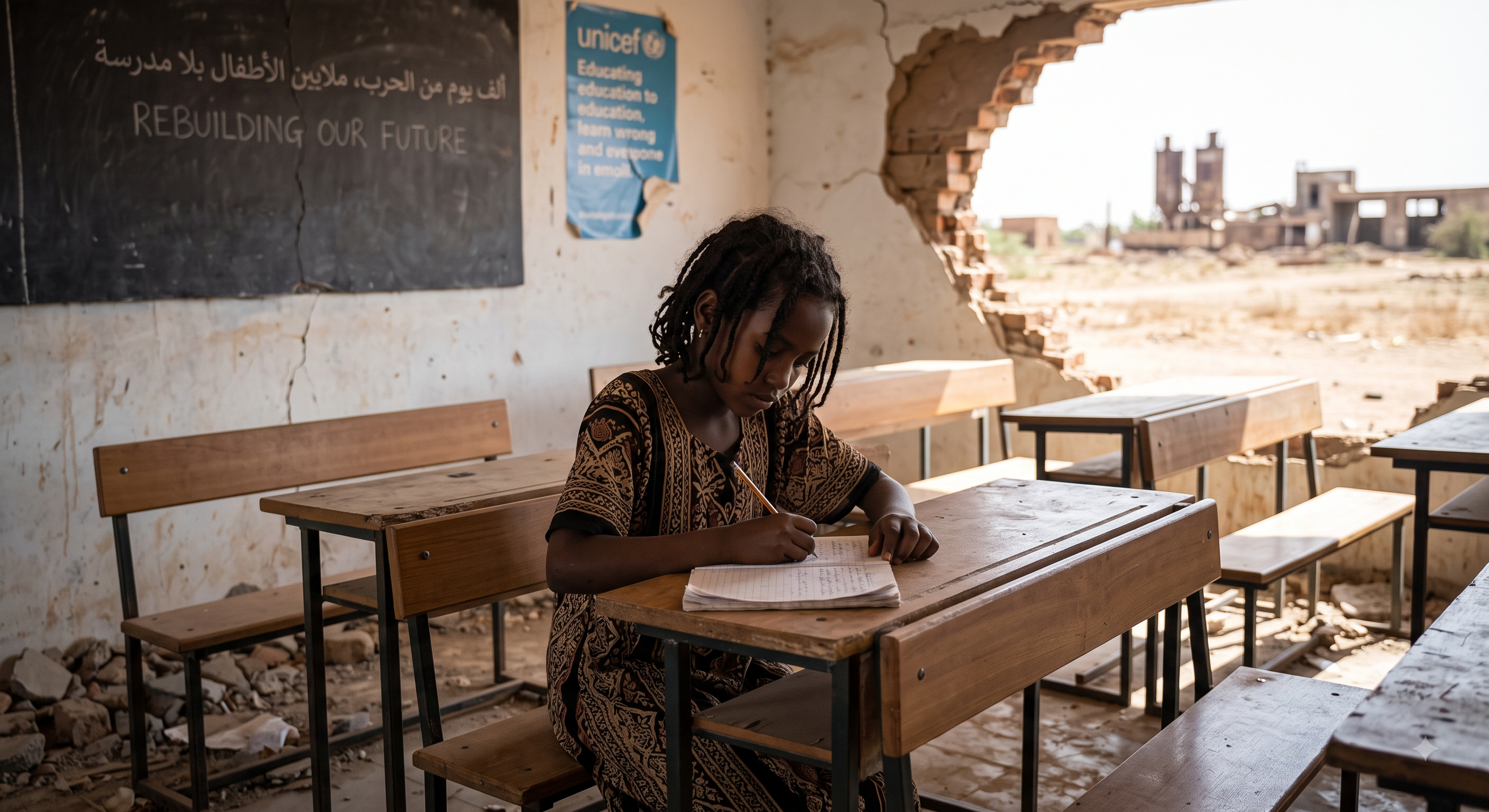

![Sudan’s conflict has damaged schools, universities and other public infrastructure while displacing millions of children.[Gemini Generated Image]](https://ocdn.eu/pulscms/MDA_/bb87d688f3c850d303df56ca99fdae4a.png)
Sudan’s more than three-year civil war is creating a crisis that could outlast the fighting itself, with millions of children missing years of education just as the country faces the enormous task of rebuilding an economy battered by conflict.
- At least 8 million Sudanese children remain out of school after more than three years of civil war.
- Sudan’s economy contracted 29.4% in 2023 and 14% in 2024, with the World Bank warning that conflict continues to weaken its recovery.
- About 80% of higher-education institutions are no longer operational, while universities, laboratories and libraries have been destroyed or looted.
- The UN says Sudan risks losing another generation as fighting shifts towards Darfur and Kordofan and humanitarian funding remains severely stretched.
At least eight million children remain out of school, according to UNICEF, while almost half of Sudan’s school buildings are either closed, being used for other purposes or otherwise unavailable for education. The disruption is particularly severe in Darfur and Kordofan, where some of the war’s heaviest fighting has shifted.
The scale of the damage prompted UN Deputy Secretary-General Amina Mohammed to warn that Sudan was moving towards losing another generation to the conflict.
Speaking at a UN meeting on safeguarding education in Sudan, Mohammed said the war had gone on for more than 1,000 days and that children continued to bear a disproportionate share of the consequences.
The UN and its partners have managed to return more than one million Sudanese children to some form of learning this year, but officials say that remains far short of what is needed.
“This is a war that men started,” Mohammed said, according to the UN account. “But it is being paid for on the backs of women, and on the backs of children who had no say in any of it but suffer most.”
DON'T MISS THIS: Sudan crisis leaves 47 Nigerian medical students in professional limbo
The warning carries implications beyond Sudan’s immediate humanitarian emergency.
Years without regular schooling risk producing a generation entering adulthood with weaker educational attainment and fewer employment opportunities, creating another obstacle for a country whose productive capacity has already been severely damaged.
A battered economy faces a long recovery
Sudan’s economy contracted by an estimated 29.4% in 2023 and another 14% in 2024 as fighting disrupted production, commerce, agriculture and public services.
The World Bank estimates that output rebounded by 6.1% in 2025 and projects growth of 5.1% in 2026. But it expects the recovery to lose momentum, with growth slowing to 3.7% in 2027.
The World Bank has cautioned that Sudan’s prospects remain constrained by prolonged conflict and what it describes as a “severely damaged industrial base”.
Continuing hostilities also threaten macroeconomic stability, food security and the country’s ability to attract the investment required for reconstruction.
That makes the collapse of education especially consequential.
Rebuilding factories, transport networks, hospitals and other infrastructure will require capital, but rebuilding Sudan’s human capital could take far longer.
DON'T MISS THIS:Sudan’s fragile fight against famine faces new threat as Gulf conflict drives up farming costs
Children who have already spent several years outside classrooms may require extensive remedial education before they can return to conventional schooling or enter the workforce.
Sudan’s education system was already under strain before the current war. The latest conflict has magnified those weaknesses, destroying or damaging schools, displacing teachers and students and forcing educational facilities to serve as shelters.
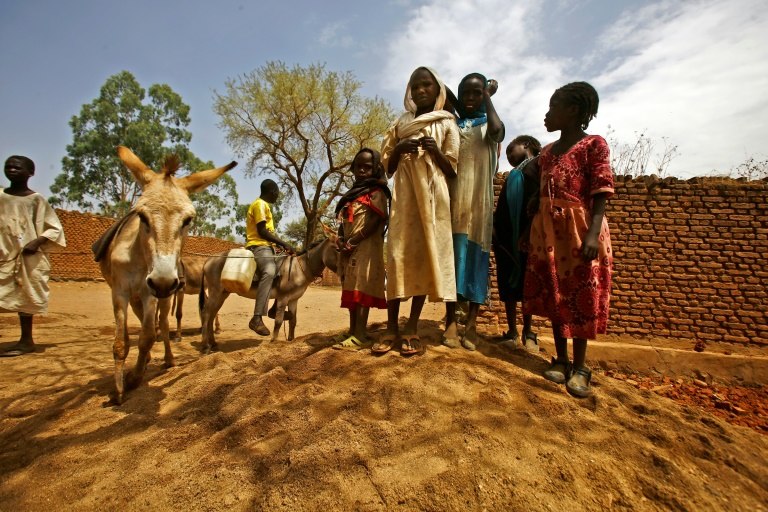
UNESCO said in June that 124 universities and colleges had been destroyed or looted, alongside 1,880 laboratories and 241 libraries across Khartoum and six other states.
Around 80% of higher-education institutions were no longer operational, underscoring the damage not only to basic schooling but also to the pipeline of skilled professionals Sudan will eventually need for reconstruction.
Three years of war reshape Sudan
The conflict began on April 15, 2023, after tensions between the Sudanese Armed Forces, led by General Abdel Fattah al-Burhan, and the paramilitary Rapid Support Forces, commanded by Mohamed Hamdan Dagalo, known as Hemedti, erupted into open warfare.
The two forces had previously shared power following the removal of longtime ruler Omar al-Bashir in 2019 and jointly staged a coup in 2021. But disagreements over Sudan’s proposed return to civilian rule, including when and how the RSF would be integrated into the regular military, helped trigger the confrontation.
DON'T MISS THIS:Canada commits $120million to Sudan as war, famine and displacement spiral
The territorial shape of the war has since changed significantly.
The army recovered Khartoum and much of central Sudan during its advances in 2025, while the RSF consolidated control across much of Darfur. By 2026, some of the fiercest fighting had moved towards Kordofan, an important corridor linking western Sudan with the centre of the country.
El Obeid, the capital of North Kordofan and an important commercial and transport hub, has become a particular focus of concern. The UN Security Council was warned in June that roughly half a million civilians there faced the risk of further escalation as rival forces fought for control of the region.
Drone warfare has also increasingly affected civilian infrastructure. UNICEF recorded at least 245 child casualties during the first three months of 2026, including 160 children killed and 85 injured. It said drone attacks accounted for nearly four-fifths of the reported child casualties over that period.
More than five million children have been displaced since the war began, according to UNICEF, often more than once as front lines changed.
The displacement has also spread Sudan’s crisis across African borders. Chad alone was hosting about 1.56 million refugees and asylum seekers by the end of July, as neighbouring states continue to absorb people escaping Sudan and other regional conflicts.
Education becomes part of Sudan’s reconstruction bill
International organisations are trying to prevent the education system from deteriorating further.
UNICEF, Save the Children and other partners launched a programme in May aimed at returning more than 328,000 conflict-affected children to education. The initiative is expected to help reopen about 850 schools across seven states, support more than 9,000 teachers and establish nearly 1,800 alternative learning spaces.
But those numbers illustrate the scale of the gap: hundreds of thousands of children may be reached by individual programmes while millions remain without regular schooling.
Funding is another constraint. UNICEF said it required $962.9 million in 2026 to provide assistance to 7.9 million Sudanese children. By the end of March, just 16% of that requirement had been funded.
The wider UN response is under similar pressure. Sudan’s 2025 humanitarian response plan received only about 40% of the money requested even as displacement, malnutrition and disruption to health, agriculture and other essential services continued.
For Sudan, the result is a reconstruction challenge that is expanding with every year the war continues.
Even if fighting ends, rebuilding roads, factories and public buildings will address only part of the economic damage. Restoring years of lost schooling, and ensuring millions of young Sudanese can participate in whatever economy emerges from the conflict, could prove to be the far longer task.