Making Transnational Ballroom in China
Ballroom culture emerged in Black and Latinx communities in the United States in the twentieth century as drag balls (Jones 2017). In the middle of the century, it developed into a comprehensive system of competitive balls between ‘houses’ competing to win category prizes such as best makeup, best runway, and for a dancing style known […] The post Making Transnational Ballroom in China appeared first on Made in China Journal.
 Black News
Ballroom culture emerged in Black and Latinx communities in the United States in the twentieth century as drag balls (Jones 2017). In the middle of the century, it developed into a comprehensive system of competitive balls between ‘houses’ competing to win category prizes such as best makeup, best runway, and for a dancing style known as voguing. Each house comprises a ‘chosen family’ of queer and trans individuals, formed in response to estrangement from natal families. This underground cultural formation has helped many racialised people build community, survive the HIV/AIDS crisis, and thrive in North America (Joseph and Bain 2024; Bailey 2013; Ultra Omni 2023). Since the 2010s, ballroom culture has also begun to flourish in several Asian countries, including China. Across China’s major cities, ballroom participants create houses as forms of chosen family and organise balls to carve out spaces for themselves. Yet, beyond celebrating queer, trans, and nonbinary resilience, it is important to ask how ballroom culture travels, under what conditions it becomes popular, and what kinds of unease accompany such ‘cultural transportation’ (Wilson 2006).
This conversation is based on a series of interviews conducted online in September 2024 between three ballroom members—David (a butch queen from the Shanghai scene), Blanca (one of the first femme queens within China’s ballroom community), and Franken (a butch queen from the Wuhan scene), all of which are pseudonyms—and scholar-organiser Ian Liujia Tian. We show that ballroom culture in China, though still emerging, has provided an important venue for trans and nonbinary people to build community and alternative kinship. Because China’s social and political contexts differ from those of the United States, we also note that ballrooms, as a foreign cultural form, may produce exclusions based on class, citizenship, and geography. We argue that transnational ballroom should not be romanticised as a form of global trans solidarity; instead, it must be understood within national, regional, and global contexts, and participants should not seek to appropriate the queer cultures of Black, Latinx, and other people of colour (POC) in the United States. The interview also addresses ballroom’s significance, its history, transnationalism, and the future. We retain several complete sections of the translated transcript to present our ideas in our own words rather than through another person’s interpretation, but, where necessary, include editorial definitions and explanations in brackets.

Chinese Ballroom and Local Scenes
Ian: What is the history of ballroom in your city, or how did you get involved?
David: I first encountered voguing in 2014 when I was studying in the United States. We watched Paris is Burning [a 1990 documentary about New York’s ballroom scene] and Tongues Untied [Marlon Riggs’s 1989 experimental film about Black gay identity] in gender study classes. At that time, I only attended a few balls as an audience member and did not know anything about ballroom. I was in the hip-hop dancing community. I came to Shanghai to participate in a waacking [a particular dance style in hip-hop] competition and noticed that a dance studio was offering voguing classes. I decided to take classes with Irina Milan, a Ukrainian cis-woman who was living in Shanghai. It must have been about 2016 or 2017. Through the voguing class, I met Shirley, a member of the first ballroom houses in Shanghai. Through Shirley, I was introduced to Shanghai’s underground ballroom scene. After I joined, more people started getting involved. Now, the scene in Shanghai is less crowded. Some have gone abroad, while others have returned to their hometowns. There are not as many attendees compared with a few years ago, but it is still slowly developing as there are still people involved.
Blanca: My introduction to the ballroom scene was in Guangzhou in 2020, during the [Covid-19] lockdown. Two individuals, named Purpo Khan and Vivian, were in Guangzhou, leading the charge in building the local community. Both are now key figures in Guangzhou’s ballroom scene. At that time, they set up a WeChat group to build the ballroom community. Since Guangzhou is quite close to where I was studying, I started to connect with them online. When the pandemic restrictions eased a bit, I reached out to Vivian, who invited me to dance for the first time. For a long time, she provided me with a lot of guidance and became my mother figure in the scene. From that first meeting, I officially started my journey, but at that point, it felt quite lonely because there was not much going on in the ballroom community in China. It was not until my third or fourth year that more new faces started to emerge. For example, WAIWAI, another femme queen, entered the scene in the past couple of years. This year, there have been even more new additions, which is great.
Franken: At the very beginning, I was in my second year of university. I was in some underground raves for fun. Some friends were also in the ballroom scene and I was curious about what they were doing. Gradually, I got into it and found it enjoyable. At that time, there was someone named Daiki in Wuhan who was teaching classes, so I started learning from them. But I did not feel I had truly entered the ballroom scene; I just thought it was fun. As time went on, I noticed more people around me were involved in ballroom. Everyone was planning to attend a ball in Beijing in April. I thought, ‘Hey, I should go, too!’ That is when I felt I had officially entered this scene.
Ballroom’s Significance in China
Ian: As trans or gender non-conforming folks, why are you drawn to ballroom and why do you like to participate?
Blanca: Before I joined, I watched the show Pose [a 2018–21 US television series set in New York’s 1980s–90s ballroom scene] and had a feeling that ballroom would be a place where I would feel a strong sense of belonging. Once I got involved, I discovered that I absolutely love it. The ballroom scene requires you to affirm your femininity. I believe this has boosted my confidence and helped me become more self-assured about my transness. Shanghai is a more liberal city and offers significant economic and social resources, which is a great advantage. Being a femme queen holds a lot of value in the scene. I feel a strong connection to the roots of ballroom culture, but ballroom means something different for everyone. There is a difference between being attracted to ballroom and staying within it. People are in ballroom because they want to be there, not because it is ‘fancy or chic’. Someone might be attracted by ballroom culture for a while, but to stay requires a lot of commitment. I am here because ballroom is full of vitality. I can see how much effort people put in to survive and exist. This is the reason I stay.
David: Confidence is the key. I am drawn to the conceptual aspects behind voguing; it is a dance style that embodies gender fluidity that does not conform to binary definitions. It allows you to perform as another version of yourself and I love that feeling. I appreciate the feminine energy, but I can also embody masculine energy, which is one of the reasons it attracts me. When I dance, I feel exhilarated. I can walk like a model, which I dreamed of doing when I was younger, and I can become who I want to be. I enjoy all the categories in ballroom, though some may not suit me. The most important reason is that it makes me happy. It is all about having fun and meeting new friends, which I also find important.
Franken: I am attracted to ballroom’s competitive aspect. I found that exciting; it drew me in because I wanted to see how I measured up. I sometimes deploy what I have learnt in ballroom in real-life scenarios. When I was nervous about an interview, I channelled the energy of performing in a ball and that gave me the strength needed to stand my ground.
Blanca: Femme queens started ballroom in the United States, but there are not a lot of us in China’s ballroom scene. The most important contribution trans people make is simply existing, because just being here in this country means a lot. What is somewhat ironic in China is that the ballroom scene is not very accessible for a lot of trans people. Especially for those who really need it, it does not seem to attract many trans women. I have trans girlfriends and when I tell them about ballroom, they do not feel drawn to it.
Franken: I am seeing more trans and nonbinary representation. The house of Roda Rosa based in Beijing has many fem queens. This house was among the first to hold events such as the ‘Trans Stories Forum’, where they invited trans individuals to share their experiences.
Blanca: Some femme queens have recruited their trans friends into ballroom, but I do not actively encourage people to join until the scene has greater capacity to include trans participants. I have trans friends around me and I do not want to add stress to lives that are already difficult. The ballroom scene needs to do more to include and prioritise femme queens. So, rather than promoting ballroom, I simply say: ‘I am going to this event; if you are interested, you can come with me.’ I explain what the scene is like, but I leave the decision to them. I do not present ballroom as a place of freedom, nor do I push anyone to join.
Transnational Ballroom and its Discontents
Ian: Obviously, ballroom is a global phenomenon. Many people are curious about Chinese ballroom and its global connections. How do you feel about the role of global ballroom in cultivating your local scene?
David: There are several differences between China’s ballroom and its US origin. First, there is a difference in duration. Ballroom originated in the United States and has had a longer history there, while the Chinese scene is only six years old. There are also different categories and understandings of gender. In the United States, there might be stricter definitions, while in China and some other countries, there tend to be different categories. For instance, in China, many ballroom members identify as nonbinary, partly due to political and economic constraints, limited access to medical technology, and few opportunities for transition. Gender reassignment surgeries now require family approval, which makes transitioning harder. So, many continue to be gender non-conforming. We added these categories to reflect a wider spectrum of genders in our communities.
Blanca: Yes, ballroom originates in the United States, so it is a foreign culture in China. Often, those in China who know ballroom are more aware of US culture, younger, and more cosmopolitan in their outlook. There are many trans women in China who have no idea what ballroom is. Ballroom has a hierarchical system such as legends, icons, and pioneers. In China, none of us, including Irina, is a pioneer. In China, discussions about how and what we should learn from the United States have been going on for a while. Some feel that we should adhere to American standards; others believe that historical and cultural contexts matter and it is okay to change.
David: In China, sometimes ballroom can become a performance-oriented activity, with people viewing it as a show. In contrast, in the United States, it is seen not so much as a performance as a gathering. China’s ballroom has built on other Asian scenes, such as those in Korea, Taiwan, the Philippines, or Japan. These scenes have not always been acknowledged by the United States’ main ballroom scenes, although they recognised Asians who went to the United States to participate in their ballroom scenes. Even European scenes are not on equal footing with the United States’ main ballroom scenes. There is a strong dynamic between who is the ‘first’. I saw on social media that in a main ball in Paris, the judge from the United States criticised the competitors harshly. Paris is already a major scene, but it can never be New York, Philadelphia, Baltimore, or Chicago. This is not to say that the US scene is undemocratic; it has a very robust democratic process, but discursively, they are the originators and globally we adhere to the New York scene’s standards. Gradually, it seems that they have begun to recognise the ballroom culture in Asia. The acknowledgement likely came after people from Asian countries returned from abroad and established local scenes.
Blanca: I like this framing. Chinese ballroom learns from everywhere: the United States, Europe, and other Asian scenes. Currently, ball organisers invite foreign icons or legends to come over and provide guidance. They share how things are done in the United States and point out areas in China that might need correction or improvement. For instance, in the Vonderland ball in Guangzhou in September 2024, all the judges were from abroad. Some were from Asia (Hong Kong, the Philippines, and Thailand) and some were from Europe. The ballroom scene in China is blending influences from the United States, Europe, and other parts of Asia.
Franken: Ballroom is an import [舶来品]. Take Shanghai, for example: it has the most resources and exposure to Western culture, which allows ballroom to develop relatively well. In contrast, many cities do not have scenes, meaning there is no-one available to form a community.
Blanca: I want to get a bit uncomfortable. There is also a global and national hierarchy of mobility and economic resources. For me, a key barrier for Chinese ballroom members to be visible globally like their Korean, Taiwanese, or Japanese peers is the global citizenship regime. For example, restrictive visa policies make it difficult for Chinese ballroom members to compete in other scenes and be visible. Ballroom participants in Korea and Japan can grab a passport and go, they have more freedom to travel and explore different scenes. In contrast, many in China, especially those from less privileged backgrounds, may feel trapped within their local scene due to financial constraints and limited opportunities. This is very similar to ballroom members in the United States: they might have spent 40 or 50 years in the same city and within the local scene, having never set foot outside the country because they are poor. This is the same thing with a lot of Chinese ballroom members, especially femme queens. Only a handful of individuals in China have travelled to international mainstream scenes, often due to their financial instability and family support. This highlights the systemic barriers that many face. Take me, for example: I want to go to other scenes, but I only have myself and no-one else.
Within China, access to ballroom is shaped by geography: more inclusive scenes tend to be concentrated in developed cities on the eastern and southern coasts, which can exclude people from less developed regions. Transgender people seeking survival often move to large cities in these areas, but participation also requires social adaptability, which partly depends on the ability to ‘pass’ as the gender they want to embody. For many trans women, ballroom is not a priority, especially because participation may also require familiarity with US culture. This context differs significantly from the United States, where ballroom is a space in which femme queens compete to see who ‘passes’ as a ‘cis-woman’. This kind of scenario does not necessarily exist in China. Many trans girls struggle simply to make ends meet. Most are confined by their families or lack stable jobs and steady income, and their mental and living conditions are often highly precarious. In this sense, the femme queens in China’s ballroom scene are relatively fortunate ones who have emerged despite all the barriers.
If a ballroom scene wants to evolve, it needs to be a bit relevant to the political situation. Ballroom originates from rebellion and resistance. The biggest difference between China’s scene and the US scene is that most people in China are ignorant of the cultures of POC. This lack of understanding is one reason we have not been able to develop as effectively. A developed ballroom scene must follow the US model where there are many people of colour. If you want to cultivate a thriving ballroom scene, one must honour Black culture. But we barely know anything about them! In China, people can be gay and face no persecution. But if you are a Black person in a tough neighbourhood in the United States, being gay might lead to bullying or even worse consequences, on top of racism. This is completely different.
David: I agree. Chinese ballroom members can try to understand Black experiences objectively, but we can never fully grasp why their culture has developed so robustly because we are in China, not in the United States. We cannot understand what Black people go through in their everyday lives. We believe many ballroom categories, especially realness, were born out of the actual needs of Black queens. In ballroom, many categories are divided by figure—for example, male/female figure old-way vogue. The reason is these categories were originally designed for trans people to rehearse how to ‘pass’ in their desired bodily figure. However, in China, different needs have emerged. Nonbinary people’s bodies do not always align with either figuring. For trans people who have not, or cannot afford to, medically transition into a male or female figure, this binary figuring can feel limiting. In response, some ballroom kiki scenes in China, drawing on their Brazilian counterparts, have introduced nonbinary performance as a new category in kiki balls to better accommodate community members’ needs.
Ballroom emerged in Black and Latinx neighbourhoods that have intersectional issues: poverty, HIV/AIDS, drugs, violence, and racism. But in China today, as much as we are facing regulation and controls, we do not need it as much as POC do. In China, being gay/trans is not a racialised experience and it is marginalised in a different way. Many ‘mainstream’ cis gays in China have been criticised for being too homonormative. Ballroom culture is on the margin of queer culture within China because it includes gender diversity.
Queer Futures for China’s Ballroom Scene
Ian: We have talked a lot about the origin stories and the barriers. What do you see for the future? How do you see ballroom’s role in sustaining and even building new movements in China?
Franken: Some obstacles are preventing China’s ballroom culture from evolving further. These include the economic inequality, lack of understanding about race and gender dynamics in the United States, and the global citizenship regime that we just discussed. In Wuhan, the biggest challenge going forward are economic barriers. First, going to balls costs money and excludes poor folks. Second, organising balls needs money. In Wuhan, it is financially tough because organisers must secure a venue. I wonder whether, in the future, I could collaborate with some LGBTQIA+ non-profits or other cheap venues, as it used to be in earlier years of ballroom elsewhere. Ball organisers are putting out love into the community, but there are no profits. It cannot be sustainable in the long term.
David: Financial barriers are not just about organising balls. The downward trajectory of China’s economy also restricts developing a scene like Europe’s—one that can be recognised by the United States with titles such as ‘legendary’, which is a status conferred on individuals who have made significant contributions to their local ballroom community. I echo Blanca’s concerns about passports and citizenship. But if a region does not have legendary or icon status, it does not hold much weight and will be looked down on. Asian ballroom members who have become icons and legends are not random individuals. In many cases, they go to the United States frequently, which is a significant expense. And some of them are professional dancers who can earn money through their performances or have their expenses covered while they are on tour. In China, many in the ballroom scene are not professional dancers; they need to make a living but must still compete in balls to earn titles.
Blanca: I am quite optimistic. I feel the scene is getting better. There were so many new-generation femme queens in the Vonderland ball of September 2024, the vitality is still there. Although I cannot speak of the future, I will continue to be in the scene, and I have started to raise my own kids. I want to become like Elektra [a Black trans woman who is a mother figure in the TV show Pose]. You can see that I am very inspired by US Black queer culture.
Franken: Covid-19 fundamentally shaped how we relate to each other. I feel that the lockdown forced many people to live in the digital world. They think everyone is isolated and has lost interest in genuine human connections. I observed that more people are turning to communal life. Ballroom is the place where people foster sustained connections and kinships that can offset the isolation and individuality of the digital world, especially for LGBTQIA+ people. More people are starting to appreciate this human connection. If the policies regarding LGBTQIA+ people in China are relaxed in the future, I would like to see more people coming to balls and having a kiki [an informal, playful gathering]. If balls in China continue inviting judges to teach us, maybe they will say a few good words about China’s ballroom scene.
David: The ballroom community will thrive on mutual care, love, and solidarity. The ballroom scene is people-based. We need people to walk and perform. I cannot say that the audience is bad, but I do not think the audience is the main group that supports ballroom. Inevitably, there will be intracommunity drama and conflict; what is more important is whether the community can provide mutual support and whether people feel loved.
Ian: Thank you everyone for this conversation. I am inspired once again by your insights. Since China’s ballroom scene emerged about 2017–18, it has witnessed exceptional growth despite broader restrictions on LGBTQIA+ social movements in the country. Yet, as everyone has noted, a long road lies ahead. When ballroom culture travels, it can unexpectedly reproduce certain hierarchies. We must think intersectionally about geographical location (the current preponderance in developed urban areas) and poverty as key factors that prevent many trans women from joining ballroom. Additionally, the Chinese ballroom scene must self-educate against anti-Black racism in both the United States and China. We must never lose sight of where and how ballroom culture originated.
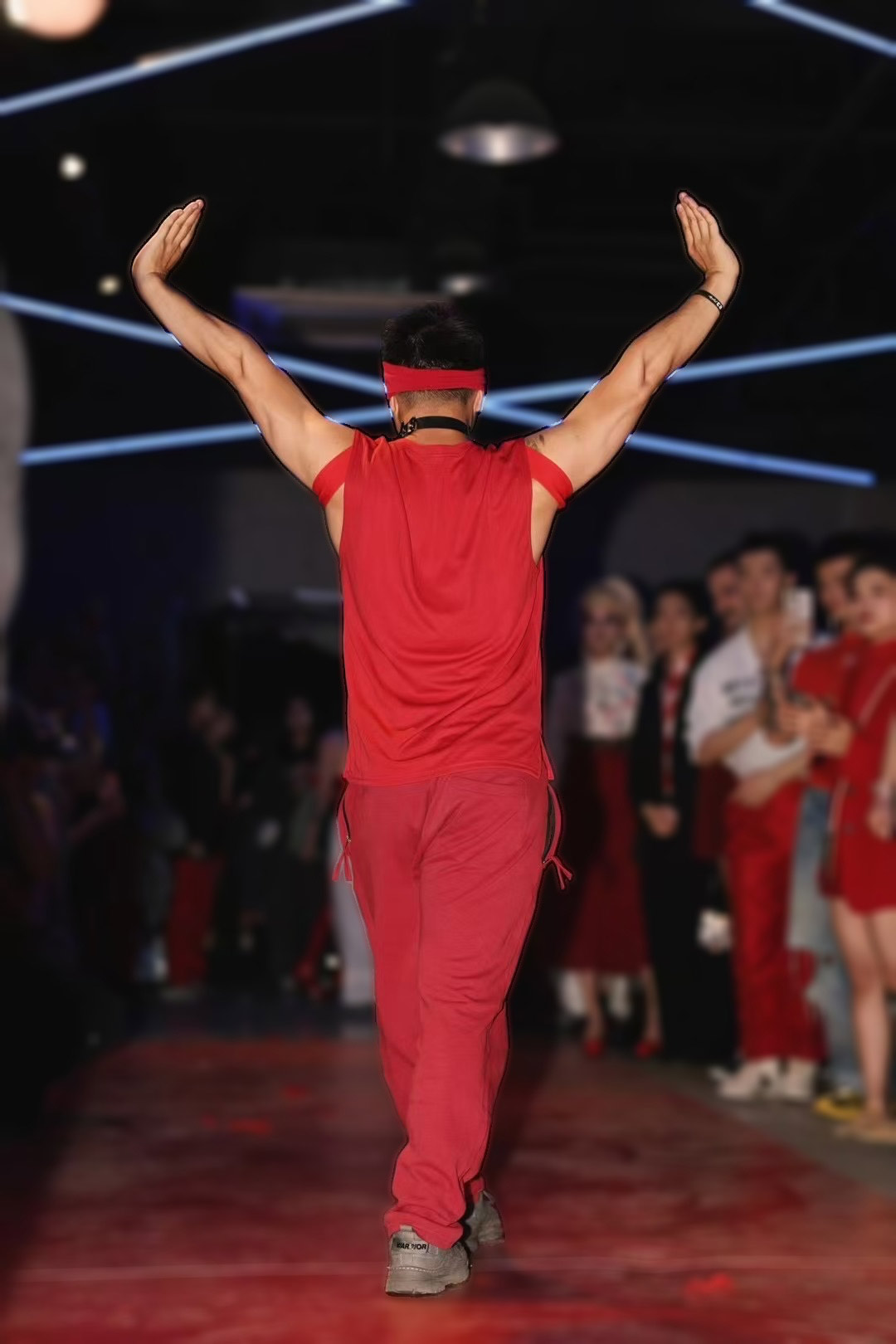
Featured Image: (Figure 1) Blanca poses for the camera at a ball. Photo courtesy of the authors.
References
Bailey, Marlon M. 2013. Butch Queens Up in Pumps: Gender, Performance, and Ballroom Culture in Detroit. Ann Arbor, MI: University of Michigan Press.
Jones, Jacqueline. 2017. ‘The Great Joy in Life: Geraldyn Dismond’s Transformative Coverage of the Hamilton Lodge Ball.’ In Writing the Harlem Renaissance, edited by E.A. Williams, 3–12. Lanham, MD: Lexington Books.
Joseph, Janelle, and Naomi Bain. 2024. ‘Leisure as Black Survival: Ballroom, Vogue, and Black Queer and Trans+ Embodied Activism in Canada.’ Leisure/Loisir 48(2): 315–32.
Reid, Shamari. 2022. ‘Exploring the Agency of Black LGBTQ+ Youth in Schools and in NYC’s Ballroom Culture.’ Teachers College Record 124(6): 92–117.
Ultra Omni, Victor. 2023. ‘Crystal Labeija, Femme Queens, and the Future of Black Trans Studies.’ TSQ 10(1): 16–22.
Wilson, Ara. 2006. ‘Queering Asian.’ Intersections: Gender, History and Culture in the Asian Context 14. intersections.anu.edu.au/issue14/wilson.html.
The post Making Transnational Ballroom in China appeared first on Made in China Journal.