Inside Trump’s Nightmare For Haitians In Springfield: ‘We’re Following Our Orders’
By Asawin Suebsaeng|Zeteo Photos: YouTube Screenshots However bad you think things must be in Springfield, Ohio, today, the reality on the ground is worse. Even if you are looking on, as a distant observer, in disgust at recent headlines (including about the suicide of 20-year-old student Pierre Damas Bel), it is difficult to grasp the scale of what is happening in and around this small Midwest city, and to its Haitian population, their friends, and neighbors. For years, Donald Trump and his party have waged a protracted campaign of racist lies, fear, and demagoguery on Springfield. This summer, that campaign culminated in the Trump administration’s ICE clampdown in the city, following President Trump’s destruction of the Temporary Protected Status (TPS) that once shielded the Haitian community. The crackdown – blessed by the Supreme Court’s right-wing supermajority that this president cemented – is unlike anything else occurring now in Trump and JD Vance’s America. The president and his allies are orchestrating horror and degradation all over the country. But in Springfield, the heightened level of fear is so widespread, and the state-imposed terror against a vulnerable minority so constant, that it is impossible to see this as anything but the Trump administration’s proof of concept for the president’s militarized vision of what America should be – a place where everyday people are afraid to go outside, in a republic of “law and order” that the federal government meticulously and arbitrarily constructs. It is the latest front in Trump and his party’s mission to codify MAGA’s brand of American racism and sadistic cruelty into law. Trump and his allies “test out their strategies here because they think people elsewhere aren’t watching,” says Katie Kersh, a Dayton-based immigration lawyer with Advocates for Basic Legal Equality, who has Haitian clients and has conducted legal clinics in Springfield. “They will bring them to your state eventually. People really need to care about this more.” I live in the Cincinnati area, roughly an hour’s drive from downtown Springfield. I live running-distance from the ICE office in Blue Ash – a Cincy suburb – where many of Springfield’s Haitians have been ordered to report, only for ICE officers to strap them with ankle monitors. I’ve been going back and forth between here and Springfield as much as I can since 2024, right after learning that St. Vincent de Paul, a Catholic-aligned nonprofit that I volunteer with, was one of the groups on the frontlines of the city’s support for Haitian immigrants – including when bomb threats rained down on Springfield when the Trump campaign made its Haitian immigrants the target of its viral, racist lies and Two Minutes Hate. Ever since President Trump was inaugurated early last year, I’ve covered his militarized assaults on Los Angeles, Chicago, the Twin Cities, DC, Memphis, and elsewhere. We have all seen what this administration is willing to do, and the body count that comes with it, so I’m not saying this lightly: The most urgent moral test in the United States today is happening right now in Springfield, Ohio – and the rest of the nation is failing that test miserably. To visit Springfield now is to travel to a city being invaded and psychologically tortured by a man who my adoptive home state of Ohio gladly returned to the White House so that he could conduct his sprees of ethnic cleansing and immiseration. In late 2024, Trump vowed to the American voter that he would launch the “largest deportation” in U.S. history, and he emphasized that he’d start with Springfield. It took him longer than he promised to get to the small city. But he never forgot about it. His crackdown is being waged in the context of two long years of thousands of Springfield’s Haitian immigrants routinely looking over their own shoulders, wondering when the men with guns would finally come. It’s been unleashed on immigrants who not only came here legally, to escape a severe humanitarian crisis in Haiti, but who were, by and large, welcomed with open arms by local leaders, at a time when the struggling Rust Belt city faced steep labor shortages. ICE agents have already taken not one but two Haitian pastors from the community. No one is safe, and a whole community has been pushed underground and into hiding. I’ve spoken to educators in the city who talk, sometimes through tears, about their Haitian students who suddenly vanished from the classroom, without a word or a trace. Numerous Haitian parents and their advocates keep telling me how they’re afraid to let their kids walk to school, fearing that ICE agents could use the children as “bait” to lure the parents out of their homes. Some Haitian families have found other places to sleep, knowing that the federal government knows where they live. Last month, I spoke to three Haitian parents who all said they had made practical and legal plans for what would happen to their
 Black News

By Asawin Suebsaeng|Zeteo
Photos: YouTube Screenshots
However bad you think things must be in Springfield, Ohio, today, the reality on the ground is worse.

Even if you are looking on, as a distant observer, in disgust at recent headlines (including about the suicide of 20-year-old student Pierre Damas Bel), it is difficult to grasp the scale of what is happening in and around this small Midwest city, and to its Haitian population, their friends, and neighbors.
For years, Donald Trump and his party have waged a protracted campaign of racist lies, fear, and demagoguery on Springfield. This summer, that campaign culminated in the Trump administration’s ICE clampdown in the city, following President Trump’s destruction of the Temporary Protected Status (TPS) that once shielded the Haitian community. The crackdown – blessed by the Supreme Court’s right-wing supermajority that this president cemented – is unlike anything else occurring now in Trump and JD Vance’s America.
The president and his allies are orchestrating horror and degradation all over the country. But in Springfield, the heightened level of fear is so widespread, and the state-imposed terror against a vulnerable minority so constant, that it is impossible to see this as anything but the Trump administration’s proof of concept for the president’s militarized vision of what America should be – a place where everyday people are afraid to go outside, in a republic of “law and order” that the federal government meticulously and arbitrarily constructs. It is the latest front in Trump and his party’s mission to codify MAGA’s brand of American racism and sadistic cruelty into law.
Trump and his allies “test out their strategies here because they think people elsewhere aren’t watching,” says Katie Kersh, a Dayton-based immigration lawyer with Advocates for Basic Legal Equality, who has Haitian clients and has conducted legal clinics in Springfield. “They will bring them to your state eventually. People really need to care about this more.”
I live in the Cincinnati area, roughly an hour’s drive from downtown Springfield. I live running-distance from the ICE office in Blue Ash – a Cincy suburb – where many of Springfield’s Haitians have been ordered to report, only for ICE officers to strap them with ankle monitors. I’ve been going back and forth between here and Springfield as much as I can since 2024, right after learning that St. Vincent de Paul, a Catholic-aligned nonprofit that I volunteer with, was one of the groups on the frontlines of the city’s support for Haitian immigrants – including when bomb threats rained down on Springfield when the Trump campaign made its Haitian immigrants the target of its viral, racist lies and Two Minutes Hate.
Ever since President Trump was inaugurated early last year, I’ve covered his militarized assaults on Los Angeles, Chicago, the Twin Cities, DC, Memphis, and elsewhere. We have all seen what this administration is willing to do, and the body count that comes with it, so I’m not saying this lightly: The most urgent moral test in the United States today is happening right now in Springfield, Ohio – and the rest of the nation is failing that test miserably.
To visit Springfield now is to travel to a city being invaded and psychologically tortured by a man who my adoptive home state of Ohio gladly returned to the White House so that he could conduct his sprees of ethnic cleansing and immiseration. In late 2024, Trump vowed to the American voter that he would launch the “largest deportation” in U.S. history, and he emphasized that he’d start with Springfield. It took him longer than he promised to get to the small city. But he never forgot about it.
His crackdown is being waged in the context of two long years of thousands of Springfield’s Haitian immigrants routinely looking over their own shoulders, wondering when the men with guns would finally come. It’s been unleashed on immigrants who not only came here legally, to escape a severe humanitarian crisis in Haiti, but who were, by and large, welcomed with open arms by local leaders, at a time when the struggling Rust Belt city faced steep labor shortages.
ICE agents have already taken not one but two Haitian pastors from the community. No one is safe, and a whole community has been pushed underground and into hiding.
I’ve spoken to educators in the city who talk, sometimes through tears, about their Haitian students who suddenly vanished from the classroom, without a word or a trace. Numerous Haitian parents and their advocates keep telling me how they’re afraid to let their kids walk to school, fearing that ICE agents could use the children as “bait” to lure the parents out of their homes. Some Haitian families have found other places to sleep, knowing that the federal government knows where they live. Last month, I spoke to three Haitian parents who all said they had made practical and legal plans for what would happen to their children, should the parents get taken away. One of these parents told me their young child, a U.S. citizen, was having a hard time understanding why their parent might be taken, and kept asking when they would return. All of these parents have had to explain to their small kids why this is happening, in the so-called land of the free that they now call home: Because we’re Haitian.
Much of the area’s Haitian population is now afraid to even step outside; they can’t go to work or already have lost their jobs and family’s source of income. Some have already been disappeared by ICE (to American jails and detention centers, or back to the humanitarian catastrophe and extreme violence of Haiti), with their families or U.S. citizen kids left behind to pick up the pieces. Many others are now fitted with ankle monitors (“shackles,” as various Haitians and their friends say), so that ICE can constantly remind them: Don’t go anywhere. We are still coming for you. Several of the free legal clinics for Haitian residents are now canceled, in part because the Haitians don’t want to risk being picked up by ICE on their way to see the lawyers, and also because the lawyers themselves are now inundated with cases of new Haitian detainees.
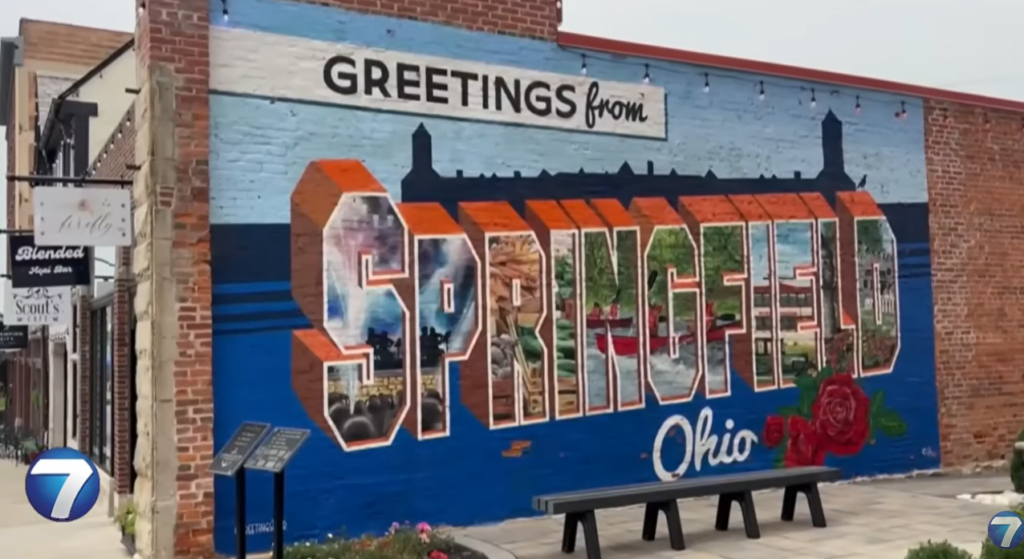
When I meet with church leaders, members of the Haitian Support Center, and other residents and students in the area, they often tell me they’ve never heard this much crying and despair from adults, from an immigrant community that watched from afar what happened in Minneapolis and St. Paul and know what President Trump and his people are capable of now. When I talk to faith leaders, activists, Haitians, and longtime Springfield residents about the ICE ramp-up over the past few weeks, the words and phrases I hear the most are “occupation,” “invasion,” President Trump’s “siege of our city,” “it has never been this bad,” and that “ICE is everywhere now.” If you walk the streets of Springfield, it isn’t hard to spot the agents. They aren’t hiding their presence. Some of them don’t even have their masks on.
I’ve asked Ohio immigration lawyers, faith leaders, and Springfield locals to recount to me their interactions with armed ICE officers ever since the clampdown began late this summer. At least a couple of the locals told me they were actively preparing for the push-comes-to-shove moment when they’d have to hide the little girl and her family in the attic, and yes, they were willing to go to jail over it.
Several of them told me that they could tell that some of the ICE agents didn’t want to be doing this – or, at least, wouldn’t have otherwise considered this operation a top priority. After all, the Haitians came to Ohio legally. They weren’t committing crimes or, as Trump and Vice President Vance famously smeared, eating Springfield’s cats and dogs. The Republican mayor of the city and the Republican governor of a reliably red state have all but publicly begged the Trump administration to let the Haitians stay, arguing that purging them would roll back economic progress.
Taken all together, it’s not actually that surprising that some of the federal agents are feeling down about their latest deployment to enemy territory, preferring that their talents be unleashed on a different city or population. Of course, they’re doing it anyway.
Due to high frequency, I’ve lost count of how many times the sources have told me that – when it comes to their actions during Trump’s Springfield offensive – an armed ICE agent or DHS employee has said to them, verbatim, “We are just following orders,” or some slight variation of the phrase famously associated with Nazi war criminals.
You would think that someone, somewhere, in the bowels of the Department of Homeland Security would have provided a shred of public-relations training to dissuade ICE officers from verbally embracing the Nuremberg defense. But during the Trump era, why would they?
“[On Aug. 2], I accompanied a handful of individuals to their ICE check-ins for Haitian TPS holders in Blue Ash,” Carolyn Marks, an Ohio immigration lawyer, tells Zeteo. “When we challenged the constitutionality of ankle monitors being placed on our clients, given that Temporary Protected Status had not at that point been rescinded (and was therefore still valid), we were told, ‘We’re following our orders.’ The reason I remember that quote specifically is I wrote it down in real time. I did this both because I wanted an accurate record of ICE’s official response to our position and also because it was so chilling to hear in this context.”
Marks then told me something that nearly caused me to have a psychotic break, and I don’t really know why: “It was also said by a man representing ICE while wearing a Hawaiian shirt with AK-47’s and grenades printed on it.” (One of my former editors refers to this simply as the “bro-nality of evil.”)
When I’ve driven to Springfield lately, there’s been a sustained concern among the Haitians and their friends and neighbors that the geyser of solidarity that they’ve all witnessed and felt may not be enough for them to win. The last time I met Carl Ruby, a local pastor, at a church in August, he didn’t have much time to talk. It wasn’t that many hours ago that he and his peers had received confirmation that ICE had detained a second Haitian pastor in Springfield. (The detained pastors’ names are Gilbert Joubert Adrien and Julio Dumano.) Ruby, Haitian community leaders, and a huddle of young and old volunteers were busy handing out sandwiches and pizza boxes to one another, gathering for an emergency meeting in the church kitchen to discuss next steps. Everyone there was in crisis-mode. When they weren’t talking about packing boxes of food or supplies to deliver to Haitian families, they were talking about things like calling and writing the offices of local and national political leaders to pressure them to act.
At that moment, Ruby and others told me they did not know how widely known it was yet that Trump’s ICE agents had snatched not one but two Haitian pastors “beloved” by their American neighbors. Everybody was still trying to figure out where the pastor was taken, and if their friend was even still in Ohio. But apparently, word had already reached some of the corridors of power in official Washington. As I stood in that kitchen, Rep. Greg Landsman (D-Ohio) told me by phone that he had heard about the second pastor, and that he and his office were asking for more information. “It’s wrong. All of it,” Landsman texted. “The Senate needs to pass the House-approved 3 year TPS extension for Haitian refugees. Immediately.”
As atrocious as the siege of Springfield is, many in the city only expect it to get more brutal. Many worry it’s only a matter of time before ICE agents stop knocking on their doors, and start knocking down doors and barging into the houses. (For now, the Haitian residents, many of whom have gone through extensive know-your-rights pro bono legal seminars, are following the vampire rule: Don’t invite them in.) But for the time being, the White House, according to the Trump advisers and senior administration appointees I’ve spoken to, is sensitive about Springfield, or anywhere else, degenerating into another Minneapolis. High-ranking officials in Trump’s government, maniacally nativist as they are, recognize that their ultra-violent, at times deadly, blitz in Minnesota this year helped wreck them in public-opinion polls – in a critical midterm election year, no less.
In Springfield, the Trump administration is testing out their revised strategy for laying siege to an American city: making Trump’s secret-police force, well, more secretive, with less viral-video-ready mayhem in the streets. Yes, ICE is conducting arrests, and the deportation flights to Haiti have begun. The ICE presence in the city is now practically ambient, but here’s what my Trumpland sources involved with these policies tell me: Before escalating to anything resembling a more “shock and awe” door-to-door approach, the Trump-Vance administration wants fear and misery to do as much of the work for them as it can.
Senior Trump administration officials, the sources tell me, want to make conditions in Springfield so bad for the thousands of Haitians still there that many of them pack up and leave (or, “self-deport”) on their own.
In that context, it is difficult to view the horrific death of Pierre Damas Bel as an outlier. Bel was an honor-roll athlete and first-year student at Wright State, who family members and local advocates say committed suicide early this week after being stripped of protected status, after federal agents strapped him with an ankle monitor this summer, and after he’d endured bullying over it. The Trump administration wanted Bel, and thousands like him, to leave the United States immediately, and is willing to make their lives so agonizing that they do.
Bel left – mortally, if not geographically. The policy is starting to work as intended.
And the Haitians can see what game the administration is playing with their lives.
When I saw Viles Dorsainvil, co-founder of Haitian Support Center in Springfield, again late last month, I could see a clear-as-day combination of inspiring resilience and deep, understandable sadness in his eyes. It’s a look all too common in that town today. Dorsainvil had TPS and his asylum case is pending, meaning: He’s not safe, at all, from the Trump-Vance administration’s onslaught. But he repeatedly indicated that he doesn’t have much time to worry about himself nowadays, and that the past few weeks have been worse and more hectic than anything he’s experienced in America before. It’s just been nonstop calls – of confusion, of despair, of tearful anguish, of anger.
We talked about how he and the other Haitians knew they were in for at least another two years of this. He praised the residents of Springfield, of all kinds of backgrounds, for their spectacular shows of solidarity that began more than two years ago, and never abated. But he couldn’t tell me how sustainable it all was, especially if the expanded ICE operations meant that many people, though not all, were afraid to go to work. Charity and food drives are great, but Haitian children still need to learn. Their parents need to work and provide for their families. How long can Springfield’s Haitians and their allies last when the full force of the U.S. federal government is being used to torment them?
Dorsainvil took a moment before he answered. He said that “right now,” the Trump administration is certainly “in a better position to win.” After all, Donald Trump controls the executive branch. But, the co-founder of the Haitian Support Center said, he and those around him are committed to helping each other and standing up for their remaining rights until “none of us are left.” It’s all they can do. And they’re going to do it right up until the moment they can’t do it anymore. It is how so many within the Haitian immigrant community in the small Ohio city feel now – even with everything that is being done to them. One of several key reasons for this, a number of them tell me, is because of how much they love Ohio and love America. They consider the communities here their home. Under duress, they are showing a profound commitment to this country that President Trump can only pretend to.
Later, after Dorsainvil tells me about how struck he’s been by the sheer number of adults and parents crying to him on the phone, I ask him an admittedly loaded question: “What in history does this all remind you of?” Dorsainvil takes a breath. He says it’s hard to pick just one “regime,” but notes: “It’s hard to say that we live in a democracy anymore.”
Needless to say, the most senior levels of the Trump administration and Republican Party are very proud of what they’re doing. Just look at their social-media posts boasting about it:
Depraved as this is, it makes perfect sense that Team Trump is doing victory laps. It took Trump, Stephen Miller, JD Vance, and the rest of them years to obliterate TPS. They fought it all the way to the Supreme Court and got their way. Now, they’re counting on American voters outside of Ohio to not care enough, so that the feds can get away with cleansing Clark County.
I’ve been communicating with Kersh, the lawyer, for two years. Something that grabbed me about the way she talks about the deteriorating situation in Springfield now is that for most of the past two years, she is one of the people who works with the Haitian diaspora who I’ve long called “the anti-alarmists.” Since 2024, it was obvious that she knew what the stakes were, and how awful it could soon get. But she always stressed to me, and to others, that the laws and the courts and the institutions of this nation still existed – and that people needed to be smart and not allow Team Trump’s fearmongering to win before the actual fight ever ended.
All of those preambles, I told her on a recent phone call, are gone now. I said to Kersh that this was one beaming indicator of how grotesque the reality on the ground had grown. I joked (or, “joked”) to her that for the past couple years, I’d viewed her as the flight attendant on the troubled flight: You look at the flight attendant to see how worried the passengers should be. If the flight attendant looks scared, then something has gone very wrong. If she seems normal, then chill out and enjoy the turbulence. Today, the flight attendant has the look of horror in her eyes.
“After that lawless Supreme Court ruling, I can’t tell them that the law will protect them,” she says, stressing that she absolutely does not mean Haitian immigrants should give up hope or the fight – quite the opposite. Kersh is merely underscoring how despicable and lawless the most powerful people in this country are behaving.
“I met with this [Haitian] guy who has a 1-year-old, and he was apprehended after ICE spotted him at a gas station in Springfield, around late August,” Kersh told me. “I was asking him questions at Butler County [jail], and he talked about how he came here: He got an appointment through a church or something like that [when President Joe Biden was in office]. He met with Border Patrol, and they sat him down and shook his hand. And then his voice broke. Through tears, he said: ‘They shook my hand and they said, ‘Welcome to the United States,’ and yesterday they arrested me.’ He’s just crying. He had to stop for a good solid minute to catch himself. To me, that really encapsulated the confusion and fear for so many people now. They were welcomed into this country and now the same agency is arresting them and throwing them in jail.”
As far as Kersh knows, the 1-year-old, a U.S. citizen whose government clearly does not want them here, is still in Springfield. You could argue that child is one of the luckier ones.
“Following its mass de-legalization efforts, this administration is knowingly sending people, including children, back into danger in Haiti. There is no limit to its cruelty and disregard for human life,” Savi Arvey, director of policy, refugee and immigrant rights at Human Rights First, said last month.
In Springfield, Pastor Carl Ruby has an anecdote he’s relayed to several members of the media: “They’ve experienced crisis over and over and over again,” he said. “A child in my church talked about seeing feral hogs eating the bodies of Haitians who’ve been killed. That’s what we’re sending them back to. And we ought to be ashamed of that as Americans.”
Again: The Trump-Vance team is counting on enough Americans not caring about this, and not feeling deep shame. Some U.S. citizens are already seizing the opportunity to prove them wrong – they just don’t know if it will ultimately be enough.
“During the first Trump administration, a colleague said to a group of us, ‘You should be really proud of the work you’re doing. If you ever wondered what you would have done during colonialism, the Holocaust, or slavery, you are doing it now,’” Marks, the attorney, told me this week. “I thought that was nice, but dramatic. An exaggeration. I see now that it wasn’t. It was predictive… These are people who are active asylum seekers, who have a current lawful right to be in this country. But at this point, ‘enforcement’ is out of control. No one is safe, all so the president can make a political point. It’s horrifying.”