Gloves come off between PetroSA and ex-partner, Nako Energy
Nako Energy was once a trusted insider at the state-owned petroleum company. Now, PetroSA accuses its former partner of trying to bully it into paying R606m while neglecting to tell the court that Nako owes PetroSA R833m in return. The state-owned petroleum company, PetroSA, is fighting for its survival in the Western Cape high court […] The post Gloves come off between PetroSA and ex-partner, Nako Energy appeared first on The Namibian.
 Black News
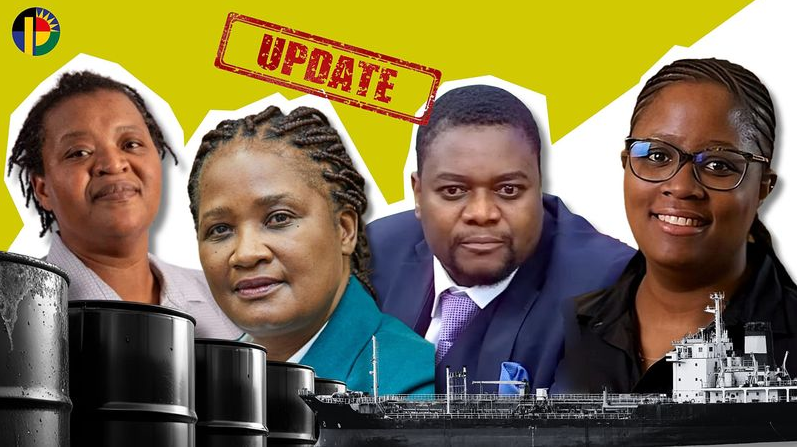
Nako Energy was once a trusted insider at the state-owned petroleum company. Now, PetroSA accuses its former partner of trying to bully it into paying R606m while neglecting to tell the court that Nako owes PetroSA R833m in return.
The state-owned petroleum company, PetroSA, is fighting for its survival in the Western Cape high court after a former business partner tried to liquidate it.
Nako Energy claims it is owed R606-million for unleaded petrol it delivered in Mossel Bay in June 2024 – fuel that PetroSA accepted, but failed to pay for. A year later, PetroSA signed an acknowledgement of debt, and when it failed to pay, Nako asked the court to put the troubled state-owned entity into liquidation.
But the story is not quite that simple, as PetroSA’s acting CEO Nombulelo Tyandela pointed out in an affidavit filed this week.
Yes, PetroSA owes Nako R606-million, but in return Nako owes PetroSA R833-million, after it bought a cargo of diesel in Durban and also failed to pay. And if the two debts are offset, Nako would have to put R227-million on the table.
“[PetroSA] disputes that it is indebted to [Nako] in any amount… [Nako] seeks the final winding up of a state-owned company on the basis of a debt acknowledged by [PetroSA] which was substantially exceeded by [Nako’s] own written acknowledged debt…” Tyandela told the court in an affidavit signed on Tuesday.
PetroSA also accuses Nako of trying to bully it into a settlement: “[Nako] has launched this liquidation application in terrorem” – by way of threat – “in an attempt … to compel [PetroSA] to make payment in circumstances where it is [Nako] rather than [PetroSA] that is owing monies … As these proceedings have been brought in terrorem, I respectfully submit that costs should be awarded against [Nako].”
PetroSA recently disclosed that it fought off another attempt to liquidate it after one of its fuel suppliers, Gunvor, threatened court action over PetroSA’s failure to pay a R796-million debt.
Yet the case brought by Nako is more personal: Nako’s CEO Nqobani Mkhwanazi was until recently considered by some to be a trusted adviser to PetroSA, and the papers filed this week suggest that PetroSA bent over backwards to push deals in Nako’s direction.
In December, even after receiving lawyer’s letters demanding it pay the Nako debt, PetroSA awarded Nako a three-month contract to supply it with diesel in Durban.
Now, however, the gloves are off: “Now that [Nako] has initiated winding-up proceedings against [PetroSA], [we] will consider and take such steps as are necessary to recover the [R833-million] owing by [Nako] to [PetroSA],” Tyandela wrote.
Chemically laced fuel
PetroSA’s R606-million debt stems from a controversial deal signed in 2023 to secure unleaded petrol to sell to various petrol stations in the Garden Route.
Nako had offered to supply PetroSA with a new kind of unleaded petrol from a supplier in the United Arab Emirates at a generous discount, but failed to mention that the fuel contained a chemical additive – N-methylaniline (NMA) – which is banned in several countries.
After customers complained that the fuel left stains on the paintwork of their cars, Total, Caltex, Shell and Engen refused to buy any more fuel from PetroSA and the deal stalled.
Publicly, PetroSA has maintained that there was nothing wrong with the fuel Nako supplied. In an April 2024 interview with SABC, then COO Sesakho Magadla said: “[T]here has been no concerns with regards to the quality itself in terms of the [fuel] but what we’ve seen is … a general concern on the staining.”
She added: “Even though we know that we are selling [fuel] that is compliant to the specification we have embarked … on an independent investigation … from the preliminary investigation there is no conclusive evidence that indicates that this concern that is raised by motorist[s] could be isolated to the [fuel] that is sold by PetroSA.”
Yet in the papers PetroSA filed this week, Tyandela conceded that there were concerns about the quality of Nako’s fuel: “[PetroSA] experienced challenges to place this product in the market arising from complaints received disputed on the quality of the ULP95 gasoline that had been delivered by [Nako],” she wrote, crossing out the word “disputed”.
Tests on Nako’s fuel had found high levels of NMA – which probably caused the staining – and, in some cases, high levels of gum which can damage car engines.
In the court papers, Tyandela included a letter she wrote to Nako’s chair, Nkosinathi Ngwenya, in May last year, describing how the Nako deal had cost PetroSA its share of the unleaded petrol market in the Garden Route and damaged its reputation in the industry:
“Due to the numerous negotiations and challenges surrounding the quality of the ULP 95, PetroSA experienced significant challenges from [the] oil industry and commercial customers to sell the above-mentioned cargo. These include customer complaints from end users as well as [the] oil industry not [being] willing to accept the product.
“These incidents have adversely affected PetroSA as [a] reliable and credible supplier of high-quality products such that PetroSA’s reputation amongst its peers is impaired. This has directly impacted the downstream value chain of the business materially with regards to the supply of ULP,” she added.
Internal PetroSA documents suggest that PetroSA has struggled to sell the last cargo of NMA-laced fuel that it received from Nako, with more than half the fuel still sitting in PetroSA’s tanks a year later. This, in turn, has left PetroSA short of cash to pay Nako.
Yet PetroSA’s legal team has not gone so far as to ask the court to invalidate Nako’s unleaded petrol deal and set aside the R606-million debt altogether.
Instead, Tyandela has asked the court to find that the two debts should be offset: “[PetroSA] has a liquidated counterclaim against [Nako] that far exceeds [Nako’s] claim against [PetroSA]. I respectfully submit that in such circumstances the court should exercise its discretion in declining to wind up [PetroSA].”
Bending over backwards for Nako
What emerges inadvertently from the court papers is how accommodating PetroSA has been towards a partner that, according to a 2025 internal PetroSA investigation, had contributed towards “financial losses, reputational damage and loss of customers” for PetroSA.
In May last year, after Tyandela’s “impaired reputation” letter, PetroSA negotiated a settlement with Nako.
At the time, Nako wanted to claim R904-million from PetroSA: R484-million for unpaid fuel, plus R81-million for interest, R167-million for finance costs, and R172-million for demurrage, which are the costs a ship incurs when it must wait offshore.
The final figures on the acknowledgement of debts (AODs), signed on 19 May 2025, were that PetroSA would pay Nako R606-million while Nako would pay PetroSA R833-million.
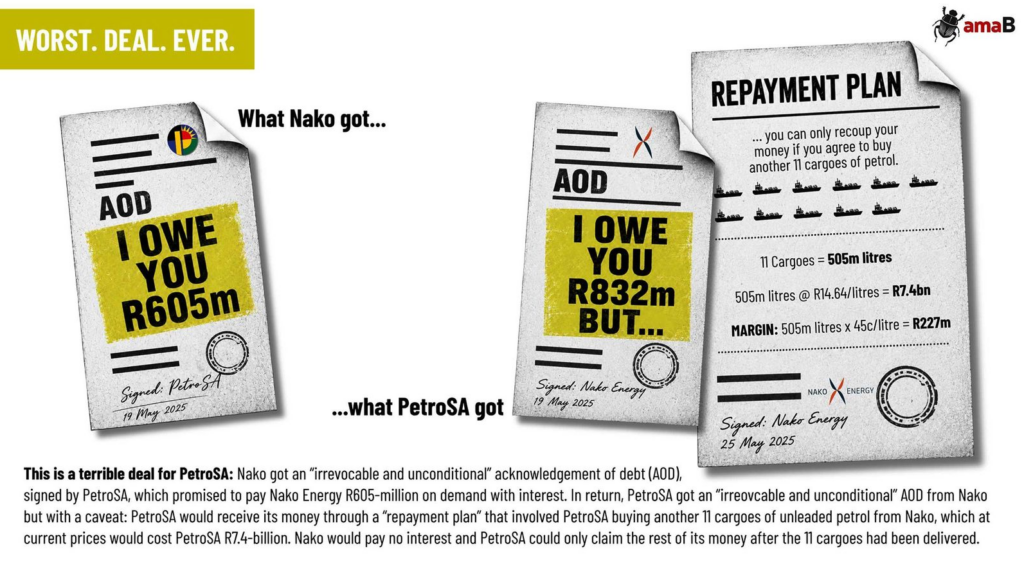
A line at the end of both AODs added: “The payment for the abovementioned amount will be subject to [a] payment plan that will be developed and agreed upon by both parties not later than 31st May 2025.”
According to both Nako and PetroSA, that payment plan was never signed.
- • Correction: in our original report, we said the payment plan was signed. We have updated the story to reflect this. Read: PetroSA was owed R227m. It may end up losing R1.4bn instead.
Instead, we have now established that a draft payment plan was negotiated whereby Nako would be allowed to fulfil the last 11 months of the unleaded petrol deal and use the profits to repay PetroSA.
The 11 shipments of fuel would cost PetroSA roughly R7.4-billion, and would be high risk considering that, according to Tyandela, the Nako deal had torpedoed its market share and left PetroSA’s customers wary of buying its product.
An email attached to the court papers shows that Nako had lined up new suppliers: “[W]e would like to know when we can commence with ULP deliveries as part of the payment plan and serving out the balance of our contract,” Ngwenya, Nako’s chair, wrote in July 2025.
But before the payment plan could be finalised, Nako’s own creditors came knocking.
In August last year, lawyers acting for Plane Tree Capital – a Sandton-based trade finance company – informed Tyandela that Plane Tree now owned Nako’s debt book, including the R606-million acknowledgement of debt that she had recently signed.
Plane Tree had put up the cash for Nako to buy fuel from the suppliers in the UAE. When PetroSA failed to pay Nako, Nako failed to pay Plane Tree, and in terms of the loan agreement, Plane Tree inherited the claim.
“Our client hereby demands immediate payment… In the event that the demand is not complied with, we will refer to our client for instructions on the institution of appropriate proceedings,” the lawyers wrote in the August 2025 letter.
At this point, PetroSA was entitled to issue its own letter of demand to Nako, pointing out that if the negotiations were off, PetroSA was entitled to claim the R833-million it was owed.
Yet inexplicably, PetroSA chose to stay in business with Nako.
“Since the conclusion of the settlement in May 2025, [PetroSA] has engaged in good faith with [Nako] towards enabling a mechanism by which [Nako] can pay its indebtedness to [PetroSA],” Tyandela told the court.
PetroSA had even agreed to freeze any interest on Nako’s R833-million debt, whereas invoices show that Nako continued billing PetroSA between R5-million and R6-million a month for interest on the R606-million it owed.
In October 2025 – two months after receiving the letter from Plane Tree’s lawyers – PetroSA asked Nako to deliver 15,000 metric tonnes (about 20 million litres) of unleaded petrol to Mossel Bay, at an estimated price of R190-million, of which about R10-million would be set aside “towards the settlement of the Nako Energy debt,” it added.
Tellingly, whereas PetroSA’s original 2023 agreement with Nako simply said, “the quality shall meet the specifications of PetroSA Mogas 95 gasoline”, the new order explicitly said that the fuel “should not contain any Methylcyclopentadienyl Manganese Tricarbonyl (MMT/NMA) or any similar octane-enhancing additive or no intentional addition of metallic or AVSR additives”.
In December, despite allegedly receiving a fresh letter of demand from Plane Tree’s lawyers, PetroSA tapped Nako again, this time to supply diesel to PetroSA through the Island View Terminal in Durban.
“On 31 December 2025, [PetroSA] appointed [Nako] as a fuel supplier for the Durban market, subject… to the finalisation and execution of all relevant commercial agreements… [PetroSA] continued to follow up with [Nako] over the months that followed…” Tyandela told the court, attaching a copy of the appointment letter that then interim CEO Sesakho Magadla had signed.
It was only after Nako approached the court in September to place PetroSA into liquidation that the state-owned entity reassessed its relationship: “Now that [Nako] has initiated winding-up proceedings against [PetroSA], [we] will consider and take such steps as are necessary to recover the [R833-million],” Tyandela had written.
Although there’s still no indication that PetroSA has sent a letter of demand to Nako, Tyandela has asked the court to treat both claims equally.
“If, as [Nako] contends, [PetroSA’s] acknowledged indebtedness became due and payable in the absence of the contemplated payment plan referred to in the acknowledgement of debt, then the same must follow in respect of [Nako’s] large, acknowledged indebtedness to [PetroSA],” she wrote.
“If, on the other hand, the reciprocal debts were not payable until the contemplated payment plan was agreed, then no debt is presented due by [PetroSA] to [Nako] and the premise upon which [Nako] seeks to have [PetroSA] wound-up falls away. On either footing, the application cannot succeed.”
On the edge of liquidation
For 18 months, seemingly PetroSA did nothing to recover the R833-million that it was owed by Nako, even as PetroSA’s own creditors have been circling.
Last month, Tyandela told Parliament that PetroSA had narrowly avoided a liquidation application from Gunvor, the Swiss commodities giant, which was owed R796-million.
“Gunvor indicated its intention to institute liquidation proceedings against PetroSA in May 2026. The debt was settled in full in August 2026, excluding interest. R639 million of the settlement amount was funded through a shareholder loan. The remaining balance of R157 million was funded and paid by PetroSA from its available cash resources,” PetroSA’s presentation read.
An internal document suggests that PetroSA owes another R747-million to Addax Energy, one of the few fuel traders still willing to do business with them.
But the big behemoth is SARS: PetroSA owes the taxman R5.1-billion – R3.6-billion in unpaid taxes and R1.5-billion in penalties. In its presentation to Parliament, PetroSA revealed that it had asked SARS for a settlement: R200-million would be paid now and R1.3-billion would be paid in instalments over the next three years.
This had resulted in PetroSA being “formally assessed as facing ‘Financial Distress’ due to inability to pay debts as they fall due,” officials told MPs. There was, they added, “heightened legal and financial risk of involuntary liquidation”; “urgent support [is] required to allow the Company to pay debts”.
PetroSA has not said how much money it needs from government to keep its head above water. Our current estimate is that it owes R10-billion to creditors.
Nako’s debt – whether it’s R833-million or only the balance of R227-million – won’t plug that gap, but considering that Magadla once said, in response to an internal audit report, that PetroSA “was even battling to cut grass on the basis of financial strain”, it wouldn’t be a bad place to start. DM
The post Gloves come off between PetroSA and ex-partner, Nako Energy appeared first on The Namibian.