Filming Reminiscence Arts in Dementia Care
An article by Barney Gibbons on his trilogy of documentaries about a creative reminiscence project in dementia care.
 Black News
Since 2023, I have been documenting Remembering Yesterday, Caring Today (RYCT), a creative reminiscence programme for people living with dementia and their families, friends and carers.
Developed more than 25 years ago by Pam Schweitzer and Errollyn Bruce, RYCT uses theatre, drawing, singing, writing, discussion and dance to help participants explore memories.
Over the years, numerous films have been made about the programme. Most adopt a narrated format in which Schweitzer explains the principles of RYCT, with accompanying footage of sessions across the programme. My trilogy takes a different approach: each film focuses on a single session and uses an observational documentary style that allows the interactions and activities to unfold without narration.
Examining the films in this trilogy, as well as the process of making them and their reception, I will consider what each film reveals about RYCT’s approach to creative reminiscence and the different audiences to whom they may appeal.
Food Reminiscence
The first film was made during a 2023 RYCT project in Westminster with Resonate Arts.
Participants share stories of food from their childhoods, recall hosting dinner parties, and then hold a feast of their own, illustrating how reminiscence can be carried into the present, while creating a shared narrative between participants.
As memories unfold around shared experiences and familiar objects, the film shows how sensory engagement can encourage reminiscence more naturally than simply asking, “Do you remember this…?”.
Like the programme itself, the film focuses on reminiscing rather than dementia, reflecting RYCT’s aim of creating a level playing field, where shared memories take precedence over predefined roles.
At the same time, the film has limitations. While it captures the atmosphere and relationships within the session, it shows relatively little of the creative processes at the heart of RYCT. The next film aimed to rectify this shortcoming.
Wedding Reminiscence
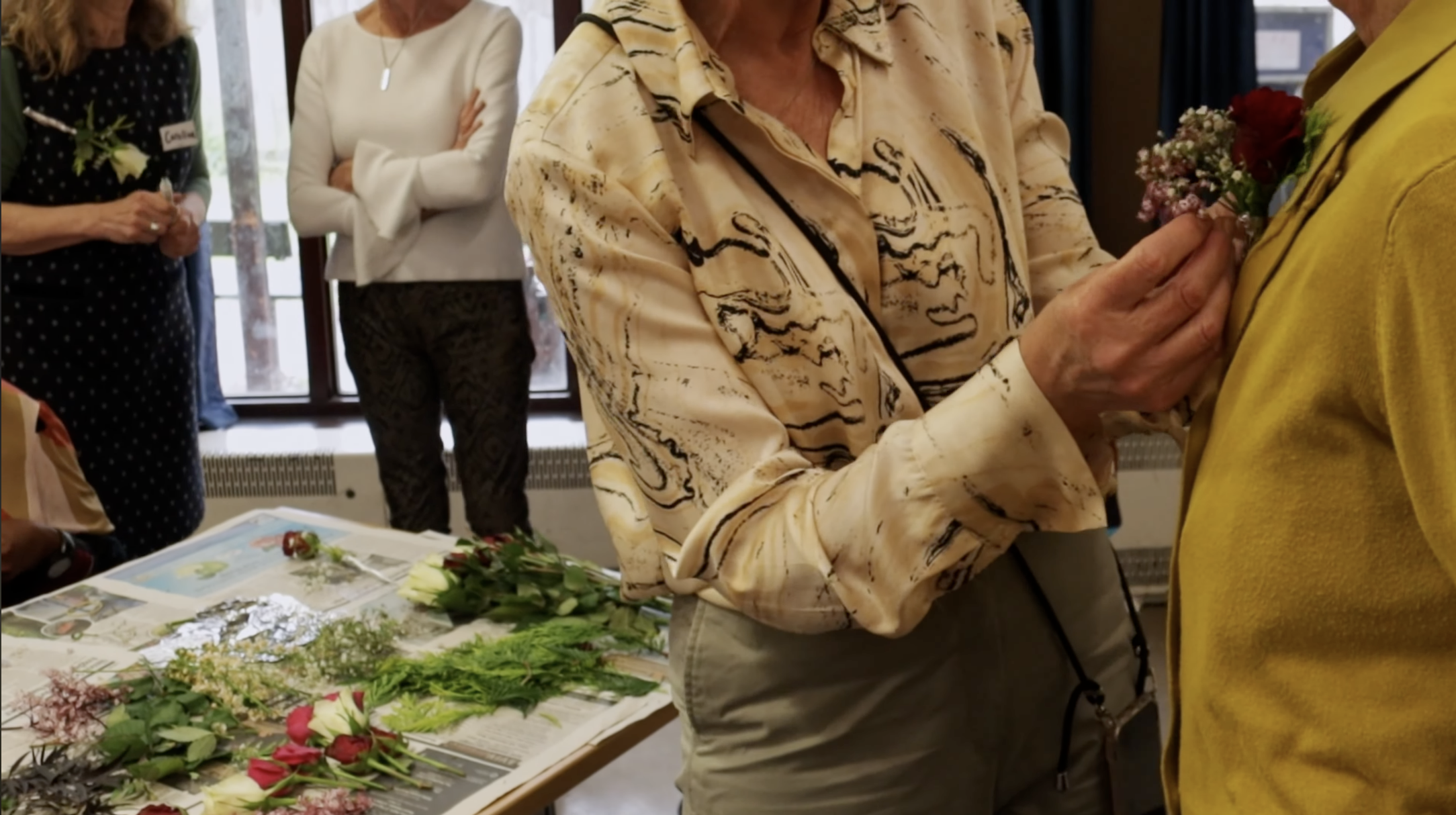
This documentary features a session from a 2024 project in Lewisham, in which participants staged a wedding together.
Here, theatrical reminiscence transforms personal memories into a shared narrative. Performance helps stimulate embodied memory, encouraging spontaneity, humour and emotional connection.
Before filming this session, I wondered whether role play might be disorientating for people living with dementia. Instead, the film shows how the facilitators skilfully weave performance with opportunities to speak about the past, allowing the session to remain grounded in the present.
The involvement of one couple, who agreed in advance to play the bride and groom, illustrates the balance between individual and collective experience. Although they occupy central roles within the performance, the wedding is equally shaped by the contributions of the wider group.
Feedback highlighted a limitation of the observational approach. Although the film successfully communicates the atmosphere and enjoyment of the session, one participating carer felt that audiences unfamiliar with reminiscence arts might not fully understand the purpose behind the activities on screen.
This tension became particularly apparent when the films were shown during training sessions for professionals learning about reminiscence arts. Earlier explanatory films were played first, providing audiences with background information before they encountered my observational documentaries.
Nevertheless, my films led trainees to discuss the relationships created within RYCT sessions, particularly the sense of equality and shared enjoyment between participants, carers, volunteers and facilitators.
The final film in this trilogy widens the lens further, exploring the breadth of creative approaches used within a single reminiscence session.
Travel Reminiscence
This final instalment in the trilogy follows a session from an RYCT project in Greenwich, in which travel memories are explored through conversation, theatre, drawing, writing and singing.
The film was supported using public funding from the National Lottery through Arts Council England.
The narrative reveals how a single session can encompass a range of artistic practices, accommodating varied abilities, interests and preferences for expression. The session also introduces participants’ scrapbooks, which record memories shared and created during the programme, as well as providing a resource that can continue to support reminiscence beyond the sessions themselves.
As the film shows, while the travel session has a looser narrative than the wedding session, participants remain connected through a shared journey: recalling places they have visited, packing imaginary suitcases and creating postcards.
Feedback on the film from participants highlighted the continuing challenge of balancing explanation with observation. In attempting to provide more context for audiences unfamiliar with reminiscence arts, the film includes more material showing how the session is facilitated, alongside a large explanatory text about the programme as a whole. Viewers suggested, however, that these changes reduce the film’s entertainment value and shift attention away from
participants’ experiences.
A further challenge was the absence of conversations about the difficulties of dementia care. One carer noted that the film focused primarily on the positive experiences created within RYCT rather than the everyday challenges faced by unpaid carers.
While these challenges are an important part of many carers’ experiences, RYCT sessions often provide separate spaces where carers can discuss these issues openly. These conversations were not filmed because the presence of a camera might have affected carers’ openness. They also took place separately from the main sessions, ensuring that participants living with dementia were not present during discussions that carers may have wished to keep private.
Nevertheless, the response to the final film demonstrated the value of documenting reminiscence arts. One carer screened the film to family and friends to help them understand how reminiscence could support their loved one living with dementia. This suggests that providing additional instructional context may have made the film more accessible to wider audiences.
Concluding Remarks
Together, these three films demonstrate different aspects of reminiscence arts within dementia care. Food Reminiscence shows how memories can emerge through sensory prompts, objects and conversation; Wedding Reminiscence explores how theatre can transform personal experiences into shared creative narratives; and Travel Reminiscence highlights the variety of artistic approaches through which participants continue to explore and express memories.
Documenting RYCT has revealed the challenges of representing reminiscence arts through film. While observational documentary captures atmosphere, emotion and relationships with remarkable immediacy, audiences unfamiliar with reminiscence arts may need additional context. Equally, too much explanation risks shifting attention away from participants’ experiences and reducing the entertainment value of the films.
Ultimately, the process of making these films has revealed that documentary and reminiscence share a similar quality: both are collaborative processes shaped through participation, interpretation and reflection.
_______________________________________________
This article was first published on the London Arts and Health website on 12/10/26: https://londonartsandhealth.org.uk/story/filming-reminiscence-arts-in-dementia-care/
To find out more about Remembering Yesterday, Caring Today, please visit: https://www.instagram.com/r_y_c_t/
If you would like to share feedback on the films or discuss the project, please get in touch via the contact details on my website: https://barneygibbons.wixsite.com/film