Cripping Culture Oral History Podcast: Announcing the first four interviews
We are delighted to announce that we will be publishing the first four oral history interview podcasts as part of UK Disability History Month 2026. The initial interview with Dr Maria Oshodi will be published later this week, with the next three to be published over the coming weeks. Summaries of the first four podcasts ... Cripping Culture Oral History Podcast: Announcing the first four interviews
 Black News
We are delighted to announce that we will be publishing the first four oral history interview podcasts as part of UK Disability History Month 2026. The initial interview with Dr Maria Oshodi will be published later this week, with the next three to be published over the coming weeks.
Summaries of the first four podcasts
Acclaimed playwright, researcher, and Extant Theatre CEO, Dr Maria Oshodi describes the creation, development and legacy of the theatre company, including its role in advancing blind and visually impaired artists, audiences and creative access in theatre. She talks about some of the early work setting up the organisation and workshopping to develop physical practices, performance styles and access approaches. Audio description was in its early stages as access provision for blind audiences. However, Extant pioneered placing description in performers’ and artists’ own hands.
The interview covers international exchange following an invitation from New Life Theatre in 1999 to the first international blind theatre festival in Zagreb, Croatia. The relationship continued for 20 years and included bringing the Croatian production Zeros and Nil to the UK with simultaneous audio description and language translation.
Maria also discusses meeting US-based writer and performer, Lyn Manning at the 2003 festival and bringing his autobiographical production Weights to the UK in 2005, alongside Extant’s own production Resistance. She talks about the creative innovation at the heart of Extant’s work giving an overview of various technology-led work exploring tactile navigation, haptic guidance and immersive experiences, emphasising the use of technology to support artistic and access aims.
Christopher Samuel describes his development as a multidisciplinary disabled artist whose practice examines identity, disability politics, archival documentation and representation.
He talks about his artistic journey beginning with a foundational self-portrait created using his electric wheelchair. Drawing on personal experiences of homelessness, housing insecurity, and the threat of forced residential care, his project Housing Crisis exposed the systemic legal and housing barriers facing disabled people.
Expanding on this theme, he talks about his research, having been invited to view the Wellcome Collection uncovering archival omissions alongside outdated, medicalised cataloguing language surrounding Black, working-class, and disabled communities. In response, he created Archive of the Unseen, an interactive microfiche installation built from his own life records to challenge these historical gaps. He later developed these ideas further with the Birmingham Museums Trust through Watch Us Lead, combining oral histories, drawings, and stained glass to examine race, faith, and colonial legacies while transforming institutional approaches to accessibility and cataloguing.
Award-winning TV and theatre writer, director, and Artistic Director of Little Cog, Vici Wreford-Sinnott, describes her work preserving North East disability arts heritage through the living archive, On Whose Shoulders We Build. This archive documents individuals, groups, and contemporary work to preserve an overlooked history, trace artistic growth, and connect generations of disabled artists. The first phase used photography and video collections, while a planned second phase will introduce paid artist conversations and expand contemporary records, on resolving challenges around funding and artefact conservation.
The discussion pays tribute to influential regional artists and organisations combining artistic innovation with activism. Ultimately, Vici describes the creative lineage represented within the archive, as part of an intention to empower new artists to claim rights and build community, with future collective hope driven by the Our Stomping Grounds festival and a potential regional disabled artists’ assembly. She also highlights her own theatre practice, including the touring productions Butterfly and Another England, emphasising the need for disabled-led storytelling and alternative aesthetics.
Mickey Fellowes is a deaf, British Indian writer and equality trainer based in Scotland with a distinguished career in disability arts and access-led training. He talks about the history of his involvement with the disability arts movement, arising initially out of an opportunity with New Breed Theatre Company, which led to professional development with the Northwest Disability Arts Forum.
With NWDAF, (which changed its name to DaDa in 2008), Mickey created accredited training programmes. He describes the groundbreaking ‘Leading the Way‘ program established in partnership with the Liverpool Institute for Performing Arts to train disabled artists.
Grounded in the social model of disability, his courses treated accessibility—using loop systems, shared note-taking, and reduced-barrier applications—as a collective group responsibility. Later, he talks about his work with Shape and the Audience Agency, championing diverse community initiatives and working to increase disabled audiences. An accomplished author, his novel Scarlet and White features disabled characters whose impairments are integrated naturally into their identities.
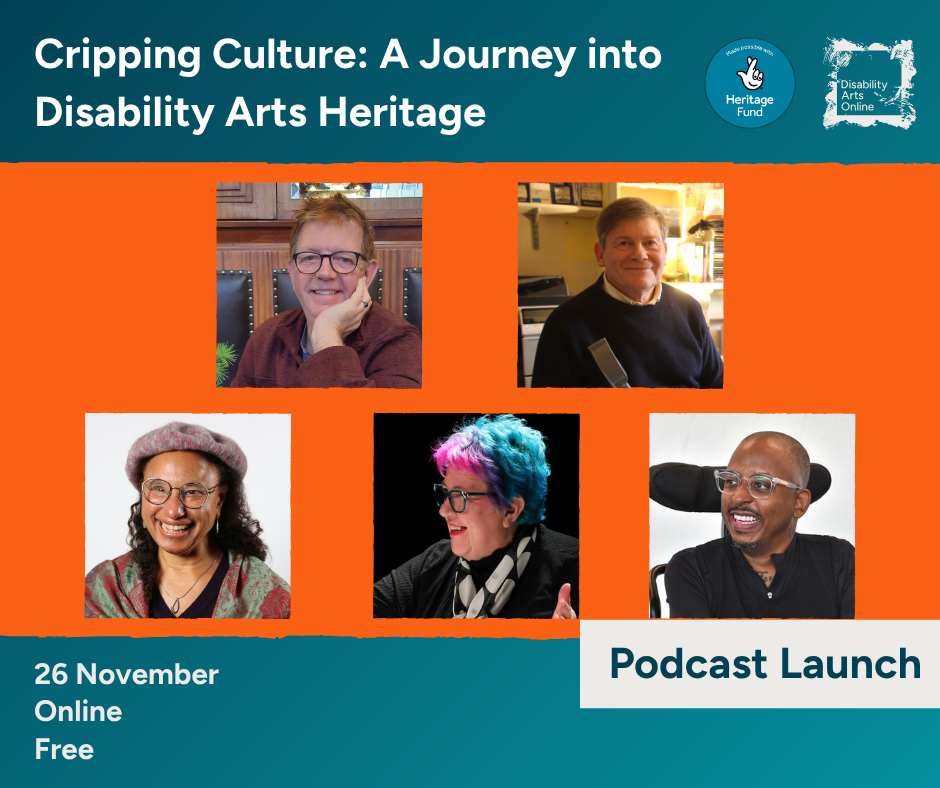
The Cripping Culture launch event will feature the first three oral history podcasts from Disability Arts Online’s Cripping Culture project drawing on the themes of Politics, Disability and Democracy through the work of the disabled artists and activists interviewed as part of the project. The event will feature clips from the podcasts alongside a panel discussion featuring Colin Hambrook (Heritage Projects Director, Disability Arts Online), Richard Rieser (Founder of UKHDM) alongside Vici Wreford-Sinnott (Theatre & Screen Writer/Director), Christopher Samuel (Artist) and Dr. Maria Oshodi (Artistic Director and CEO of Extant).
The event launching the first three of the podcasts will take place on Thursday 26 November 5:30-7pm. You can sign up on DAO’s listings events page
It be BSL interpreted and a live transcript will also be available on Zoom