Black Voters Make History, Deliver Stunning Rebuke to Trump
Black voters helped fuel a Democratic wave that put Hakeem Jeffries on the verge of becoming House speaker, elected America's first Black woman governor and made a Mississippi Senate race unexpectedly competitive. The post Black Voters Make History, Deliver Stunning Rebuke to Trump appeared first on Word In Black.
 Black News

For nearly two years, President Donald Trump has used the power of the federal government to dismantle diversity programs, attack racial equity initiatives and roll back policies intended to address generations of discrimination.
On Tuesday, voters delivered a response that was difficult to ignore.
In a sweeping midterm election that handed Democrats control of Congress, Black political power emerged as one of the defining stories of the night. A Black man stood on the verge of becoming speaker of the House, a Black woman won a governor’s race for the first time in American history, and Black candidates broke barriers in statehouses and congressional races across the country.

In the Deep South, where Republicans have dominated statewide politics for decades, Black voters helped deliver a historic victory for a Black woman in Georgia and pushed a Black man in a Mississippi Senate race to the brink of an extraordinary upset.
Jeffries Ascendant
The results represented a stunning political rebuke to Trump, whose administration has made opposition to diversity, equity and inclusion a centerpiece of its governing agenda.
But the election results went beyond punishing a deeply unpopular president.
It demonstrated the political strength of Black communities that have spent years fighting voter suppression, restrictive election laws, and institutional efforts — from legislatures to the White House to the U.S. Supreme Court — to diminish their influence. And it suggested that the movement to turn back the clock on racial progress had encountered something its architects may have underestimated: the power of the ballot.
At the center of that transformation stands House Democratic Leader Hakeem Jeffries.
In the Deep South, where Republicans have dominated statewide politics for decades, Black voters helped deliver a historic victory for a Black woman in Georgia and pushed a Black man in a Mississippi Senate race to the brink of an extraordinary upset.
The 56-year-old Brooklyn congressman is poised to become the first Black speaker of the U.S. House of Representatives when the new Congress convenes in January, after Democrats’ capture of the chamber.
Jeffries would assume arguably one of the most powerful positions in American government, second in the presidential line of succession and responsible for directing a House majority with the authority to investigate the Trump administration and challenge its legislative agenda.
The milestone comes more than 150 years after Joseph Rainey of South Carolina became the first Black person to serve in the House during Reconstruction.
The first Black lawmaker to lead a major party in Congress in 2023, Jeffries has promised a legislative agenda focused on lowering costs, improving healthcare and restoring congressional oversight.
His expected elevation would give Democrats a new opportunity to confront Trump, whose party lost both the House and Senate amid voter frustration over high prices, the war with Iran and concerns about government corruption.
Though Black candidates made stunning breakthroughs, the election results do not mean Trump’s executive orders or anti-DEI policies will automatically disappear. But a Democratic Congress would be positioned to block legislation, scrutinize federal agencies and challenge the administration’s priorities.
Black Women Break Through
The historic gains extended to the Senate.
Illinois Lt. Gov. Juliana Stratton won election to succeed retiring Democratic Sen. Dick Durbin, becoming the sixth Black woman ever to serve in the chamber.
She will join Democratic Sens. Angela Alsobrooks of Maryland and Lisa Blunt Rochester of Delaware, who made history in 2024 as the first two Black women elected to serve simultaneously.
For the first time, three Black women will hold Senate seats at once, a remarkable development in an institution where Black women were excluded entirely until Carol Moseley Braun of Illinois won election in 1992.

The breakthroughs were especially striking in the governors’ races.
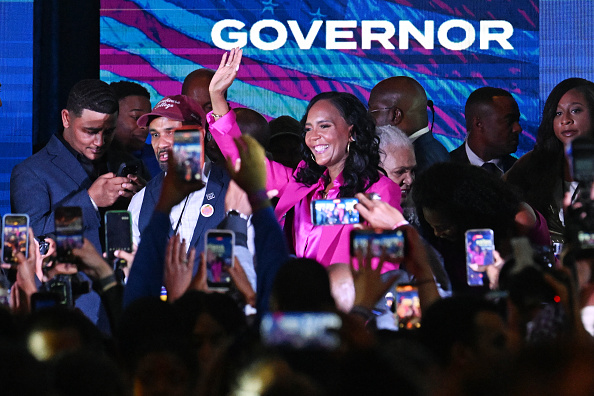
In Georgia, former Atlanta Mayor Keisha Lance Bottoms defeated Republican billionaire Rick Jackson, becoming the first Black woman elected governor of any U.S. state.
Bottoms, 56, also became Georgia’s first woman governor, ending more than two decades of Republican control of the office.
Her victory was a testament to the organizing power of Black women, particularly Stacey Abrams, whose unsuccessful gubernatorial campaigns in 2018 and 2022 helped transform Georgia from a reliably Republican state into a competitive political battleground.
Abrams never reached the governor’s mansion. But the registration drives, organizing networks and multiracial coalitions built around her campaigns helped deliver Georgia to Joe Biden in 2020 and elect two Democratic U.S. senators.
Bottoms built on that foundation, campaigning on expanding Medicaid, improving public education, protecting abortion rights and addressing the rising cost of living.
Jackson, who spent heavily from his personal fortune, sought to portray Bottoms as an ineffective former mayor. She countered by linking him to Trump and arguing that Georgia needed a governor focused on working families.
Her victory also carried a deeply personal historical significance.
Bottoms has traced her Georgia ancestry to relatives enslaved in Crawfordville. On the eve of the election, she visited their graves.
Generations after her ancestors endured slavery in the state, she will occupy its highest office.
Gains in Governor’s Mansions
Georgia was not alone in making history.
In Wisconsin, Milwaukee County Executive David Crowley won the governor’s race, adding another Black Democrat to the nation’s roster of governors.
In Maryland, Democratic Gov. Wes Moore won reelection, while Florida elected Republican Rep. Byron Donalds, a staunch Trump ally, as its first Black governor.
Donalds became the first Black Republican elected governor in American history, defeating Democrat David Jolly in a closely contested race that bucked the national Democratic trend.

The results mean at least four Black governors are expected to serve simultaneously, an unprecedented moment in American politics.
Donalds’ victory also underscored that Black political representation is not confined to one party or ideology. His political rise has been closely tied to Trump and the MAGA movement, even as civil rights organizations have sharply criticized the administration’s policies.
Meanwhile, in Mississippi, a state with one of the nation’s largest Black populations, Democrat Scott Colom was locked in a remarkably close contest with Republican Sen. Cindy Hyde-Smith.
Colom, a Black district attorney, mounted an unexpectedly competitive challenge in a state that has not elected a Democrat to the Senate since the 1980s.
Late Tuesday, unofficial returns showed the candidates virtually tied, with the outcome still uncertain.
‘Black Belt’ Breakthrough
The race illustrated the enormous potential influence of Black voters in Mississippi, where Black residents account for approximately 37% of the population and roughly one-third of the electorate.
According to the Associated Press, more than nine in 10 Black Mississippi voters typically support Democrats. Civil rights organizers had estimated that mobilizing another 75,000 Black voters could substantially change the state’s electoral calculations.

That organizing effort drew on a long tradition of civil rights activism in a state where Medgar Evers was murdered for fighting racial discrimination and where Black residents endured generations of violence and intimidation to exercise the franchise.
Mississippi NAACP Executive Director Charles Taylor described the opportunity in straightforward terms: “Mississippi is not just a moral argument. It is simple math.”
Whether Colom ultimately wins or loses, the competitiveness of the race offers another measure of how Black political participation can reshape elections long considered safely Republican.
Across the South, those developments challenged assumptions about the limits of Black electoral influence.
The full picture of Black turnout in the 2026 midterms will take time to emerge. Detailed racial breakdowns from validated voter files are not yet available, and early exit polls cannot establish precisely how much Black turnout increased.
But the election results already demonstrate the consequences of sustained political organizing, particularly in communities where voting rights have been contested for generations.
Trump’s administration has sought to redefine the nation’s relationship with race, dismantling federal diversity programs and challenging policies designed to address systemic inequality.
Tuesday’s election did not erase those policies or settle the country’s deep divisions over race.
It did, however, shift political power toward a Congress capable of challenging them, while placing Black elected officials in positions that would have been unimaginable to earlier generations.
For Black voters and organizers, the night was both a historic breakthrough and a reminder of the work that remains.
The barriers broken Tuesday were generations in the making.
What happens next will determine whether those victories become lasting political change.
The post Black Voters Make History, Deliver Stunning Rebuke to Trump appeared first on Word In Black.