
Why Can’t A Woman Just Be Good At What She Does?
There doesn't always have to be another explanation.
 Black News
Have you ever noticed how quickly people become detectives when a woman starts doing well?
A woman gets a great job, and suddenly someone wants to know who recommended her. A woman starts a successful business, and the first question is where the money came from. A woman gets an opportunity people have been fighting for, and somebody will eventually ask about who she is dating, who her parents know or who is “really” behind the whole thing.
There always seems to be another explanation. She couldn’t possibly have just been good.
This is especially obvious when the woman is doing something in a space traditionally dominated by men. There is suddenly a need to inspect the achievement from every possible angle. How did she do it? Who helped her? Was it actually difficult? Was she lucky? Did she really build it herself?
Somehow, the answer is rarely allowed to simply be: she did it.
The conversation around Lagos Life has been a particularly interesting example of this.
For those who somehow missed the internet’s latest obsession, Lagos Life is a virtual game created by Shalom Rayhamen that lets players experience a version of Lagos through their screens. This was inspired by her experience playing The Sims while growing up. Since its launch, the game has attracted a huge audience and generated serious conversations about what it could become.
Naturally, people have opinions. That part is normal.
A game can be criticised. Its design can be called basic. Its technology can be questioned. Its business model can be analysed. Nobody is above criticism because they built something that people like.
However, there is a particular kind of criticism that starts sounding less like an assessment of the product and more like an investigation into whether the woman behind it deserves the success.

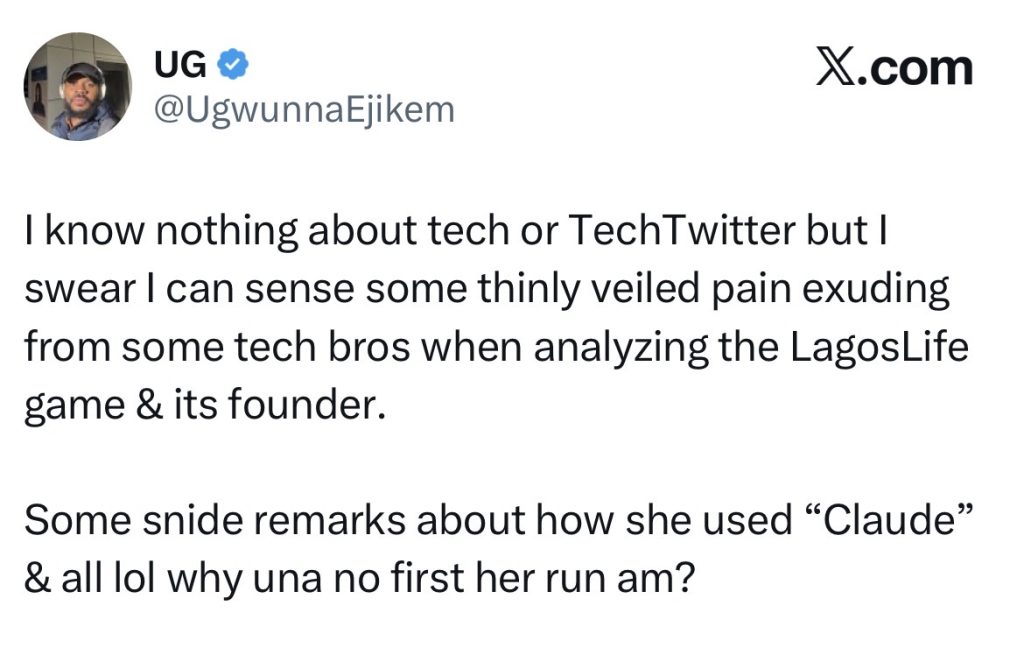

One recurring argument has been that Lagos Life was “vibe coded” with AI.
There is something funny about the way this gets used as an insult.
AI is a tool. Developers use tools. Writers use tools. Designers use tools. Businesses use tools. The existence of a tool does not magically mean the person using it contributed nothing.
If anything, the interesting question should be what someone was able to create with the tools available to them.
Instead, the conversation often becomes, “Well, AI did it.”
As if the AI woke up one morning, decided to build a game about Lagos, figured out what Nigerians would find funny, created the product, launched it, attracted players and then started dealing with the inevitable chaos that comes when thousands of people descend on something you made.
Apparently, the machine did all of that, and the woman just happened to be standing there.


Then there are the people who insist the game is basic. Again, it is perfectly fine to think a game is basic, but there is a funny thing about the word “basic” when it is used to explain away something that is clearly working. A product does not have to be technologically revolutionary to be successful. Sometimes people just want something fun. Sometimes the simplest idea is the one people understand immediately. Sometimes a product does not need to impress developers to entertain the people actually using it, and that last part seems particularly important here.
While some people are busy explaining why Lagos Life isn’t impressive enough, others are playing it. Lots of people. And that should count for something. All of this was just criticism until the $100,000 offer came into play.
Someone offered to buy Lagos Life for $100,000, and the creator’s reaction was almost as interesting as the offer itself.
You’ll Enjoy: We Can’t Talk About Male Privilege Without Talking About Mothers
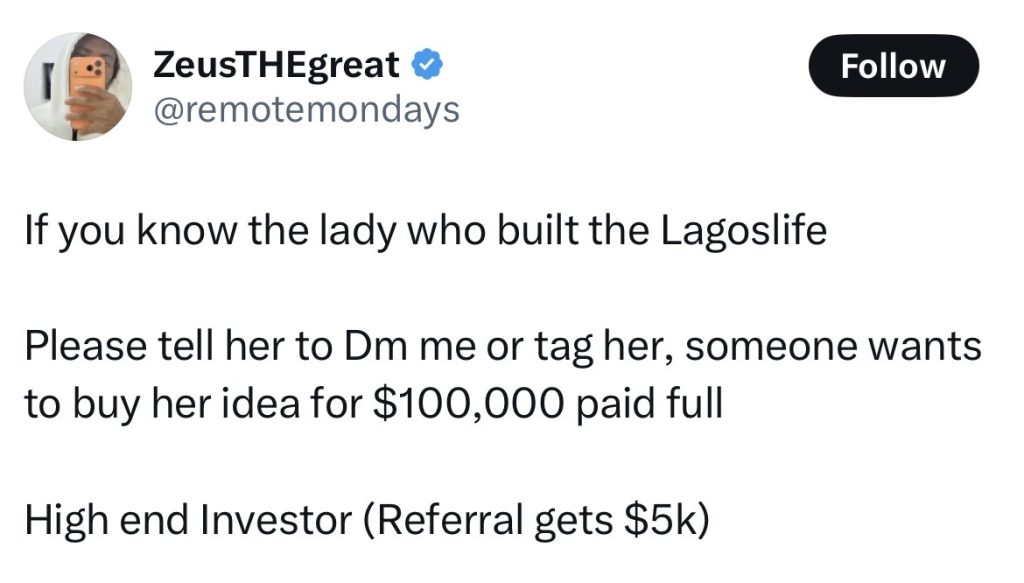


The offer was presented with the kind of condescension that suggested $100,000 should have ended the conversation immediately. As though anyone who had built something successful should be grateful that somebody had finally arrived to tell them what it was worth. But what happens when the person who built it disagrees? What happens when she says, “No. I think this is worth much more”
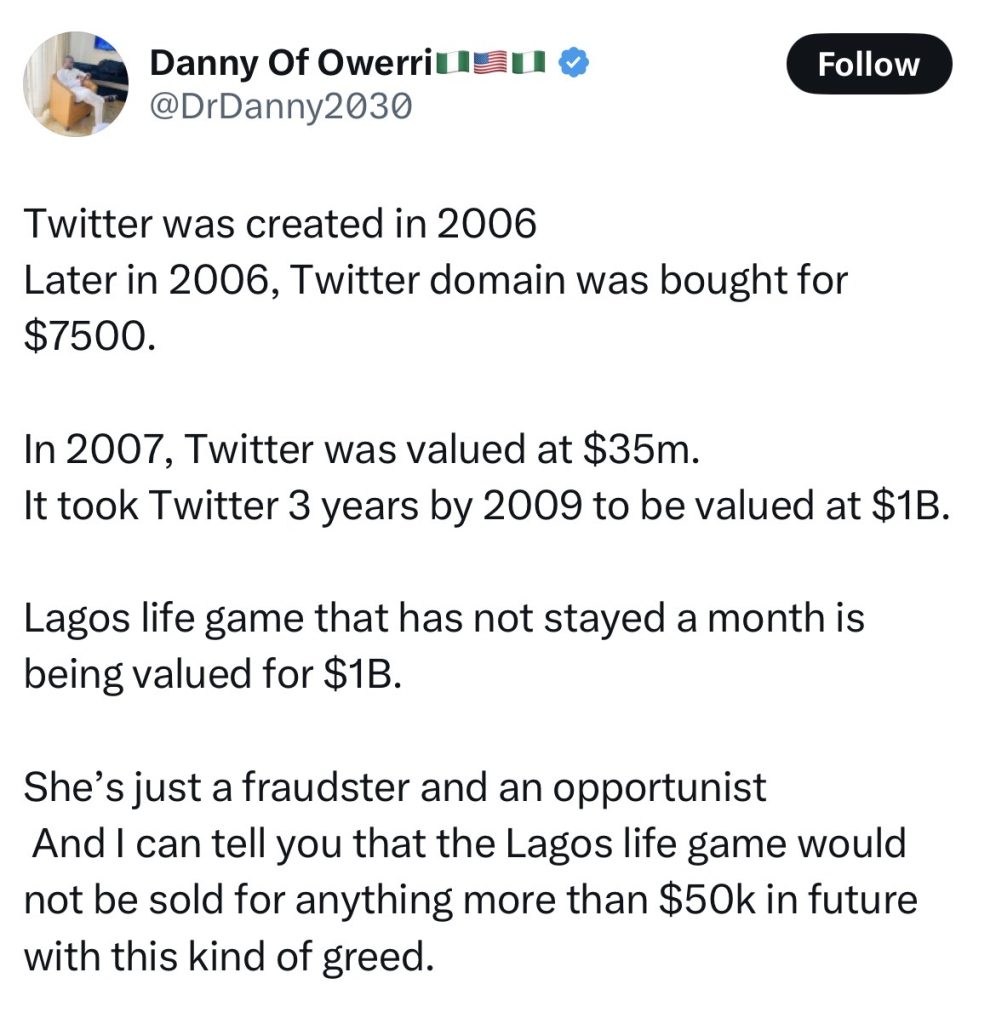
Apparently, that is where things get interesting because Shalom has spoken publicly about valuing Lagos Life at $1 billion.
Now, $1 billion is an enormous valuation. It is also completely fair to question it. Perhaps it is too ambitious. Perhaps the market will eventually prove otherwise. Perhaps there are things about the company’s current numbers that do not justify it. Those are legitimate conversations.
But somewhere along the line, questioning the valuation became calling her a fraud, and that leap says a lot.
Because women are constantly told to know their worth. Negotiate. Ask for more. Stop accepting the first offer. Build something valuable. Take yourself seriously. Then a woman actually does it, and suddenly everyone wants to teach her a lesson in humility.
There is a very specific discomfort that appears when women are confident about the value of their own work. Confidence becomes arrogance. Ambition becomes delusion. Negotiation becomes greed, and being unwilling to accept less than what you believe something is worth becomes evidence that you don’t understand your own business. It is almost as if women are allowed to succeed as long as they remain sufficiently surprised by their own success.
This feels familiar outside tech. Every woman knows what it’s like to do something well and have someone search for the part she couldn’t possibly have done herself.
“She got the job because of someone.” “She got the opportunity because of someone.” “She looks that good because of something.” “She got that far because somebody helped her.”
An invisible person is always credited for a woman’s visible achievement. And yes, women get help. Everybody does. Nobody builds anything completely alone.
However, there is a difference between acknowledging support and refusing to believe that a woman could have been the driving force behind her own success. That is where the Lagos Life conversation becomes bigger than Lagos Life. The issue is not that every criticism of the game is misogynistic. It isn’t. The issue is the pattern.
When the product succeeds, some people immediately reach for luck. When AI is involved, they reach for “she didn’t really build it.” When the product is simple, they reach for “it’s basic.” When someone offers money for it, they decide she should take it. When she says what she thinks it is worth, they reach for “fraud.”
At some point, the question stops being whether the game is good enough. The question becomes why some people seem so committed to finding a reason; the woman behind it cannot simply be good at her job.

Perhaps that is the most uncomfortable part of women succeeding in spaces never designed with them in mind.
It forces everyone watching to confront a possibility they would rather avoid. Maybe there was no shortcut. Maybe there was no mysterious man behind the scenes. Maybe she was not particularly lucky. Maybe she used the tools available to her and made something people wanted. Maybe the game really is that simple.
And maybe, just maybe, a woman built something that worked. There does not always have to be another explanation.
You’ll also love: Virginity Is a Social Construct. So, Why Does It Carry So Much Weight?