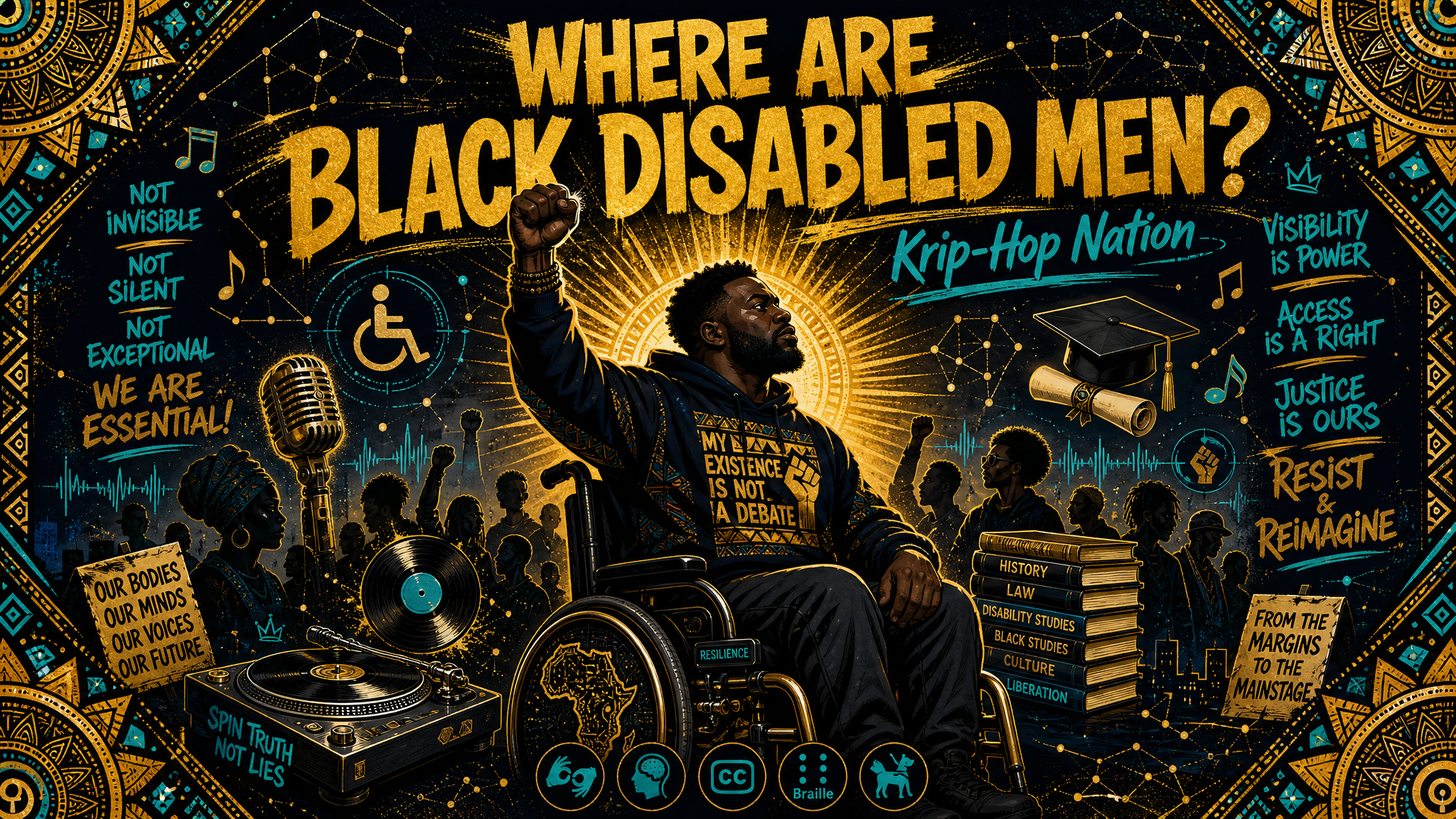
As a Black disabled man in my late fifties, I often look back on my decades of involvement in the disability sector and ask a question that continues to trouble me: Where are Black disabled men? From therapy programs in the 1970s, disability sports in the 1980s, disability rights activism, disability arts, nonprofit leadership, and academic spaces, I have consistently witnessed a serious lack of visible Black disabled men. Even today, after decades of organizing and cultural work, that absence remains.
My journey in disability activism spans more than forty years. In 1998, alongside another Black disabled man, Gary N. Gray, I helped start a nonprofit organization, DAMO. In 2002, I founded Krip-Hop Nation and intentionally brought Black disabled men into leadership as co-founders and artists. In 2005, I helped co-found Sins Invalid with the late Patty Berne, and I worked to bring many Black disabled and Deaf men into that movement. Sins Invalid would later help inspire what became known as Disability Justice. Despite these efforts, I continued to notice how few Black disabled men were publicly engaged, politically active, or openly discussing disability as part of their identities.
This reality led me to organize a gathering of Black disabled men in my Section 8 apartment in Berkeley, California, in 2018. For me, that gathering was historic. It was the first time I had witnessed Black disabled men openly discussing our experiences, our struggles, our identities, and our dreams in a collective space. The conversations were honest, vulnerable, and necessary. That gathering helped inspire Black Disabled Men Talk, which formally emerged in 2019 and was revived again in 2025. These spaces were created because too often Black disabled men are invisible not only within mainstream society but also within Black communities and disability communities.
As a Ph.D. student at UCLA in 2026, I continue to witness this absence. I rarely encounter Black male graduate students with visible disabilities. This reality reminds me of a radio series I produced before beginning my doctoral studies called Disabled & Black/Brown With/Striving Ph.D. Doctor. The series featured five Black and Brown disabled scholars, two of whom had already earned their doctorates while three were still pursuing them. Today, several of those participants, including Lateef McLeod and other Black disabled men, have earned their Ph.D.s. Their accomplishments demonstrate that Black disabled men belong in higher education, yet our representation remains limited.
What makes this absence particularly complex is that many Black men with disabilities do not identify disability as a political identity. Throughout my life, I have met Black radicals, artists, activists, nonprofit leaders, and community organizers who have disabilities but rarely discuss disability publicly. In many cases, disability remains hidden, unspoken, or disconnected from their political analysis. Social media has made this even easier. People can carefully curate their images and stories, masking disability or minimizing its significance. At the same time, many of the most visible disability advocates and content creators online are women with disabilities, especially Black women with disabilities. Their leadership is vital and should be celebrated. Yet the lack of Black disabled male voices remains striking.
This invisibility also extends to public conversations about racial justice and police violence. During the 2020 police brutality uprisings, many cases that fueled public outrage involved Black disabled men. Yet the disability dimension of those stories often disappeared from public discourse. We can trace this pattern back even further. Rodney King, for example, reportedly had a learning disability before his brutal beating by police and later experienced physical and mental health disabilities as a result of that violence. Yet disability was largely absent from discussions surrounding his case. The experiences of Black disabled men continue to be overlooked even when they stand at the center of major social movements.
The consequences of this invisibility are profound. Black disabled boys often grow up without seeing themselves reflected in media, education, activism, or leadership. They rarely encounter role models who openly embrace both Blackness and disability. Too many grow up believing they must choose one identity over the other or hide parts of themselves to survive. Too many internalize society’s messages that disability diminishes masculinity, sexuality, intelligence, leadership, or worth.
For decades, my poetry, music, activism, and scholarship have challenged those assumptions. One example is the song “The Strength of a Man,” a collaboration between myself and the late Rob Da’ Noize Temple. Originally developed through the Men’s Story Project, the song explored the realities of Black disabled masculinity in a society that often defines manhood through narrow standards of physical strength, independence, and bodily perfection. Together, we challenged stereotypes that portray disabled men as weak, undesirable, or less masculine. We argued that true strength comes not from conforming to society’s expectations but from surviving, resisting, loving, creating, and affirming oneself despite those expectations.
Rob Da’ Noize Temple spoke powerfully about how disability complicated society’s understanding of his masculinity. As a musician, martial artist, husband, and artist, he constantly encountered assumptions that disability made him less of a man. Yet he refused those definitions. His story reflected a larger truth shared by many Black disabled men: our bodies are often judged before our humanity is recognized. Society measures us against standards we did not create and then questions our worth when we do not fit them.
My own poem, “Man-to-Man Talk,” extends that conversation. It traces my journey from birth through experiences of racism, ableism, isolation, sexuality, family, and self-acceptance. The poem asks difficult questions about Black masculinity, disability, relationships, fatherhood, and belonging. It confronts the reality that many Black disabled men feel caught between communities that do not fully recognize them. Yet it also celebrates survival and self-love. It declares that Black is beautiful, disability is gorgeous, and that our bodies deserve visibility, desire, and respect.
As I approach the final year of my Ph.D. program, I remain committed to creating spaces where Black disabled men can see themselves reflected and valued. But commitment alone is not enough. Universities must fund recruitment initiatives, scholarships, disability-inclusive Black Studies and Black Male Studies curricula, and measurable retention goals for Black disabled students and scholars. Disability organizations must create paid leadership pathways, place Black disabled men in decision-making roles, and publicly track representation. Foundations, media outlets, and cultural institutions must invest in Black disabled-led research, archives, arts, and community programs. These are essential structural changes, not symbolic gestures.
The next generation cannot wait. Black disabled boys deserve to see themselves in classrooms, on campuses, in media, on conference stages, and in positions of leadership. Families, schools, faith communities, grassroots organizations, and policymakers must move beyond rhetoric and act now to remove barriers, expand opportunity, and elevate Black disabled voices. We are here. The challenge is not finding Black disabled men, it is, making us visible and transforming the structures that have kept us unseen for far too long.
Here we end with the song lyrics that Rob Da Noize and I wrote:
The Strength of a Man
The strength of a man
is not measured by muscle or might,
but by how he rises
through the longest night.
The strength of a man
is not found in perfection or pride,
but in the courage to live truthfully
with nothing to hide.
The strength of a man
is in surviving what others cannot see,
holding on to dignity,
claiming the right to be free.
The strength of a man
is in love, resistance, and grace,
in honoring every scar
and every part of his place.
The strength of a man
is Black, disabled, bold, and strong,
a voice once silenced
now singing its own song.
The strength of a man
is the power to stand and proclaim:
I am worthy, I am visible,
and I will never be ashamed.


 Black News