The Power of the Leaf: Inside Birmingham’s Growing Black Cigar Culture Scene
First of Three Parts By Mia Watkins | For the Birmingham Times Imagine making a business deal or connection. Most would picture a boardroom or maybe a golf course. Most wouldn’t see a smoky lounge filled with men and women taking their time and taking a load off with their favorite cigar. That’s exactly where […]
 Black News

First of Three Parts
By Mia Watkins | For the Birmingham Times
Imagine making a business deal or connection. Most would picture a boardroom or maybe a golf course. Most wouldn’t see a smoky lounge filled with men and women taking their time and taking a load off with their favorite cigar. That’s exactly where businesses are built, friendships are formed and people gather to give back in Birmingham.
“I think, more so, it’s become the country club of the indoors,” Cigar Men of Distinction Co-founder and President Kevin Johnson said. “You can find yourself in a place where you can have a wonderful conversation in a safe place with like-minded people. It’s become more accessible, and people started realizing that this is a great place for me to network, synergize and strategize. I can’t count how many business contacts I’ve made in the cigar lounge. We call it the power of the leaf. Sometimes, it’s meeting the kid that you’re giving a job or an internship to or hiring somebody to do drywall in your house. There are all types of opportunities there.”
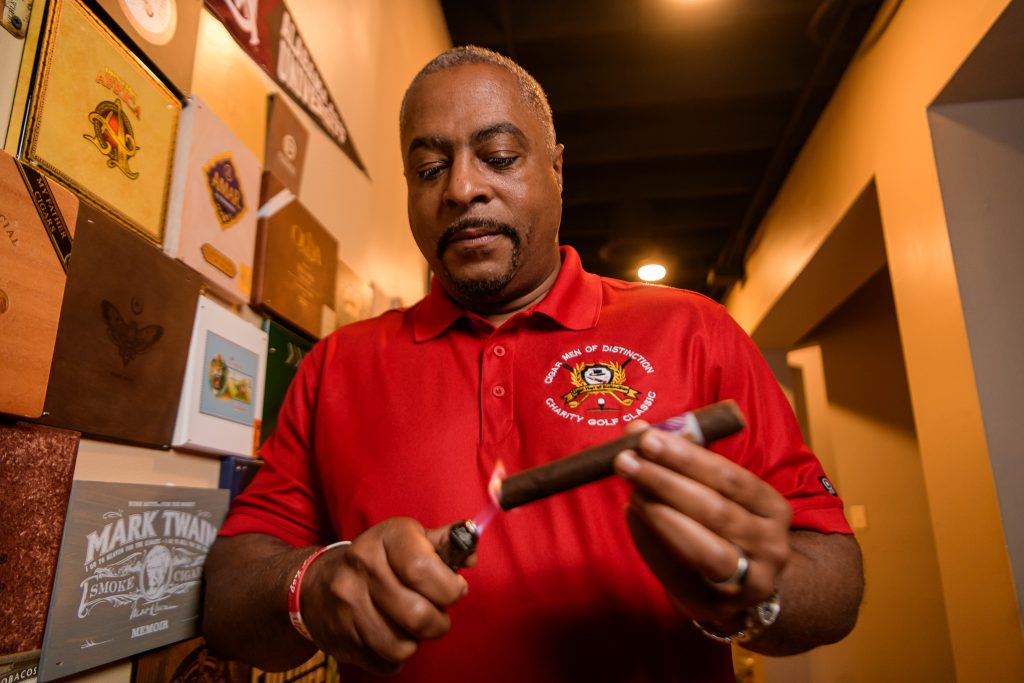
Cigars, often seen as a sign of wealth, have a place in Black culture. From the enslaved people who toiled in backbreaking conditions to harvest tobacco on plantations to hip hop artists such as Jay-Z, who’s rapped about good sticks several times, including lyrics such as, “Welcome to Havana, smoking cubanos with Castro in cabanas” or “Carter, rap harder like I’m part of a cult like Cuban cigar maker ‘cept I’m harder to smoke.” Even southern rapper Rick Ross named one of his songs “Cigar Music.”
Cigars reach just about every facet of Black culture. Luminaries of Black thought, such as W.E.B. Du Bois and Booker T. Washington, and iconic musicians Louis Armstrong and Duke Ellington were frequent smokers.
In Birmingham, Johnson describes the scene as diverse in ages, races and professions. The average smoker could range anywhere from their early 20s to their late 60s. But, in all, it’s a scene that’s hard to pin down. He describes it as built on connection. Cigar smoking allows people to slow down and, in that, get to know fellow smokers.
“When I sit around you, and I’ve been around you for two or three hours enjoying a cigar and conversation, possibly even having a libation, that’s a significant amount of time to sit conversing with someone,” Johnson said. “I’m going to remember what you said. You have to be your real self; you can’t be someone else for two or three hours. I think it makes people see you really quickly. You’re able to develop real relationships.”
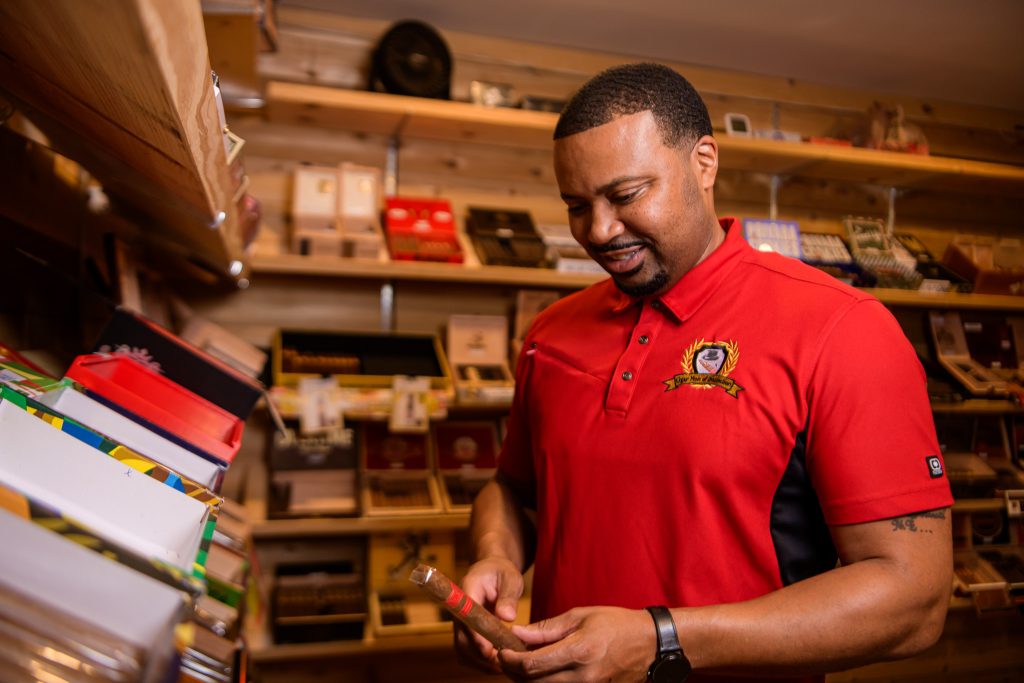
More Than a Puff: The Making of Cigar Men of Distinction
The Cigar Men of Distinction (CMOD) was founded in April 2015 by Johnson, Vice President Courtney King, and others who were brought together by a love of the tobacco leaf and a love of philanthropy. Currently, the organization has around 95 members, spanning three chapters: Birmingham, Atlanta and Indianapolis.
“The founders of the organization, we would get together and we would smoke cigars together and we would go to different cities and enjoy different lounges,” he said. “One of our founders asked, ‘Hey, we’re doing these trips. I like this. Man, let’s go ahead and do this thing. What do you guys think about helping people along the way?’ We liked it. It was a way of giving back. It started off with six, and it just kind of grew.”
Locally, they are an official partner for the Magic City Classic Kickoff Party, an event that serves as a scholarship event for students at Alabama State and Alabama A&M Universities. Last year, the organization awarded around six scholarships to Birmingham students.
CMOD also hosts signature events, including Shop Talk, an event that provides grooming for young men headed back to school, and Party with a Purpose, an all-white party. All of these events have a philanthropic arm, according to Johnson.
Another deeply personal event for members is Golf for Autism, where members raise awareness and partner with organizations that offer autism and behavioral health services, such as Glenwood and Mitchell’s Place.
“One thing that we were able to identify internally was that each one of us was three steps away from being impacted by autism with people that we know, work with, or socialize with, “King said. “First, the point of it was awareness, but this year it’s unique because it’s really changing from awareness to acceptance. Our focus is being able to show support and love.”
CMOD also sponsors holiday dinners for families in the area. Each year, the organization provides the number of meals equal to the years that it’s been in existence. This year, CMOD plans on sponsoring 11 meals.
“We have so many different strengths in our members, to where this person may have resources to help a young kid in this area, this person may have resources in this area,” Johnson said of the organization’s philanthropic efforts. “We can come together collectively, and what I can do by myself, the impact would probably be minute, versus when I add all the others, it becomes grand. Our members leave with a sense of purpose. When they actually wear their shirt, they can honestly say we don’t just blow smoke.”
Membership in CMOD is a rigorous process that takes anywhere from nine months to a year and a half to complete, according to Johnson and King. The organization doesn’t actively recruit, but interested members must have the stamp of an internal sponsor. Prospective members are required to attend a certain number of CMOD events. Every member must adhere to the group’s code of conduct and pass a background check.
“We’re actually watching to see if you’re just coming to our parties or if you’re coming to roll up your sleeves and help these kids on a Saturday morning,” Johnson said. “Are you willing to do that? Are you willing to carry those bags of charcoal to events and help us out? There’s an expectation that you’re going to start helping the community before you even think about getting into this organization. You probably won’t make it if you don’t have any sweat equity on it.”
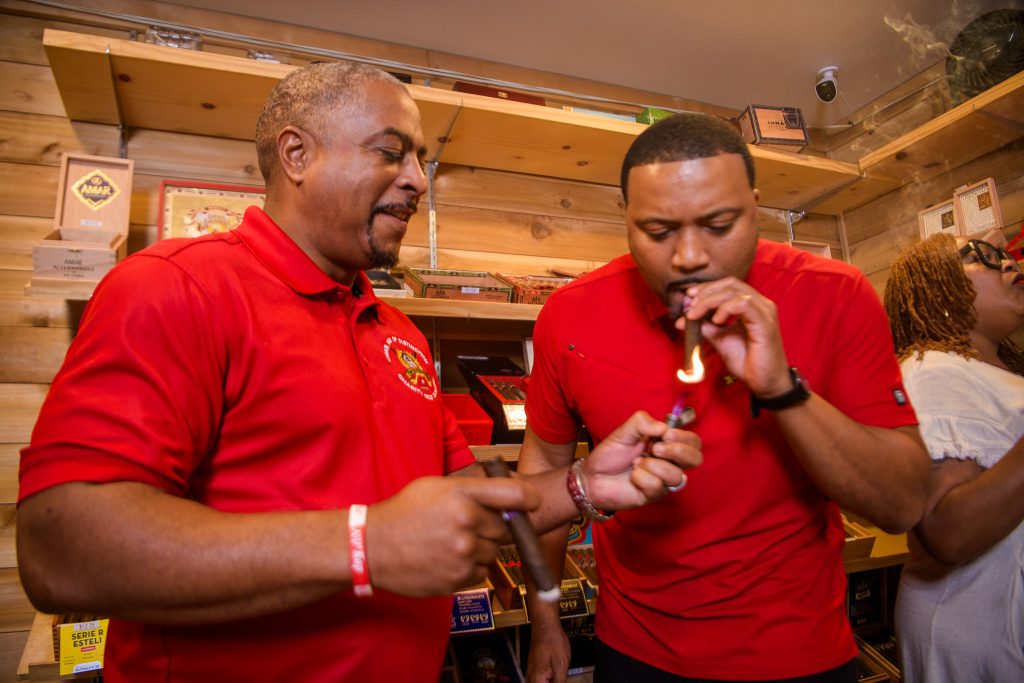
A Reward for an Honest Day’s Work
Both Johnson and King say they’ve seen growth in the cigar scene in Birmingham in the past few years.
“I’ve been in Birmingham for 13 years, and I can tell you, Courtney and I would go into some of the shops, and it would be just us,” Johnson said. “I can see the demographic change drastically.”
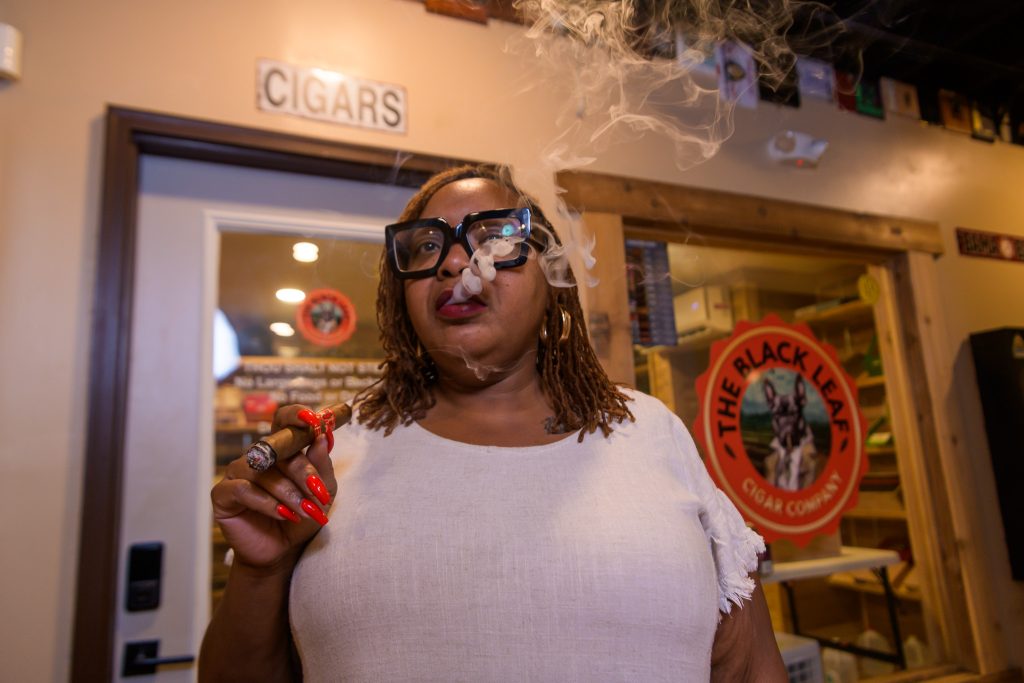
One of those changes is the opening of The Black Leaf Cigar Company on the city’s west side by CMOD member and cigar aficionado James Spencer.
Spencer began smoking premium, hand-rolled cigars at an Alabama A&M fraternity gathering in 1990. After discovering that he liked them, he and his cigars became a fixture around campus. He said smoking taught him about individuality.
“All of this wasn’t popular,” he said of cigar smoking in the 1990s. “I was at Alabama A&M walking around with a cigar hanging out of my mouth, girls telling me that I stink. But it’s what I enjoyed. I learned to be unapologetically me.”
He grew up around his grandfather, who also smoked.
“A cigar for me is a reward for an honest day’s work for an honest man,” he said.
Spencer, who is also a pastor, said that cigars are a part of his spiritual practice, citing Victorian-age preacher Charles Haddon Spurgeon’s famous quote, “I intend to go home tonight and smoke a cigar to the glory of God.”
“First thing I do in the morning when I wake up, I grab my Bible, I go out in my shed in my backyard, and I commiserate with God with a premium hand-rolled cigar,” he said.
After retiring from the military, Spencer was looking for the next chapter in his life. Two years ago, Black Leaf’s doors opened in an unassuming building that used to be a hair salon next to the 3rd Avenue Package Store on the main corridor on Birmingham’s west side. He chose the name to honor his grandfather and the Black people who came before him and toiled the land.
“Black Leaf is the hands that picked the tobacco — Black hands, dark hands,” he said. “If you look at most of the cigars, they are rolled by ‘hecho a mano.’ Made by hand.”
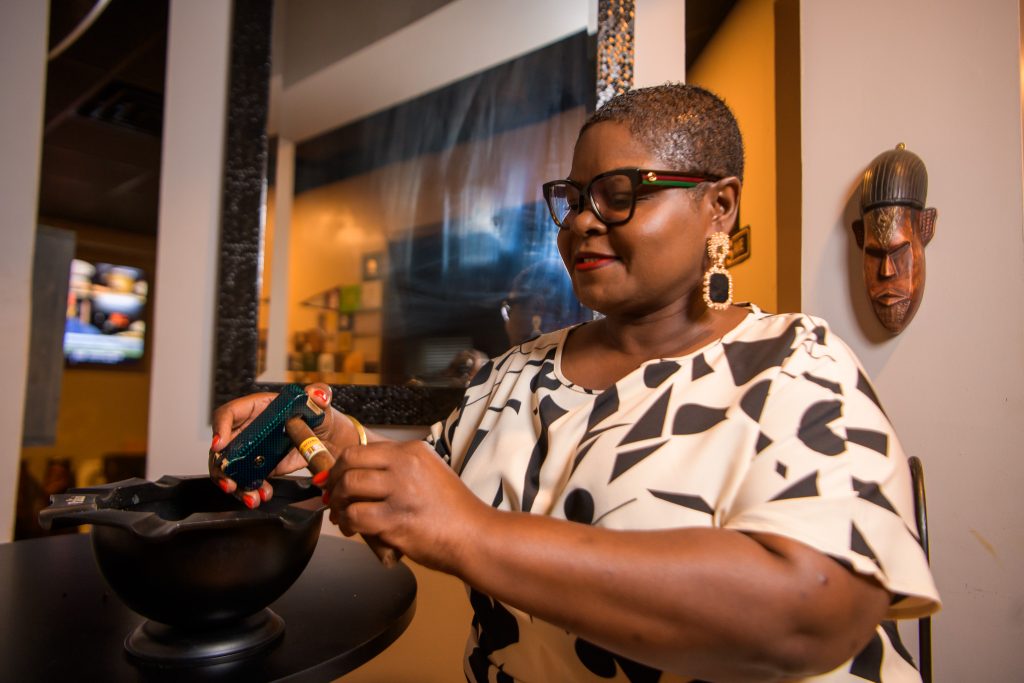
Black Hands, Black Leaf: A Cigar Company Built on Legacy
After ascending the ramp to get in, visitors enter a cigar lounge that feels like a family reunion. To the left, there’s a large, walk-in, specialty humidor made of western red cedar that is insulated with foam and R-40 and R-13 insulation and moisture-resistant sheetrock. There’s also a mini-split HVAC unit, all serving to preserve the products.
“It’s set at 70 degrees so that tobacco beetles don’t hatch,” Spencer said.
The rest of the space is filled with chairs, leather couches, and other places to sit, surrounding either a TV or a set up facing each other for conversation.
To stick to more of a traditional cigar lounge feel, Spencer doesn’t serve liquor at Black Leaf or hire music entertainment. He makes a point to describe the difference between what he calls smokers’ smokers and those who casually indulge for the aesthetics, which is why he calls the Birmingham cigar scene “fickle and deceptive.”
“People want to be seen smoking cigars,” Spencer said. “They’ll dress up in their finest, and they’ll go out and take a lot of selfies. But what I find is that most of those people don’t really like cigars. If you ask them how often they smoke a cigar, they’re only going to tell you once a month or once every two or three months.”
Spencer points out that he chose to buy a building in what he calls a “cigar desert” because he wants Black smokers to have a place where they can purchase fine cigars without leaving their own community or being discriminated against.
“I wanted to make sure that my people had the opportunity to be able to purchase a hand-rolled cigar without having to drive into a neighborhood where they’re unwanted and might be profiled,” he said. “The second reason is not going into cigar shops where folks might not want you in there because of the color of your skin.”
Black Leaf caters to its members who are often looking for a place to unwind after work. The lounge primarily sells boutique brands and offers a more pared-down experience, something that was intentional, according to Spencer.
“Down south, cigar lounges are normally in older homes that you walk into that have a rustic appeal,” he said. “It’s a clean place, but it’s not pristine clean. There might be a little dust, there might be an old ashtray that’s got a little ash in it. It’s got a unique smell to it. It’s got a unique look to it. Browns, tans, golds. It’s decorated with affluent things, college allegiances, American flag, retired military trinkets around the place, TVs so current events can be watched.”
Cigar aficionado and Black Leaf member Kristy W. Stewart calls the atmosphere therapeutic.
“Just today, I had a long day,” she said. “I came in, and when I tell you I feel so much better, I was able to release and let go. We hugged, we laughed. It just allows me to relax, relate and release.”
While Black Leaf might be a healing environment, every cigar lounge in the city has its own vibe.
“Every lounge has something different and unique,” Stewart said. “How you’re feeling depends on what you’re looking for that day. If I want upbeat, party type, I know where to go. If I want to chill, be laid back, or if I want to go and sit and talk, I know where to go. It’s all love.”
Tailored Smoke: A Sleek Take to the Lounge
Across town in the Colonnade and tucked in among restaurants and other businesses is Tailored Smoke. When it opened in January of 2026, it marked the beginning of franchising of the original location in Charlotte, North Carolina.
“I saw the growth in cigars,” investor and co-owner Jonathan Hackett said of why he wanted to franchise in the city. “I saw how people were going to cigar lounges and how people were actually conversating. You meet new people at cigar lounges, so we felt like this culture, Birmingham, needed something different.”
The experience relies on a sleeker atmosphere than a traditional lounge, complete with a marble bar and plenty of leather seating sectioned off into conversation pods. Outside, there is a sizable patio area.
Tailored Smoke is open to the public, but it has corporate and VIP cigar locker membership tiers that feature free cigars, after-hours access and discounts on drinks and sticks. The customer experience is the same, regardless of membership status.
“Our customer service is number one, that’s point blank,” he said. “When the customers come in, we’ll say, ‘Welcome to Tailored Smoke.’ We’ll ask what you’re smoking today. For example, if they say Perdomo, even though we don’t sell those, we’ll find a cigar similar to that.”
Throughout the entire process, there’s a person called a cigar tender guiding the customer through their selection and asking questions about what they like. Every 15 or so minutes, the tender empties out ashtrays and makes sure the customers are enjoying themselves.
“Our cigars are behind the bar, so the customers do not go behind the bar,” Hackett said of the process. “There’s a cigar tender to pick the cigar and hand it to the customer. We’ll ask if that’s all they want, or if they want a beverage from the actual bar. Now, we’re reaching out to customers and still having that one-on-one conversation. Then, we’ll ask how they want their cigar cut. We’ll go ahead and cut the cigar, and we’ll light it. At this point in time, they’re enjoying their cigar, drink and having a conversation with someone that’s already there.
Tailored Smoke hosts a happy hour, ladies’ nights and other nights that feature DJs and live music. Most of the customer base is over the age of 35, but Hackett said the team is working to appeal to younger smokers.
“There’s not really anybody below 30 smoking cigars,” he said. “That percentage is very, very low, like maybe 10% of that age group that smokes.”
That low rate reflects a niche market overall. Only 2.6% of 18- to 24-year-olds surveyed by the National Health Interview Survey reported smoking cigars. The number rises to 4.9 % in the 25-44 age group. Only about 5.8% of Black respondents reported smoking cigars. And only 18.8% of adults surveyed reported the use of one tobacco product.
Despite being a small group, Hackett sees the cigar scene in Birmingham growing at a slow but steady pace. Cigar lounges offer a change of scenery from typical nightlife.
“A lot of people don’t like to go to clubs; they may go to a lounge, but they’re trying to have a good conversation, somewhere where they can relax,” he said.
In the next five or so years, Hackett sees the scene exploding.
“It’ll be blowing out the water,” he said. “It would probably have taken off and gotten where it needs to go.”
Visit cigarmenofdistinction.com/birmingham or follow on Instagram @cigarmenofdistinction for more information.