
Hafrik: From African Community Networks to a Video Game about Life in China
One of the more interesting developments in the digital lives of Africans in China is the emergence of Hafrik, aContinue Reading
 Black News
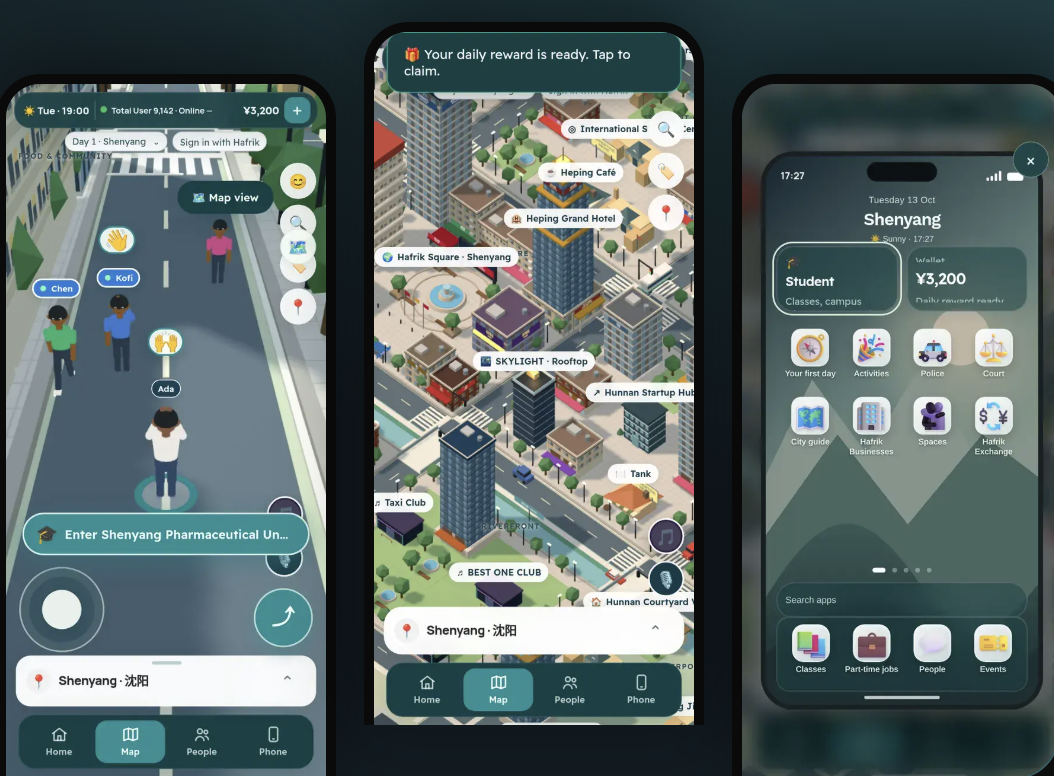
One of the more interesting developments in the digital lives of Africans in China is the emergence of Hafrik, a platform specifically designed for Africans living, studying and doing business in the country. Released as an iPhone app in May 2026 and regularly updated since then, Hafrik brings together social networking, commercial services, community discussions and practical information about life in China. Somewhat unexpectedly, it has also developed a video game in which users can simulate the experience of moving to China and building a life there.
For those of us who have been following African mobility to China since the late 2000s, the emergence of such a platform is particularly interesting. Much of the early research on Africans in Guangzhou documented the ways in which migrants developed their own social and commercial infrastructures, often under relatively precarious conditions. Restaurants, churches, trading companies, shipping agencies, community associations and entertainment venues were not simply places where Africans gathered; they were also important sites for the circulation of information, the establishment of trust and the development of a sense of belonging.
Over the years, much of this activity has acquired a digital dimension, particularly through WeChat. Hafrik appears to be an attempt to reorganise some of these dispersed networks into a more integrated infrastructure specifically catering to African communities.
From WeChat groups to a dedicated platform
The problem identified by Hafrik’s developers will be familiar to anyone who has spent time in migrant community groups. Useful information about accommodation, visas, suppliers, shipping agents and employment opportunities circulates across numerous chats, where it can be difficult to retrieve or verify. Newcomers often find themselves asking questions that others have already answered countless times.
Hafrik proposes to address this through dedicated discussion spaces organised around cities, universities, commercial activities and shared interests. Alongside these community functions, it advertises business listings, a marketplace, currency exchange and supplier payment services. Its official website suggests that the developers eventually envisage adapting this model to other diasporic communities beyond China.
According to its developers, Hafrik has been optimised for Chinese internet infrastructure and can be accessed from mainland China without a VPN. This is an important consideration for a platform seeking to establish itself as part of the everyday digital infrastructure of African communities in China. Whether Hafrik will attract enough users to become a viable alternative or complement to WeChat remains to be seen. Nevertheless, the attempt itself is interesting because it points towards the possibility of Africans in China developing digital infrastructures over which they might exercise greater control, rather than relying exclusively on platforms developed for other populations and purposes.
There is, of course, a commercial dimension to this. The knowledge and relationships accumulated through years of African migration to China constitute a potentially valuable resource. How this knowledge is organised, who controls it, and who benefits financially from its circulation are questions worth keeping in mind as the platform develops.

Playing at migration: ChinaLife
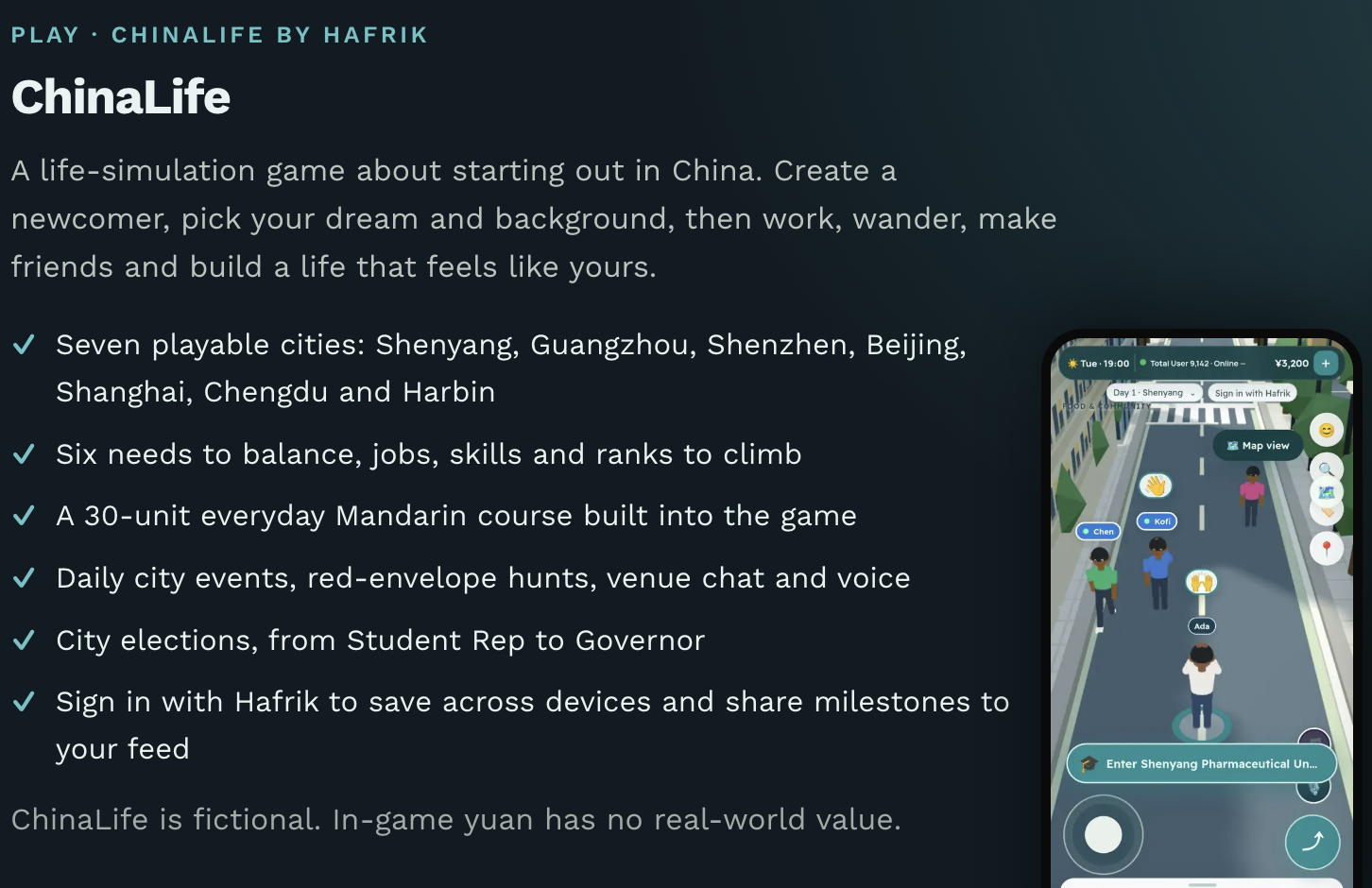
Perhaps the most curious aspect of Hafrik is ChinaLife, a life-simulation game incorporated into the mobile app in October 2026.
According to the developers, players can create a character arriving in China, select their background and aspirations, and gradually establish themselves in one of seven cities: Guangzhou, Shenzhen, Beijing, Shanghai, Chengdu, Shenyang or Harbin. The game incorporates employment, language learning, social relationships and various forms of personal advancement. There is even a Mandarin course embedded within the game.
What is particularly interesting here is the possibility of exploring migration to China through a digital simulation. We have written extensively on this website about how Africans document and represent their experiences in China through social media, but ChinaLife potentially takes this a step further by allowing prospective migrants to imagine themselves living in the country before they actually arrive.
It would be fascinating to examine the assumptions about migration, social mobility and belonging embedded in the game’s design. What constitutes a successful life in China? How much depends on individual effort, entrepreneurial ability and language acquisition? And to what extent does the game incorporate the less predictable aspects of migrant life, including immigration restrictions, racialisation and the difficulties of establishing longer-term residence?
These are not necessarily criticisms of ChinaLife — it is, after all, a game — but the choices made by its developers could tell us something about how China is being imagined as a destination for African mobility.
A development worth following
One of the limitations of much of the public discussion about Africans in China is that Africans continue to be represented primarily as traders, students, migrants or, when the media is in a particularly sensationalist mood, as a demographic problem. Considerably less attention is paid to their activities as producers of technology, knowledge and digital culture.
Hafrik offers an opportunity to think about African presence in China from this rather different perspective. Whether or not the platform becomes commercially successful, its development raises interesting questions about the changing forms of African entrepreneurship, community-building and place-making in Chinese cities.
We would be particularly interested in hearing from Hafrik’s developers about the origins of the project, their experiences building the platform and, of course, what inspired them to create a video game about life in China.
Explore:
Related research from our archive: