From Refugee Camp to Nobel Prize: The Chemist Turning Desert Air Into Drinking Water????
Some inventions start in a lab. This 1️⃣is based on a childhood memory. Growing up in a refugee community in Jordan???????? ,Omar Yaghi lived in a????with no running????& no electricity. He shared close quarters with his family of????, & remembers the neighborhood word spreading that the????truck had finally arrived — a signal that sent everyone […]
 Black News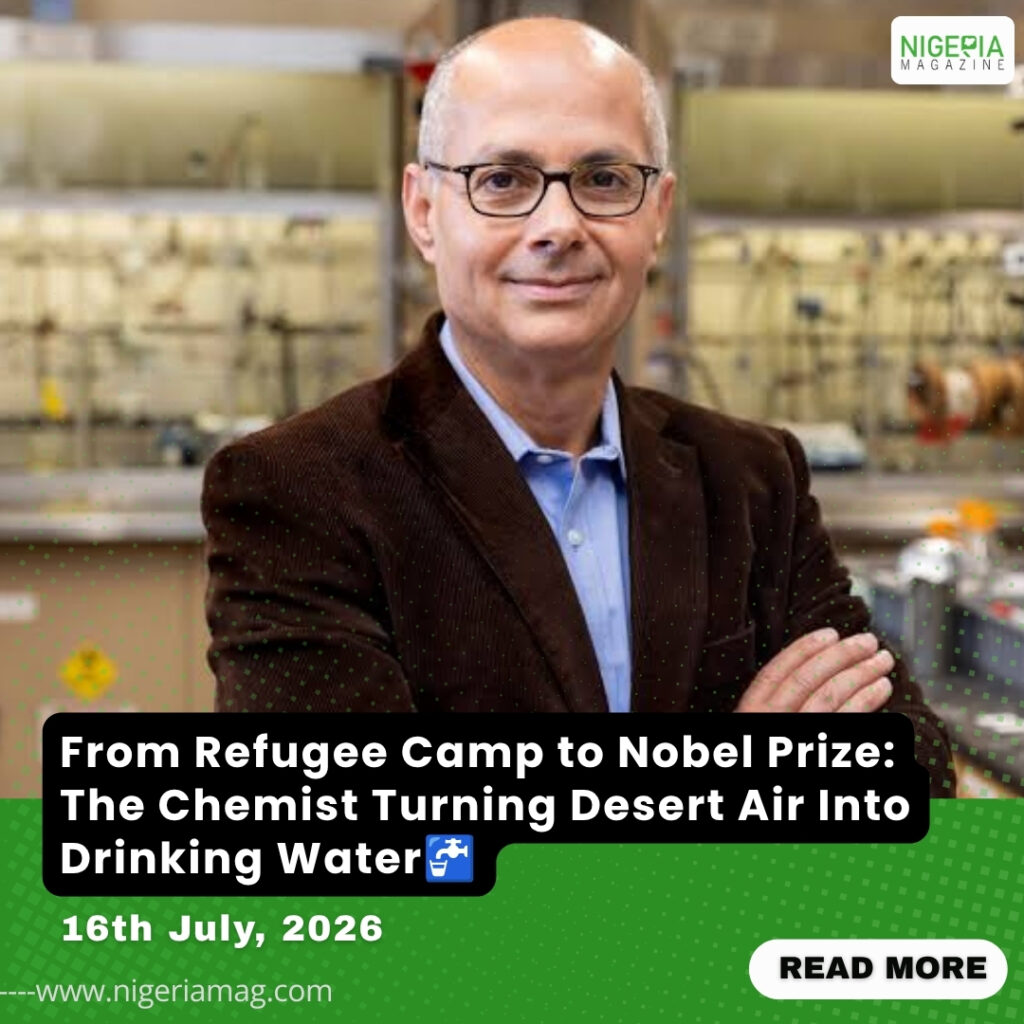
Some inventions start in a lab. This 1⃣is based on a childhood memory.
Growing up in a refugee community in Jordan ,
,
Omar Yaghi lived in a with no running
 & no electricity. He shared close quarters with his family of
 , & remembers the neighborhood word spreading that thetruck had finally arrived — a signal that sent everyone rushing to fill whatever containers they had before the supply ran out.
Decades later, that memory is the engine behind one of the most promising climate technologies of our .
.
The Science: PullingFrom Thin Air
OmarYaghi now a chemistry professor at University of California, Berkeley, is the behind #metalorganicframeworks (#MOFs) — ultra-porous crystalline materials so riddled with microscopic pockets that a single gram can contain the surface area of a football field. Those pores can be engineered to grab hold of specific molecules out of the air, includingvapor.
The device his team built, developed through his company Atoco, works almost like a passive machine: it capturesmolecules from the air overnight, then uses nothing but ambient sunlight during the day to release that moisture & condense it into clean, drinkable. No power grid. No Just the
 & the air.
It’s already been field-tested in Death Valley, one of the hottest & driest places in North America, & it kept performing even in conditions below 20% humidity — air so dry it would seem to have nothing to give. Reports on the technology put its output at up to roughly 1,000 litres (about 270 gallons) of cleanper day.
Recognition on the Biggest Stage
In 2025, Yaghi was awarded the #NobelPrize in Chemistry, sharing it with Richard Robson &
Susumu Kitagawa, for the development of MOFs — work the Nobel committee recognized for its ability to harvestfrom desert air, capture carbon dioxide, & store gases.
Why It Matters
Nearly a third of thepopulation already lives in -stressed regions, & the United Nations projects that by 2050, close to 5 billion people could facestress for significant parts of the year. Yaghi’s technology offers something desalination & long-distance pipelines can’t:production at thelevel, independent of fragile centralised systems, & useful for everything from drought-stricken communities to cut off after hurricanes.
Yaghi calls his vision “personalised” — a future where acan produce its own the same way solar panels let it produce its own
 .
.
The Takeaway
This isn’t fiction. It’s
 , sunlight, & a childhood spent waiting for atruck — turned into a machine that might help solve one of humanity’s oldest problems.
“The science is here,” Yaghi has said. “What we need now is the courage to scale these solutions.”