‘Few Who Flew’: New Art Exhibit Honors Freedom Riders who Desegregated Montgomery Airport
By Shauna Stuart | For the Birmingham Times A new public art exhibit at the Montgomery Regional Airport honors the group of civil rights activists who launched a campaign to desegregate the airport in the 1960s. A set of colorful panels located in the airport’s terminal honors the legacy of the “Few Who Flew” — […]
 Black News


By Shauna Stuart | For the Birmingham Times
A new public art exhibit at the Montgomery Regional Airport honors the group of civil rights activists who launched a campaign to desegregate the airport in the 1960s.
A set of colorful panels located in the airport’s terminal honors the legacy of the “Few Who Flew” — a group of Freedom Riders who fought to desegregate air travel and airports in Montgomery, Alabama, and Jackson, Mississippi, in 1961.
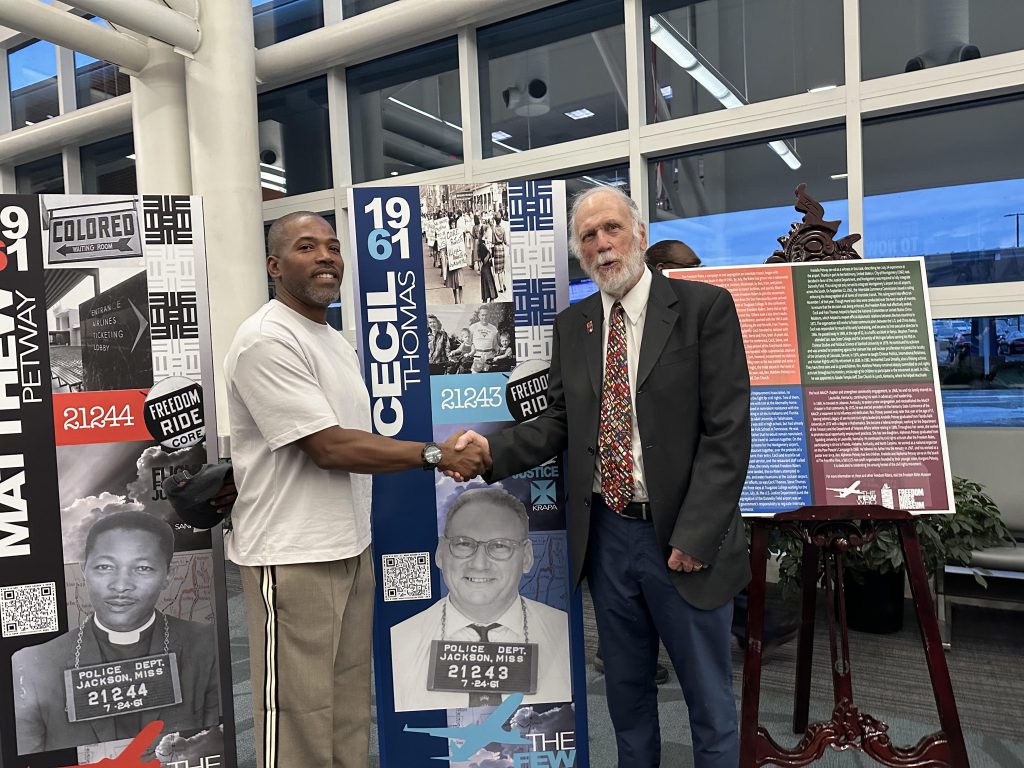
Organizers commissioned Birmingham-based artist Milton Madison to design the exhibit. For the project, Madison designed the panels featuring a black-and-white mugshot of Rev. Matthew Petway, Kredelle Petway, Alphonso Petway, and Cecil Thomas — Freedom Riders who were arrested and jailed after attempting to enter airport restaurants, waiting areas, and restrooms in Montgomery and Jackson.
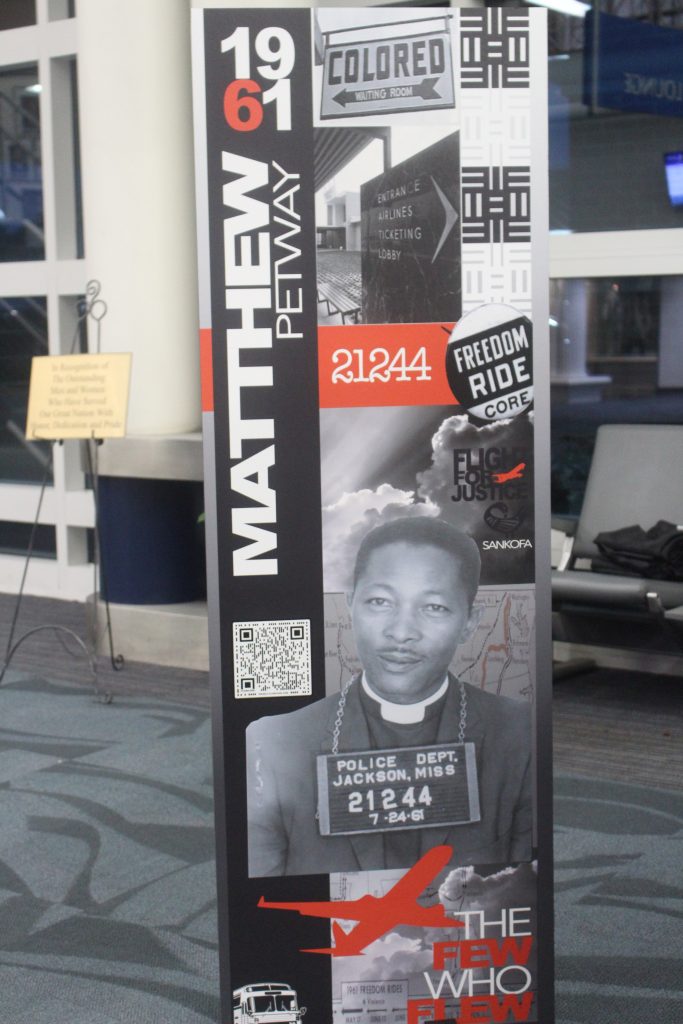
Madison combined the mugshots with black-and-white photographs of protests and segregated areas in the Jim Crow South and lined the borders of the panels with color. Each panel has a QR code that viewers can scan with their phones to read a three-page history of the “Few Who Flew,” compiled by the Freedom Rides Museum and Alabama Historical Commission.
Madison, whose work includes the vibrant sidewalk mural in front of the Freedom Rides Museum in Montgomery, said he wanted to incorporate modern design to showcase the activists’ courageously defiant mugshots from the movement.
“We wanted to make sure the legacy of what they did held true and transitioned to make an impact for the next generation,” Madison told The Birmingham Times. “The design was supposed to be bold, it was supposed to be bright. Because a lot of times we get lost in the black-and-white images that make it seem like it was so long ago.”
The airport, in partnership with the Friends of the Freedom Rides Museum, unveiled the exhibition on July 24, marking 65 years to the day that the activists entered the segregated restaurant of the Montgomery airport — then known as Dannelly Field–before boarding their flight to Jackson.
The event — part of the yearlong commemoration of the 65th anniversary of the Freedom Rides — featured remarks from historians, politicians, community members, and the family of freedom riders to honor the legacy of the “Few Who Flew.”
“This is long overdue,” Dr. Valda Harris Montgomery, the President of the Friends of the Freedom Rides Museum, told attendees. In 1961, her family opened their homes as a meeting place and shelter for Freedom Riders who were brutally attacked while integrating bus stations in the South, including John Lewis. “The history of the buses seems to be the history everyone knows. More people need to know about the story of those who integrated air travel.”
“As much history that comes through Montgomery, this is the first exhibit of its kind to honor these courageous individuals,” said Montgomery City Councilwoman Franetta Riley, who moderated Friday’s event. Riley, who met Kredelle and Alphonso Petway in 2025 during conversations about preserving the history of the airport, said she is working to secure a historic marker for the airport to further memorialize the contributions of the “Few Who Flew.”
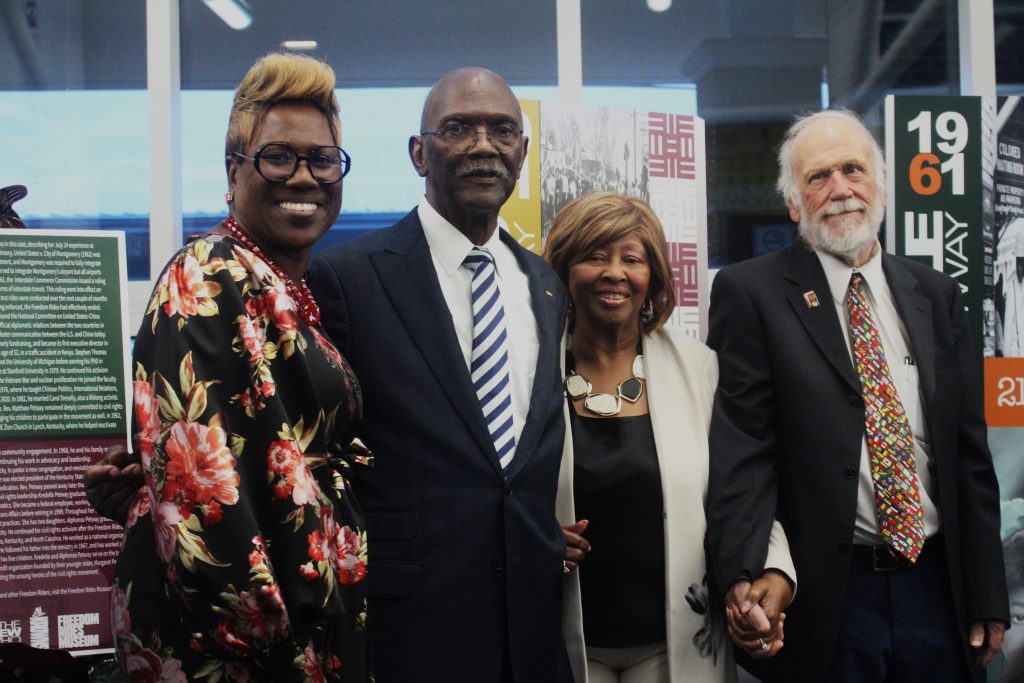
with ‘Few Who Flew’ Freedom Riders Rev. Alphonso Petway, Kredelle Petway, and Dr. Stephen
Thomas. (Shauna Stuart, For the Birmingham Times)
“I just know that’s something that they deserve,” she said. “Montgomery was integrated through the Petways and the Thomases, and I want to thank them for what they’ve done. Because we could not fly if it wasn’t for them.”
The Few Who Flew
Montgomery County Commissioner Isaiah Sankey said he credits the “Few Who Flew” for inspiring him to read more about the perils Black people faced while trying to travel by air during the Jim Crow era. During his research, he learned Black passengers were often put on waitlists when trying to make flight reservations. Companies, including American Airlines, required employees to place “segregation” codes on airline tickets for Black passengers. When planes had to refuel, Black passengers were served boxed lunches and told to remain on the plane while white passengers were allowed to exit the aircraft to dine at airport restaurants.
When the Freedom Riders started their mission to desegregate mass transportation systems throughout the South in 1961, most activists fought to integrate bus and train stations. Air travel was still relatively young, and smaller spaces and tight federal aviation regulations made segregation difficult to enforce in the air. It was, however, easier to enforce segregation in airport common areas such as restaurants, waiting areas, and bathrooms.
“State and local governments across the country, especially in the South, were still building systems and policies for segregating airports,” said Freedom Rides Museum site director Alexander Strickland.
“The result was that the nature of segregation in airplanes and in airports was constantly evolving in contrast to the rigid, well-established patterns of segregation in buses and bus stations. For airline passengers, this made segregation very difficult to predict and plan. Every time they entered an airport, they walked into the unknown.”
In the summer of 1961, Cecil Thomas helped organize a conference on interracial cooperation at Tougaloo College in Jackson, Mississippi. Thomas and his wife Fran were educators, civil rights activists, and close friends of the King family. According to history from the Freedom Riders Museum, after the conference, Thomas, his 16-year-old son Stephen, and Stephen’s friend Thomas Schooley boarded a bus to Montgomery. In Montgomery, they stayed at Rev. Ralph David Abernathy’s home, where they met Rev. Matthew Petway — the then-pastor of Ebenezer AME Baptist Church — and his son and daughter, Alphonso and Kredelle. The group decided to fly to Jackson.
On July 24, they went to Dannelly Field. When they attempted to place orders at the airport restaurant, restaurant staff called the police. The group boarded their plane to Jackson before they could be arrested. In Jackson, the Petways and Cecil Thomas were arrested and jailed when they tried to sit in the airport waiting areas, dine at the restaurants, and use the airport bathrooms. Two days later, the U.S. Department of Justice sued the city of Montgomery. The complaint alleged the segregation of Montgomery Airport was unconstitutional. Kredelle Petway testified in the case. United States vs. City of Montgomery (1962) later ruled in favor of the Justice Department, requiring Montgomery to integrate Dannelly Field.
“I stand on my father’s shoulders”
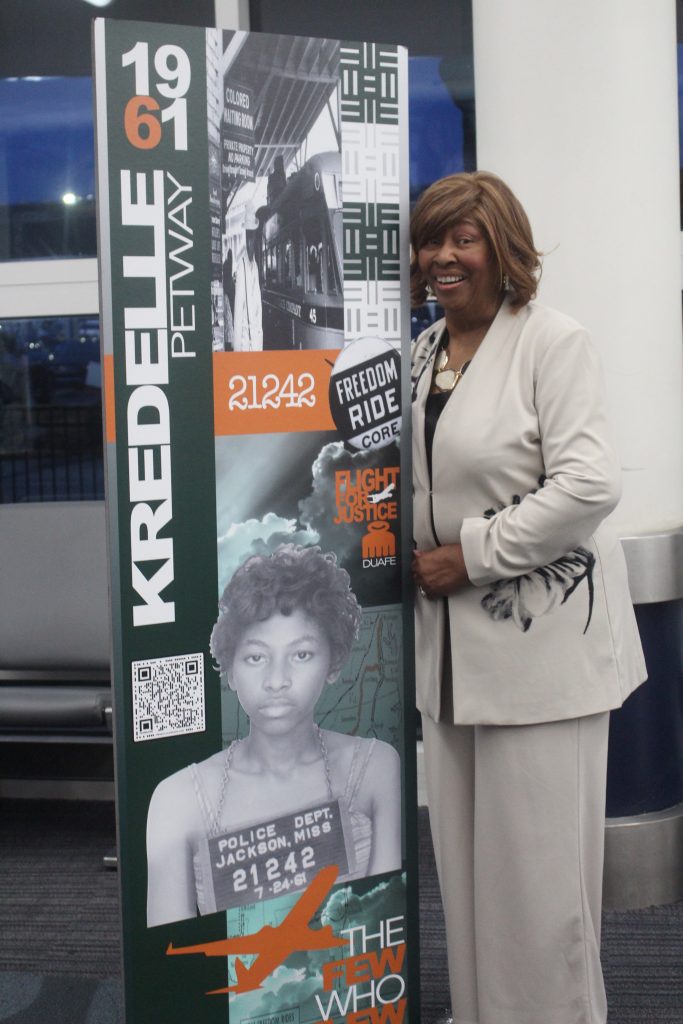
Kredelle Petway was emotional as she delivered her remarks at the opening night of the exhibition.
“I stand here today because of my father, Matthew Petway. I stand on his shoulders.”
Standing behind the podium, Petway recounted the moment her father challenged her to deepen her involvement in the civil rights movement and become a Freedom Rider.
Kredelle had been volunteering with the Montgomery Improvement Association since she was a teenager. One day, Matthew Petway, an activist since the 1950s, asked his daughter if she thought she was doing enough work in the movement.
Kredelle Petway, then 20 years old, told her father she didn’t think she was ready to join any form of physical protest. In response, her father asked if she thought someone else should fight for the rights she would eventually get to enjoy.
“I think I hung my head in shame,” Kredelle Petway said, laughing. “I had not had any formal training for the movement. However, my training was just a litany of questions from him. I passed the test with flying colors, and that’s how I was on Delta Airlines out of Montgomery’s airport.”
Petway still remembers the vivid details of July 24, 1961. She remembers the waitress who tried to have her arrested at the lunch counter and the officer who said the activists were not in violation of any city ordinance. She also remembers dashing across the tarmac to catch the plane, arriving in Jackson a little over an hour later, then being arrested and taken to the Hinds County Jail where she was photographed and fingerprinted.
“It was a surreal experience,” said Kredelle Petway. “However, today, the legacy must be continued.”
Her brother, Rev. Alphonso Petway, agrees.
“We’re in a dangerous period of time where progress and voting rights are being dismantled,” said Alphonso Petway, referencing this year’s battles against redistricting as Republican-led states try to redraw voting maps. “There’s an awful lot of work to be done.”
In his speech during the Freedom Riders’ 65th commemoration week in May, Petway said he wasn’t ready to pass his baton in the fight for social justice. Two months later, that sentiment is even stronger.
“I still have some energy to use. I’ve got some fight to participate in the struggle. And I’m not yet ready to give it up.”
“We are the ones that have to tell our history”
The exhibition comes at a pivotal time for historic and cultural preservation efforts as President Donald Trump signs executive orders to remove historic exhibitions and overhaul the messaging at cultural institutions around the country in a series of efforts to retell the narrative of American history. That Friday, Trump issued an executive order to install signs in front of the Smithsonian’s National Museum of American History telling visitors that some of the exhibits “are inaccurate.”
Madison says these recent events underscore the importance of visible public art projects that help make history accessible.
“We are the ones that have to tell our history because they are trying to remove it. In Montgomery and Birmingham, these freedom fighters fought in ways that shape the way we [continue to] fight for the whole country and for the world,” said Madison. “We have to be the storytellers of the legends that they are. We have to magnify their images and make them larger than life so that they won’t be forgotten. We have to make them icons and memorialize them in the way they should be memorialized.”
Jerrick and Ron Lewis, the nephews of John Lewis, traveled from Troy to see the unveiling. The cousins, who oversee the John R. Lewis Institute — a nonprofit founded in 2021 to preserve the legacy of the late congressman and civil rights giant — say the presence of art, especially during this present generation, speaks volumes.
“It’s needed now more than ever,” said Jerrick Lewis. “There are people who are trying to take away history.”