Europe’s most important multi-country regional visa unaffected by a recent crisis from Africa - minister says
The recent migration crisis that affected the Spanish enclaves of Ceuta and Melilla seems not to have affected the Schengen Visa, Europe’s most important travel document.
 Black News


The recent migration crisis that affected the Spanish enclaves of Ceuta and Melilla seems not to have affected the Schengen Visa, Europe’s most important travel document.
- The recent mass migration into Spain's Ceuta and Melilla did not negatively impact the Schengen free-travel zone, according to Portugal's foreign minister.
- Tensions arose as Italy and Spain implemented border checks in response to the crisis, drawing criticism for potential political motivations behind these measures.
- Ceuta and Melilla, Spanish territories in North Africa, saw a huge influx of migrants in July, with about 73,000 people estimated to have entered Ceuta alone.
- The incident led to several deaths and rekindled a long-standing dispute between Spain and Morocco over the sovereignty of the enclaves.
In late July, tens of thousands of African migrants entered Ceuta in 24 hours by land and sea, while another 300 to 400 people crossed into the nearby enclave of Melilla, according to local authorities.
However, according to Portugal’s foreign minister, the migration crisis had no negative effect on the European Union’s free-travel zone.
DON'T MISS THIS: One of Europe’s most financially modest kings is set to visit the disputed African/Spanish enclave despite his distant ties with Africa’s richest king
“We can say there was no immediate threat to Schengen right as it happened,” Portugal’s foreign minister, Paulo Rangel, said in an interview on Saturday, on the sidelines of the Ambrosetti Forum in Cernobbio, near Milan.
“This was always our assessment, and we are neighbors, so with France we would have suffered the first impact,” he added.
As seen on Bloomberg, the mass crossing led to a harsh decision from the Italian Premier Giorgia Meloni, who quickly imposed border checks with Spain.
Spain wasted no time in replicating the same decision towards travelers arriving from Italy.
Although Spain is a member of the European Union’s passport-free Schengen zone, travelers departing Ceuta remain subject to identity verification before proceeding to other parts of the bloc.
Critics of Prime Minister Meloni’s decision contend that the implementation of border controls represents a political maneuver intended to bolster her standing amidst rising support in polling for the far-right National Future movement.
Conversely, the administration maintains that these controls were instituted in response to legitimate security considerations, while signaling that the measures may undergo reassessment in the near future.
Furthermore, Prime Minister Meloni and Spanish Prime Minister Pedro Sánchez have publicly engaged in disputes concerning immigration policy and various other geopolitical issues.
Spain and Italy are “friends,” Portugal’s foreign minister said, adding that he’s “sure that this small tension” would be solved soon.
The minister further revealed that, despite the fact that the Portuguese government refused to sign a European leaders’ letter to prompt a meeting over Ceuta last month, it still supported Meloni’s call for a meeting between interior ministers.
Portugal monitored the situation hour by hour and was “receiving information and also providing information,” he said, noting Morocco’s efforts to contain illegal immigration were “really very impressive.”
Ceuta mass migration
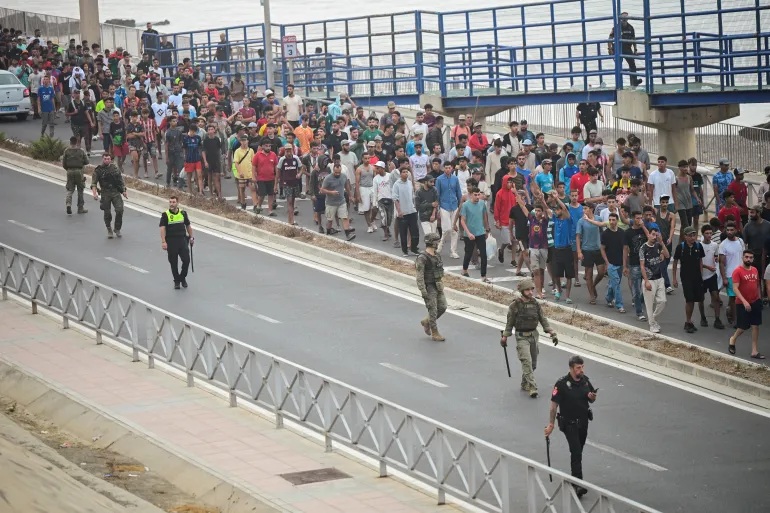
In July, two Spanish territories, Ceuta and Melilla, located on Morocco's northern coast, which represent the European Union's only land border with Africa, were invaded by migrants from Africa.
By August, Spanish authorities estimated that about 73,000 people entered Ceuta during the mass crossing that began on July 30. Many were Moroccan, while others came from sub-Saharan African countries affected by conflict and economic hardship.
Dozens of people died while attempting to reach the enclave, although the reported death toll has continued to change as bodies have been recovered and identities verified.
The migration crisis, shortly after, spilled into a wider diplomatic dispute after Morocco renewed its claim to Ceuta and Melilla.
However, Spain rejected any discussion over the sovereignty of the two enclaves, describing them as integral parts of Spanish territory.