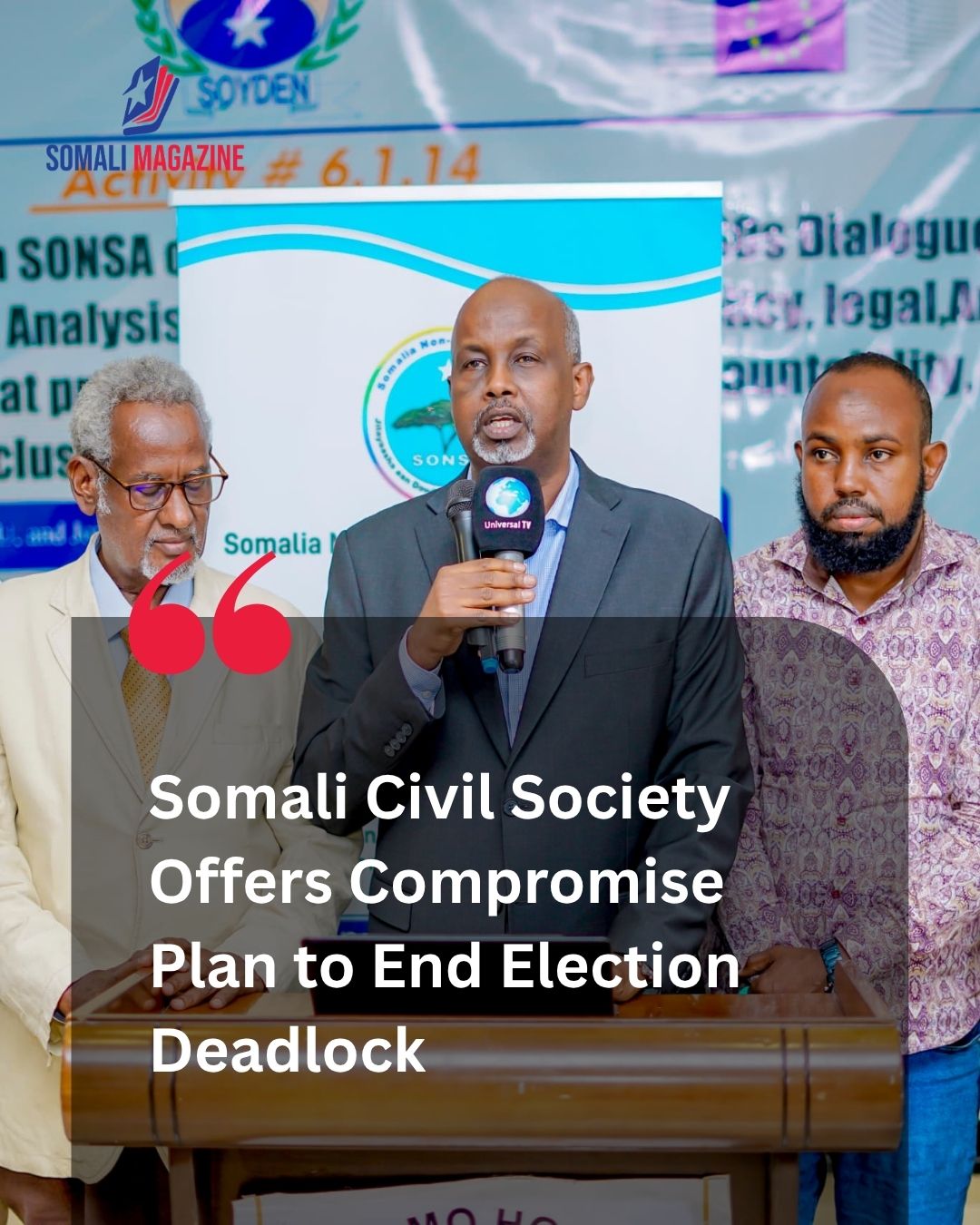
As political friction deepens between federal leadership and regional administrations, a broad coalition of Somali civil society proposes an interim electoral model to break the national political deadlock. The civil society initiative— spearheaded by non-governmental organizations, women’s groups, religious leaders, and legal experts—comes amidst growing concern over delayed federal elections and escalating disputes regarding constitutional amendments. Representatives from the Somalia Non-State Actors Coalition presented the technical proposal during a press briefing in Mogadishu, urging all political stakeholders to embrace a realistic, middle-ground electoral framework to prevent institutional breakdown and preserve national stability.
The proposed compromise model seeks to bridge the sharp divide between the federal government’s push for universal “one-person, one-vote” direct elections and the opposition’s demand for a traditional consensus-based model. Recognizing that ongoing security challenges, incomplete civil registries, and logistical constraints make immediate universal suffrage unfeasible in all regions, the compromise suggests a phased, hybrid approach. Under the proposal, direct elections would be held in secure, stable municipal districts across Federal Member States, while expanded delegate caucuses based on the traditional 4.5 clan structure would select parliamentary representatives in areas where direct voting remains technically impossible.
Central to the civil society proposal is the immediate reconvening of an inclusive National Consultative Council meeting. The coalition called on President Hassan Sheikh Mohamud, federal member state leaders, and the opposition alliance to formally adopt an agreed timeline and establish an independent, multi-stakeholder committee to supervise the election process. Proponents argue that introducing a hybrid framework addresses opposition concerns over unilateral executive changes while maintaining forward momentum toward universal suffrage in future electoral cycles.
International partners and regional observers have welcomed the civil society intervention, emphasizing that a mutually negotiated agreement remains the only viable path to avoid a governance vacuum. Civic leaders warned that further delays or unilateral political steps could trigger regional boycotts, increase political fragmentation, and distract security forces from ongoing counterterrorism operations. As political factions review the proposal, civil society organizers expressed optimism that their neutral, consensus-driven roadmap can serve as the baseline for a national compromise ahead of expiring political mandates.

 Black News