Banjul youth demand answers over delayed D21m KG5 stadium project
By Demba Bah For months, the gates of Banjul’s KG5 Mini Stadium have remained largely shut, leaving young footballers without the city’s main football ground and raising growing anger over a D21 million rehabilitation project that was supposed to be completed last year. On Saturday, representatives of Nawetaan teams, youth leaders and community stakeholders gathered […]
 Black News
By Demba Bah
For months, the gates of Banjul’s KG5 Mini Stadium have remained largely shut, leaving young footballers without the city’s main football ground and raising growing anger over a D21 million rehabilitation project that was supposed to be completed last year.

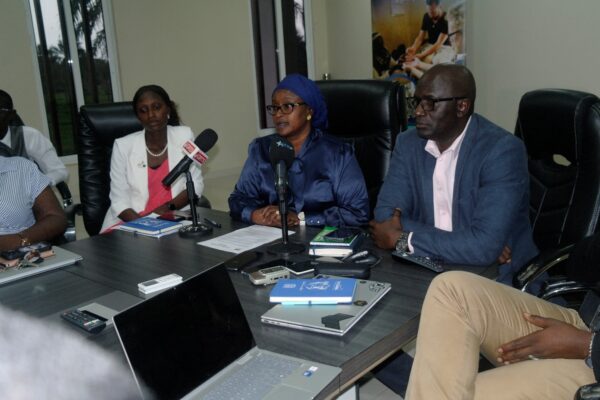
On Saturday, representatives of Nawetaan teams, youth leaders and community stakeholders gathered in Banjul to demand answers over the delay, saying the continued closure of the stadium is hurting football, youth development and community life in the capital.
The press conference was coordinated by spokesperson Ebrima Camara. Tamsir Sambo, secretary of the group, said KG5 was much more than a football pitch.
“KG5 Mini Stadium is not only a football pitch, but it is a place where the youth always gather each and every year to showcase their talent and engage in productive activities,” he said.
“The delay in rehabilitating KG5 has a lot of consequences that are put on the shoulders of us, we the Banjulians.”

The rehabilitation project was funded by the government through GAMWORKS and awarded to Dingareh Construction in August 2025, according to the group. The contractor was given a four-month implementation period, with completion and handover expected by December 2025. Ten months after that deadline, the mini-stadium remains unfinished.
Sambo said the group had tried to get answers directly from those responsible for the project.
“We have not sat back,” he said. “We have engaged GAMWORKS, including a meeting with the Director of GAMWORKS, to seek first-hand information regarding the reasons for the prolonged delay, the status of the contract and what was being done.”
The group also said it had engaged Dingareh Construction and taken the matter to the State House, where members met Momodou Sabally, a an adviser to President Adama Barrow.
The concerned residents of the city said they recognised the efforts of the Banjul Sports Committee and Banjul City Council to push the project forward, but argued that the public still deserved clear information.
“The question we ask now is: how long must the young people of Banjul continue to wait?” Sambo said.
The group is demanding details on the current state of the project, the reasons for the delay and what remains outstanding. It also wants an explanation of the financial status of the D21 million contract, the responsibilities of GAMWORKS, Dingareh Construction and other partners, and a firm date for completion and handover.
“This is not about political affiliation or personal interest,” Sambo said. “This is about football, youth development, and the future of Banjul.”
The dispute comes as the city faces a shortage of suitable grounds for youth football.
Speakers including Foday Suwareh, Ousman Cham, Omar Jammeh, Ousman Touray, known as Wuyepa, and Sisawo Kanteh, known as Ayo, said young players were also being denied access to other grounds, including McCarthy Square, Gambia High School and St Augustine’s High School. Tanbi Wetland, which is sometimes used as an alternative playing area, is a protected wildlife habitat, they said.
Sambo warned that the problem was therefore not simply about football.
“When the only major sporting facility is not functioning, the question goes far beyond football,” he said. “When opportunities are limited, our young people become vulnerable to drug abuse and irregular migration, the backway.”
The group also argued that Banjul was being left behind in terms of sporting infrastructure and said KG5 should be treated as a matter of national importance.
“We call on Gamworks to provide a clear and transparent public update, and on Dingareh Construction to account for progress,” the group said in a joint statement.
“We further call on all parties to put aside obstacles and return KG5 to the people of Banjul.”
But hours after the press conference, Banjul City Council deputy mayor Abdul Aziz Gaye, also known as Dabakh, said there had been a major development: the artificial turf materials had finally arrived at the stadium.
In a message to residents, Gaye said containers carrying the turf had been held at the port for more than a month because of bureaucratic delays.
“The truth is, all the materials for the fixing of the artificial turf arrived more than a month ago but couldn’t be removed from the ports due to bureaucratic bottlenecks,” he said.
“However, that has been resolved and this afternoon, all the containers are out and already delivered at the mini stadium grounds.”
He said the materials were now at KG5 and expressed hope that work would resume shortly.
“So I believe Gamworks will get the contractor to go back to work as soon as possible to complete the project,” he said.
Gaye said the delay had not been intentional.
“Once the funds were raised, Gamworks, which is a professional agency was given the responsibility to implement and manage the project, with the main goal of ensuring efficiency, timely and quality delivery of the project,” he said.
“The delay is therefore unintentional and never anticipated.”
He also said the central government would not normally be responsible for municipal parks, which fall under the local council’s mandate. But he said President Adama Barrow had committed to fixing the KG5 pitch with artificial turf after repeated appeals from the Banjul Sports Committee and residents.
The commitment, Gaye said, was announced during the president’s previous Meet the People Tour at the Memorial Arch in Banjul. He said he, Executive Coordinator Ebrima Jawo and Banjul Sports Committee president Momodou Musa Njai remained involved in efforts to see the project completed.
“All can be assured that the Dep. Mayor Aziz Dabakh Gaye, Exe. Coordinator, Ebrima Jawo and the President of Banjul Sports Committee, Momodou Musa Njai are all fully committed and involved in following up the project,” he said.
“We are, however, happy that the turf materials that caused the delay have now been delivered, and if everything goes well, football will soon return to KG5.”
For generations of Banjulians, however, the wait for KG5 has been about more than a construction project. The ground, whose name comes from King George V, was established during the colonial period when Bathurst, now Banjul, named its main recreation ground after the British monarch. By the 1960s, KG5 had become a centre for primary school football. McCarthy Square was associated with athletics and cricket, while Box Bar hosted national matches.
For decades, KG5 remained a simple sand pitch, but it became the centre of Banjul’s Nawetaan football culture and a breeding ground for local talent. Teams including Bob Marley, KG5 FC, Hurricanes and Tally 8 became part of the city’s football history.
On 14 January 2010, the Banjul Sports Committee handed the ground to GAMWORKS/GAMTEC, with BOA Construction as contractor. The D9.6 million project was funded by the government, Banjul City Council, the Social Security and Housing Finance Corporation and the Banjul Sports Committee. Artificial turf was laid on 8 December 2010. The renovated ground was officially opened on 26 February 2011 by football veteran Alhaji O.B. Conateh. At the time, it was regarded as one of the country’s most modern turf grounds. With a capacity of about 3,000, it became home to clubs including Real de Banjul, Hawks and Banjul United.
More than a decade later, the Gambia Football Federation’s infrastructure programme brought floodlights to KG5 in 2022-23. The development allowed the ground to host Nawetaan football at night for the first time.
Banjul Sports Committee president Momodou Musa Njie described the arrival of floodlights as an “unimaginable dream”.
But the turf itself deteriorated. By 2024, players were describing its condition as “a very big risk” because of the possibility of injuries.
In 2025, QGroup founder Muhammed Jah funded a 500-seat pavilion at the ground’s famous Jamaica End, giving supporters shelter from the sun and rain after years of watching matches in difficult conditions.
Now, the latest development has brought the stadium back into focus. For the youth representatives who gathered on Saturday, the arrival of the turf materials is welcome, but the demand remains the same: they want KG5 completed and returned to the people of Banjul.
“We have engaged respectfully, we have attended meetings,” the collective said.
“Patience should not be mistaken for indifference.”
They added: “We hope authorities will respond positively and that we will not be forced into actions that none of us wants to see. Our preference remains dialogue and peaceful resolution.”