A Decisive Win with Many Open Questions
Attacking Israel no longer carried an electoral price, whereas making a point of speaking out in support of the Jewish state, once a sure applause line with Democratic voters, could actually damage one’s campaign. The post A Decisive Win with Many Open Questions appeared first on Moment Magazine.
 Black News

Jewish Politics & Power is published every other week. Sign up for our newsletter for updates.
1. Israel wasn’t on the ballot, or was it?
“There’s a great dislike, incredibly, for Israel.”
This observation was made by President Trump in an interview with 60 Minutes taped Friday and aired last night. The context: Trump was listing the reasons for the Republicans’ defeat in last week’s midterm elections, alongside the Iran war, the cost of living and what the president perceives as the general weakness of his party’s candidates.
Trump adopted, albeit with a clear sense of surprise, the analysis made by his vice president, in a lengthy X post that placed America’s relationship with Israel among the top reasons that led voters to turn their back on the GOP.
With that, the president has made a full reversal, from viewing his strong ties with Israel as an asset to recognizing them as a political liability. This does not necessarily spell an immediate change in policy toward Israel, but it provides an explanation for Trump’s Election-Day announcement on Fox News that he intends to zero out America’s nearly $4 billion annual aid package to Israel, perhaps in the hope that voters would hear the message before casting their ballots.
The midterm saw a shift in the American political calculus regarding Israel.
Initially, U.S. support for Israel was an issue only on the Democratic side, increasingly serving as a litmus test for a candidate’s liberal credentials. Progressives battled moderates over use of the term “genocide” and on the subtleties of full boycott of military aid vs. specific limitations on arms sales. For Democrats, it became clear early on in the midterm cycle that the politics of Israel had flipped: Attacking Israel no longer carried an electoral price, whereas making a point of speaking out in support of the Jewish state, once a sure applause line with Democratic voters, could actually damage one’s campaign.
Republicans seemed immune from this debate. Supporting Israel, its wars in Gaza and Iran, and the idea of sending American weapons and taxpayer dollars to help its defense were, by and large, a matter of consensus. Anti-Israel undercurrents existed, especially in the isolationist margins of the MAGA crowd, but hardly as major concern for voters.
Apparently, these sentiments were stronger than Republicans had been willing to acknowledge. The ongoing Iran war, viewed by many as intended to benefit Israel and not the United States, coupled with the significant dollar amount of military aid to Israel at a time when Americans are struggling to make ends meet, created a fertile ground for the rise of the anti-Israel sentiment to which Trump and Vance pointed post-election.
The U.S.-Israel relationship was not on the ballot last Tuesday, but it still suffered a double whammy: On the Democratic side, results confirmed the notion that support for Israel is morally wrong and should be limited or eliminated altogether; and on the Republican side the midterm’s outcome gave credence to the idea that backing Israel amounts to ignoring the will of everyday voters.
2. Israelis cry gevalt, but only on one side
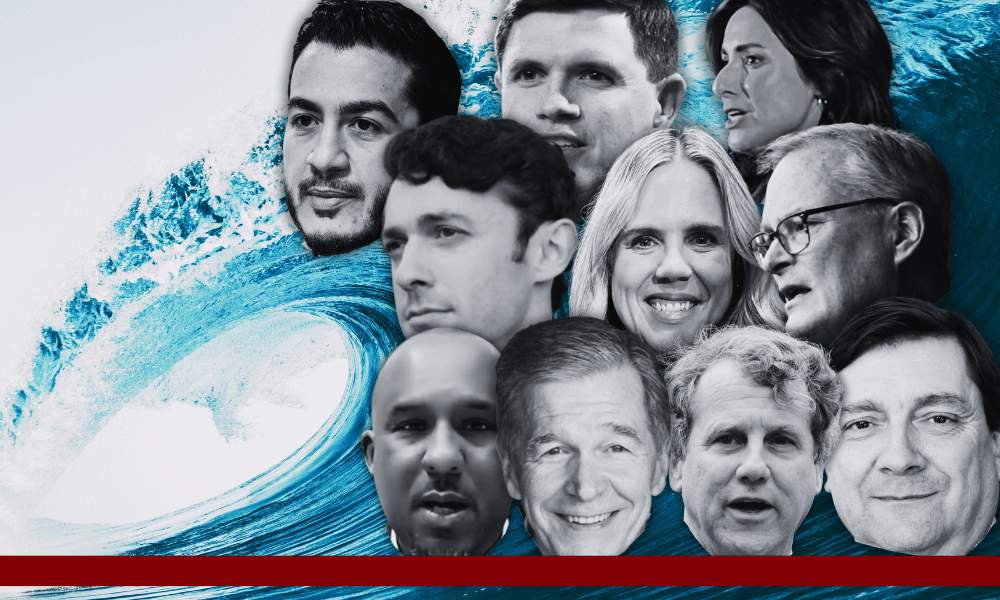
Israelis woke up with dread to the news of the blue midterm tsunami. Newspapers were plastered with descriptions of a U.S. Congress with a sudden influx of anti-Israel Democratic lawmakers bent on isolating and sanctioning Israel. Graphic images on TV networks pointed out the states on the map that elected progressive Dems who have vowed to cut U.S. support. There’s not a single Israeli by now who has not heard the name of Michigan Senator-elect Abdul El-Sayed, who had taken over the role of No. 1 villain previously held by New York City Mayor Zohran Mamdani.
Israel’s concern is rooted in campaign statements made by many of the Democrats who will now be in power, but is also fed by a fair measure of paranoia gleaned from years of depicting Democrats as enemies of the Jewish state.
Beyond the alarming headlines, officials in Israel have pointed to several legislative measures that can likely move forward now, including sanctions on extremist settlers, measures against Israeli expansion of West Bank settlements and the conditioning of specific arms sales to Israel. All these are on the Democrats’ legislative wish list, although all are also susceptible to a presidential veto and therefore will likely not materialize in the next two years.
At the same time, Israeli politicians and the Israeli public willfully turned a blind eye to the burst of anti-Israel sentiments in the post-midterm Republican side. Trump’s comment on immediately ending military aid was seen as no more than a last-minute campaign move that won’t take place in the near future. Vance and Trump’s finger-pointing at Israel as a reason for Republican failure garnered little concern and were not perceived as signaling any imminent change in policy.
3. The numbers
Counting Jewish votes has become a biennial Jewish ritual, which follows the exact same lines: Each side claims that a tiny change in voting patterns, in a community too small to poll, should be seen as a seismic shift.
So here’s all you need to know about how Jewish Americans voted in the 2026 midterms: The large majority of American Jews remained loyal to the Democratic Party (72 percent, or 68 percent—take your pick.)
One notable shift seems to have taken place in Michigan, where there was a measurable drop in Jewish support for El-Sayed. A comparison between his performance to that of the Democratic gubernatorial candidate Jocelyn Benson in neighborhoods known to have a significant Jewish population shows that El-Sayed underperformed by 15 percent.
Bottom line: Jewish voters remain aligned with the Democratic Party but are willing to push back when their party puts forward candidates who are especially critical of Israel or viewed as being insensitive toward the Jewish community.
4. Habibi pack
El-Sayed took to the airways after his victory. From one TV studio to another, he emerged as a happy progressive warrior, excited to carry on the fight to advance his worldview, including his wish to end all military aid and arms sales to Israel.
Among his first actions was launching a new Political Action Committee (PAC), aimed at supporting like-minded candidates. He playfully named it “Habibi PAC.” In Arabic, Habibi means “my dear” or “my beloved” and is commonly used when addressing friends in conversation.
El-Sayed has masterfully woven the term into his comments and speeches, including when reminding the vice president that, like it or not, he will soon have to swear him in as a senator. “JD, Habibi,” El-Sayed said in a comment that went viral.


El-Sayed is likely the first national-level politician to freely use Arabic words in his public comments, including during his Michigan victory speech late Tuesday night, where he said: “Today, tonight, we can turn that ‘inshallah’ into an ‘alhamdulillah,’” meaning that the campaign has gone from “God willing” to “Thank God.”
Normalizing the use of Arabic in American political life is a reminder of the long way Muslim Americans have traveled in their battle for political representation. It’s hard to ignore the parallels to the struggle of Jewish Americans to feel comfortable on the political stage, before reaching the point when a young senator from New York could freely use the phrase “I am the shomer of Israel,” the guardian of Israel, in his campaign speeches. That senator, Chuck Schumer, is likely to soon re-assume the role of Senate majority leader, making him once again the highest-ranking Jewish politician in American history.
5. Miller’s crossing
The first victim of Trump’s post-election White House revamp was Chief of Staff Susie Wiles, who was replaced by Stephen Miller.
Much has already been said and written about Miller, who has been Trump’s confidant ever since his first term. He’s known for his combative style and provocative rhetoric, and most of all for his obsession for shutting America’s doors to immigrants.
Miller is now perhaps the most influential Jewish American in the administration. The fact that he is also the staunchest anti-immigration figure in the U.S. government could seem ironic, given the Jewish community’s reputation of supporting immigration, helping migrants and offering a safe harbor for those in need. The unanswered question remains: Is it merely a quirky twist, or is Miller an outlier signaling a future shift in the community’s approach to immigration?
(Top image credit: Kenneth C. Zirkel, CC BY-SA 4.0; The Circus on SHOWTIME, CC BY 3.0; Antonioaesparza, CC BY-SA 4.0; Stimpus1, CC0; RRC1701, CC0; Leoniceno, CC0; ArenLeBrun, CC0; AFGE, CC BY 2.0; The Contrarian, CC BY 4.0; NCDOTcommunications, CC BY 2.0, all via Wikimedia Commons)
The post A Decisive Win with Many Open Questions appeared first on Moment Magazine.