

UK-listed oil producer makes $360 million bet on Egypt as geopolitical risks reshape energy investment
London-listed Genel Energy has agreed to acquire Capricorn Energy in a $360 million all-cash deal, giving it a major foothold in Egypt as it seeks to reduce its reliance on oil assets in Iraq’s conflict-prone Kurdistan region.
 Black News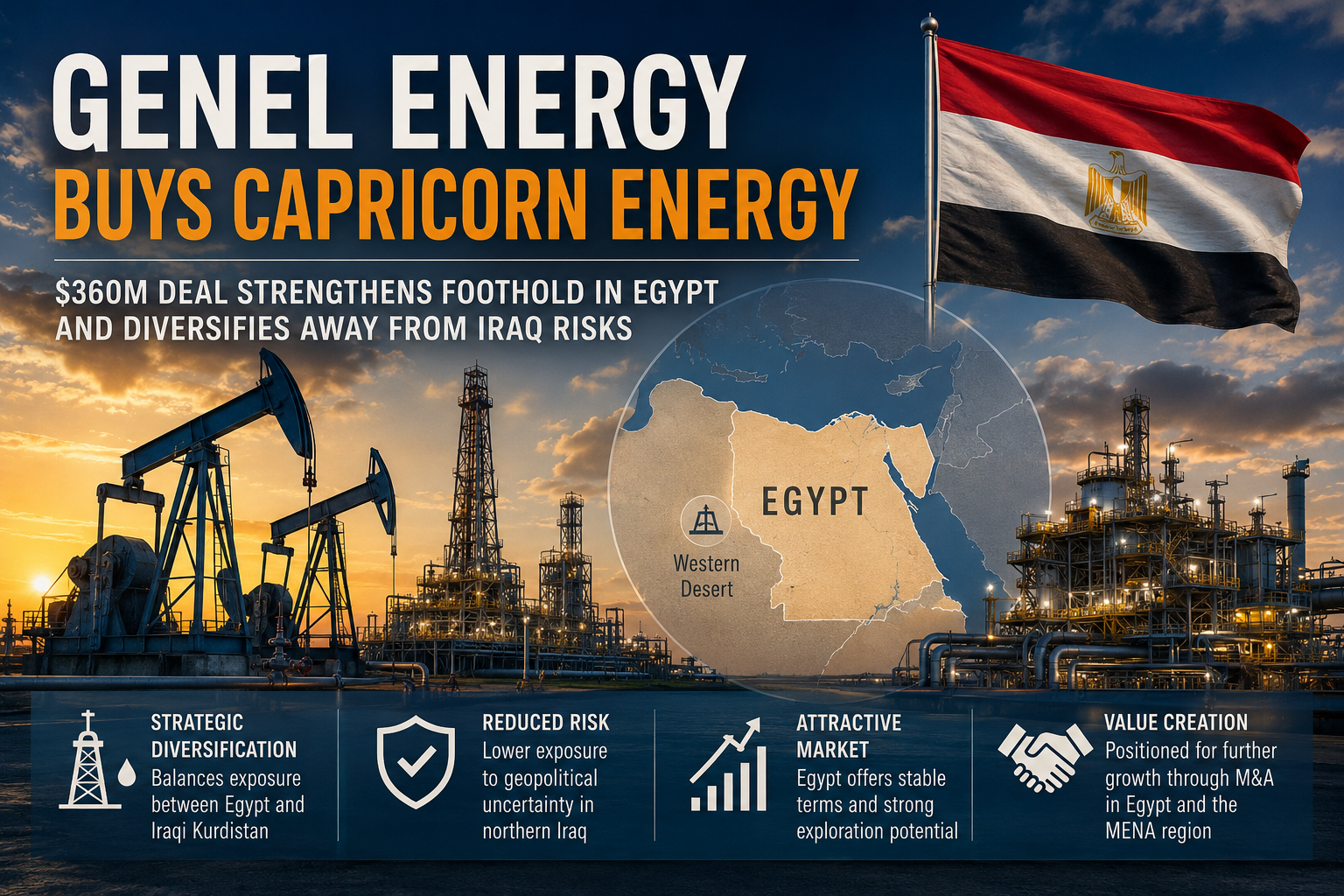
![Genel Energy is expanding into Egypt through a $360 million acquisition of Capricorn Energy, marking one of its biggest strategic moves in years. [CHATGPT]](https://ocdn.eu/pulscms/MDA_/531536e8707186e9b90cedf6e8af338b.png)
London-listed Genel Energy has agreed to acquire Capricorn Energy in a $360 million all-cash deal, giving it a major foothold in Egypt as it seeks to reduce its reliance on oil assets in Iraq’s conflict-prone Kurdistan region.
- UK-listed Genel Energy has agreed to acquire Capricorn Energy in a $360 million all-cash deal.
- The acquisition gives the company a major presence in Egypt while reducing its dependence on Iraqi Kurdistan.
- Egypt’s investment reforms and renewed exploration activity have strengthened its appeal to international oil producers.
- The deal highlights how geopolitical tensions are reshaping energy investment across the Middle East and North Africa.
The acquisition marks one of the latest signs that international energy companies are increasingly turning to Egypt as they rebalance portfolios amid rising geopolitical risks across the Middle East and renewed efforts by Cairo to attract foreign investment into its oil and gas sector.
Under the agreement announced on Thursday, Genel will pay $4.74 per Capricorn share, comprising $3.75 in cash and a $0.99 special dividend, valuing Capricorn at approximately $360 million.
The offer represents a 33% premium to Capricorn’s closing share price on 10 March, before Saudi Arabia’s privately held Cafani Group disclosed its interest in the company.
Investors welcomed the transaction, sending Capricorn’s shares up by as much as 22% to their highest level since 2012, while Genel’s shares climbed around 9% in London trading.
DON'T MISS THIS: Oil exploration in Egypt's largest arid region generates very promising results
Why Egypt?
For Genel, the acquisition is about far more than adding production. The company has spent years searching for assets outside Iraq’s Kurdistan region, where political disputes between Baghdad and the Kurdistan Regional Government have repeatedly disrupted crude exports through the Iraq–Türkiye pipeline.
More recently, heightened regional tensions involving Iran have added another layer of uncertainty for operators in northern Iraq, reinforcing the need for greater geographic diversification.
Capricorn’s producing assets in Egypt’s Western Desert immediately provide that diversification.
Genel said the portfolio offers meaningful oil and gas production in a country with an established regulatory framework, stable contractual arrangements and competitive fiscal terms.
Once completed, the acquisition will leave the enlarged company with production split almost evenly between Egypt and Iraqi Kurdistan, significantly reducing its exposure to a single operating region.
DON'T MISS THIS: Why Egypt is racing to map its hidden mineral wealth after four decades
“The enlarged group is well positioned to pursue further value-accretive mergers and acquisitions within Egypt and the MENA region more generally,” the company said.
Egypt’s energy revival attracts investors
The deal also reflects Egypt’s renewed push to restore its position as one of Africa’s leading energy producers.
Over the past two years, the Egyptian government has introduced measures to accelerate exploration, improve payment terms for international oil companies and encourage fresh investment as the country works to reverse declining domestic gas production and strengthen energy security.
In May, Agiba Petroleum, a joint venture between the Egyptian General Petroleum Corporation and Italy’s Eni, announced its largest hydrocarbon discovery in 15 years in the Western Desert.
Earlier this year, US producer Apache also reported a new natural gas discovery in the same region, underlining continued exploration potential.
While Egypt has recently imported liquefied natural gas to help meet domestic demand during periods of supply tightness, authorities are simultaneously seeking to increase local production through new exploration campaigns and partnerships with international energy companies.
Against that backdrop, Capricorn’s Western Desert portfolio represents an opportunity for Genel to gain immediate exposure to one of North Africa’s most established upstream markets.
DON'T MISS THIS: Egypt hits biggest oil and gas jackpot in 15 years with massive desert discovery
Capricorn ends months of takeover interest
Capricorn had attracted acquisition interest for several months, including multiple approaches from Saudi Arabia’s privately held Cafani Group.
The company’s board unanimously recommended Genel’s offer, saying it represented the strongest proposal received and offered greater certainty than other competing approaches. Cafani Group still has until 29 July under UK takeover rules to submit a formal competing bid.
The acquisition is expected to complete in the second half of 2026, subject to shareholder approval, court approval and regulatory clearances, including consent from the Egyptian General Petroleum Corporation.
For Genel, the transaction represents more than a corporate acquisition. It signals a strategic shift towards building a broader Middle East and North Africa energy portfolio at a time when geopolitical uncertainty is increasingly shaping where global oil companies choose to invest.