They Were Not Asking Us To Leave. They Were Telling Us.
At 1:12 AM, the morning of June 30, my sister sent a message to our family group chat: ‘Lock your doors and bedrooms as well.’ Then, thirty-three minutes later, she sent another one: ‘I’m too scared. I just want to be prepared.’ Another sister of mine replied: ‘You’ll be fine.’ And then, after a pause: ‘Hopefully.’ I live in Germiston, east of Johannesburg. By the time the sun came up, demonstrators were already moving through the CBD, fewer than fifty at first, carrying sjamboks and clubs, singing as they went. By afternoon, they were going door to door in Delville, […] The post They Were Not Asking Us To Leave. They Were Telling Us. appeared first on African Arguments.
 Black News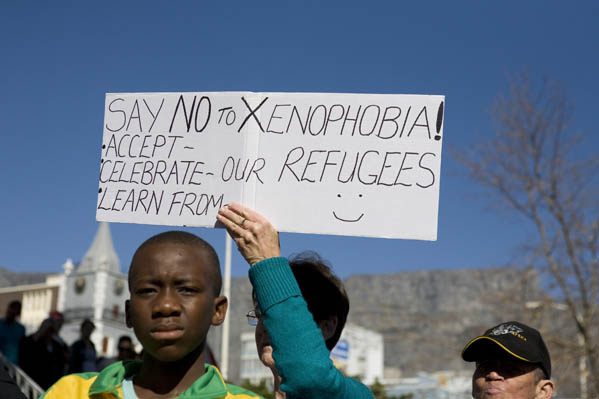
At 1:12 AM, the morning of June 30, my sister sent a message to our family group chat: ‘Lock your doors and bedrooms as well.’ Then, thirty-three minutes later, she sent another one: ‘I’m too scared. I just want to be prepared.’ Another sister of mine replied: ‘You’ll be fine.’ And then, after a pause: ‘Hopefully.’
I live in Germiston, east of Johannesburg. By the time the sun came up, demonstrators were already moving through the CBD, fewer than fifty at first, carrying sjamboks and clubs, singing as they went. By afternoon, they were going door to door in Delville, entering homes, pulling people out, handing them to police and demanding their papers be checked. The police lost control of the situation. A major general had to intervene personally. Meanwhile, in Durban, a Congolese man waved his Home Affairs documents through the bars of a police van. The officers told him his papers weren’t real even though he’d gotten them from Home Affairs.
I have been having this conversation my entire life.
I was born in South Africa to Congolese refugee parents. I have held refugee status for as long as I can remember, carried a laminated A4 permit as identification, sat in Home Affairs queues before the sun came up, watched officials look at my documentation with that particular expression: not quite hostility, not quite pity, something in between. I recently received South African citizenship, after years of legal limbo, through a pro-bono lawyer. I am not writing about this community from a distance. I am writing from inside it, on the day a movement decided it should not exist.

A placard at a demonstration against xenophobia in South Africa.
What is happening in South Africa right now is being described, by those reporting on it and those participating in it, as xenophobia. I want to be precise: it is not. Or rather, it is not only that, and calling it only that lets too many people off the hook.
One of the marchers in Johannesburg today, an uMkhonto weSizwe (MK) party member, put it plainly without meaning to: “So we’re not fighting against those foreign nationals. We’re fighting against our government.” She was right. But the march was not going to the Union Buildings. It was going door to door in Germiston.
The Democratic Republic of Congo supplies more than 70 percent of the world’s cobalt, the mineral without which there are no lithium-ion batteries, no electric vehicles, no smartphones. That cobalt is extracted under conditions that human rights organisations have documented for decades: child labour, unsafe mines, and communities dependent on a mineral economy that has funded decades of broader regional conflict. The eastern DRC, where rebel groups have operated with devastating effect for thirty years, is not separate from the global economy. It is the foundation of it. The world’s access to technology has been subsidised, in blood and displacement, by Congolese people.
Those same people, when they flee — when the conditions created partly by that extraction make staying impossible — are told, in country after country, that they are a problem. And in South Africa, on the 30th of June, they were given a deadline.
This is not a coincidence. It is the shape of a system.
But I want to be careful here, because the people marching today are not simply villains in this story, and treating them as such is its own form of dishonesty. Post-apartheid South Africa transferred political power without transferring wealth. The land, the capital, the infrastructure; more than thirty years after 1994, these remain overwhelmingly concentrated in the hands of the minority that held them under apartheid. The townships and informal settlements where poor Black South Africans live are the same areas where immigrants settle, because these are the only areas accessible to people without resources. What gets produced is a competition — for space in a taxi, a bed in a public hospital, a place in a school — between people who are all, in different ways, abandoned by the same system.
The data makes this plain. South Africa lost 80,000 formal jobs in the first quarter of 2026, right before the March and March protests intensified. Community services lost 53,000 jobs. Trade lost 40,000. Construction, the one sector where migrant labour is concentrated, actually grew. The job crisis is not caused by immigrants. It is caused by structural failures that have been building for thirty years. But structural failures do not march. They do not gather at King Dinuzulu Park. They do not have a face.
March and March is not wrong that resources are scarce. It is wrong about who made them scarce.
The government’s response has been to absorb rather than challenge that misdirection. Proposed employer penalties for hiring undocumented workers. Proposed employment quotas. The phasing out of the green ID book. These are policies designed to signal action while avoiding the question that actually matters: why, thirty years after apartheid ended, is the wealth still where it was?
I understand why the answer is too large and too diffuse to march against. An abstraction cannot be deported. A structural failure cannot be loaded onto a bus and driven to a border. But the Congolese family in the next street can. And when June 30 passed without the mass deportations the movement wanted, its leader announced they would march every Thursday for the next six months until, she said, ‘they are gone’.
There is no finish line in that sentence. There is only a direction.

Tonight, my sisters will lock their doors. I will sit inside a country that has just spent a day deciding, loudly, that people like me represent its problems rather than its failures. I will continue building a record of the stories I witness, because the archive is the only advocacy available to those of us who cannot march, who cannot make noise without risk, who can only document and wait.
The cobalt in your phone came from somewhere. The person who paid for it may be living in a high-risk corridor in Germiston, wondering if six months of Thursdays will be safe.
June 30 was yesterday. The deadline had arrived. We are still here.
The post They Were Not Asking Us To Leave. They Were Telling Us. appeared first on African Arguments.