
The invisible architects: Five hard realities of the surveillance state
Artificial intelligence isn’t just changing how we work—it is reshaping how we’re watched. In this analysis, Leah Harmony examines the rise of the modern surveillance state, from AI-powered school buses and predictive policing to data architecture and “smart city” technology. As governments and tech companies build increasingly interconnected systems, she asks a fundamental question: Who controls the tools that increasingly control us—and what happens to freedom when every movement becomes data? The post The invisible architects: Five hard realities of the surveillance state appeared first on San Francisco Bay View.
 Black News
by Leah Harmony
“You have zero privacy anyway. Get over it.” – Scott McNealy (former CEO, Sun Microsystems)
In the Bay Area we are in the belly of the tech beast and as a part of our ongoing coverage of the good, the bad and the ugly in the age of AI, it’s time to take a realistic look at the surveillance arm as it’s becoming. The reality is that it’s shaping who gets watched, who gets protected, who gets profiled, and who gets free.
Being Black in America means surveillance isn’t just the plot of a movie or TV show. From slave patrols to redlining, from COINTELPRO to predictive policing, the state has a tricky way of using “safety” as a reason to monitor, control and contain us. More often than not, the citizens who feel they need protection approve these methods and even build the tools themselves. Today, the tools have changed. I’d argue that the logic has not.
Artificial intelligence is being sold as one such tool, described as neutral, efficient and inevitable. Is there anyone who gets to move through the world without being tracked?
We are no longer simply using technology. We are living inside it. Cameras, sensors, databases, apps, license plate readers, school systems, phones, buses, drones and government platforms are becoming one connected layer of observation. The new surveillance state does not always arrive with flashing lights or armed officers. At least not at first. Quietly, it arrives through software updates, public-private partnerships, and those misleading promises to “keep us safe.”
This is why free speech, freedom of movement and liberation must be at the center of any conversation about AI. A people cannot organize freely if they are always being watched. A community cannot speak freely if its words, faces, cars and neighborhoods are constantly turned into data.
Here are five realities we must immediately confront:
1. Your child’s school bus could become a roaming surveillance vehicle
Some of the most dangerous expansions of surveillance begin with the most sympathetic language: child safety.
BusPatrol, a company that equips school buses with AI-powered cameras, was originally promoted as a way to catch drivers who illegally pass stopped school buses. Cool. No one wants children to be in danger, right?
The concern is what happens next. Reports and internal documents suggest that this technology could expand and become a mobile network of automatic license plate readers. That means school buses could scan and record the plates and locations of cars they pass, whether or not anyone has broken the law.
That changes the school bus from a vehicle of care into a vehicle of surveillance.
Civil liberties attorney Harvey Silverglate in his book “Three Felonies a Day,” estimates that the average American professional unknowingly commits about three felonies a day. For Black communities, this matters deeply. We already know what happens when “public safety” systems are built without public accountability. The same technology used to catch a reckless driver will also be used to track neighbors, protesters, workers and families committing felonies they don’t even know are felonies, or doing something the state doesn’t approve of, whatever that may be.
The question is not whether children should be safe. Of course they should. The question is whether safety should be used as a Trojan horse to build surveillance systems that communities never truly consented to.
A liberated society protects children without turning neighborhoods into open-air databases.
2. The real power in AI is not the chatbot. It is the map behind it.
AI is more than just a cute bot, or an app, or even a tool that writes emails and answers questions. The power it holds is underneath all of that and lives in the structure behind the AI: the data map.
Companies like Palantir focus on something often called an “ontology.” This is a simple idea that holds a lot of weight. An ontology organizes real-world information into a digital model. It tells the system what things are, how they relate, and what actions can be taken. It creates a digital twin. Imagine what your twin is doing as we speak.
Logistically, regular databases store names, dates, addresses or case numbers. An ontology turns those pieces into a living map of an organization, a city, a battlefield, a hospital or a population.
If you don’t think that’s dangerous, you’re not considering what that means.
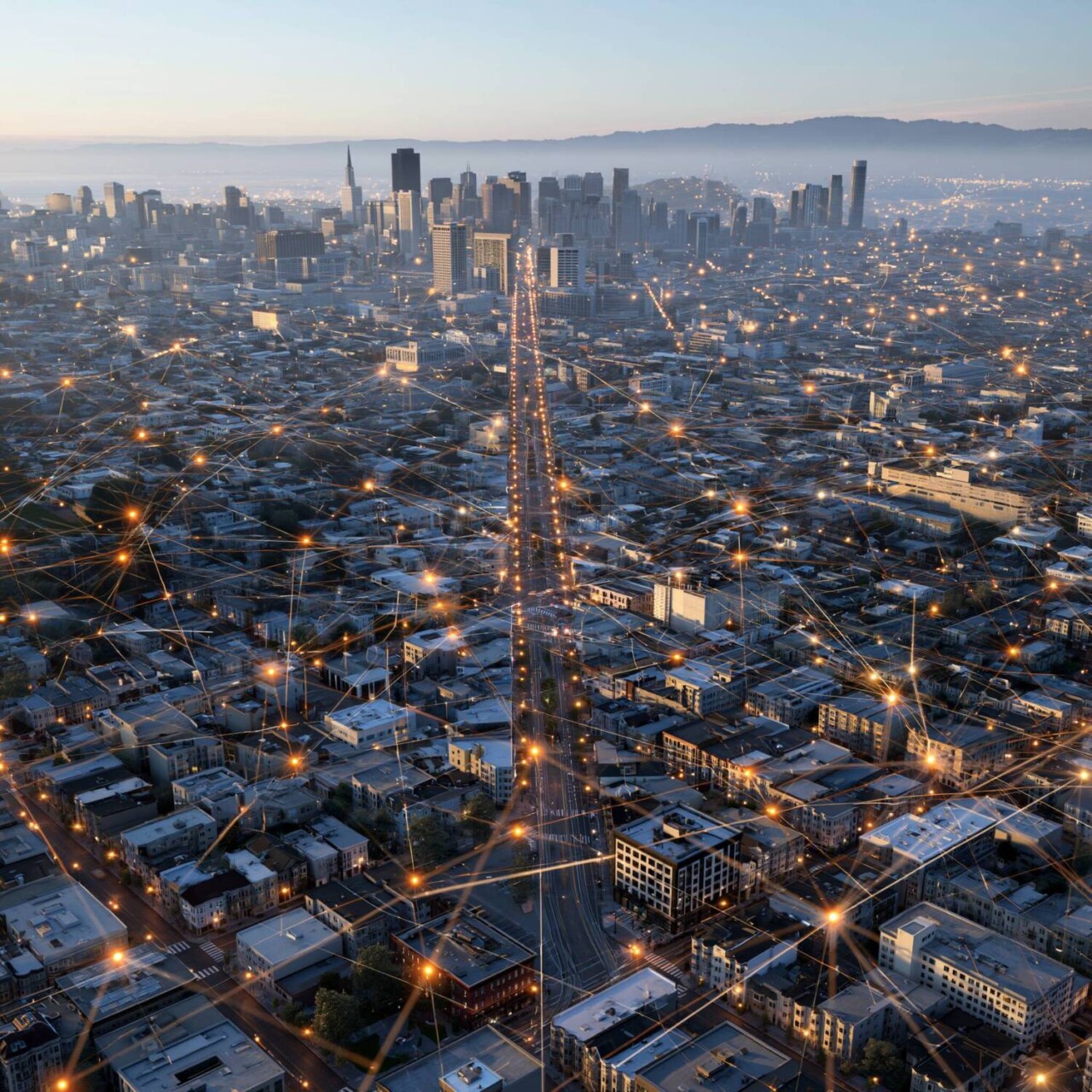
A chatbot without context is limited. But an AI system connected to a rich map of people, vehicles, agencies, records, locations and histories can produce decisions, recommendations and alerts at scale.
That is how raw footage becomes intelligence. That is how a license plate becomes a movement pattern. That is how a neighborhood becomes a target zone. This is why fighting back against the cameras we can see must continue but we must also have the clarity to fight the data architecture we cannot see. This is what all the civil unrest training is for in our police academies and on our military bases.
The goal for us must be power over the systems that define us.
3. The people building these systems aren’t your friend
Don’t let your personal or political views blind you from the truth. One of the most complicated figures in this landscape is Alex Karp, the CEO of Palantir.
Karp does not fit the usual image of a defense-tech executive or the tech bros we see around the Bay Area. He is often described as “philosophical, eccentric and intellectually intense.” Social theory is his obsession and he speaks of democracy, civil liberties and the dangers of authoritarianism. Ha. Palantir is almost the exact opposite of that.
The builders of surveillance technology will almost never present themselves as enemies of freedom. They’ll say their tools are necessary to defend freedom. They say democratic governments need better technology to defeat the bad people threatening such things. They say the right institutions must have the strongest systems. Often people go along with it, all the while not asking who decides which institutions are the right ones?
Black people in America should remember. Law and Order … Urban renewal … National security … Public safety … Blah. Blah. Blah. Literally, every one of those terms has been used to justify policies that harmed Black communities.
The issue is not whether threats exist. They do. They will. They always have. The problem is fear, being their favorite excuse for chess moves to our detriment. This time around its permanent surveillance. It seems, before tech came to town, we knew much better how to take care of ourselves.
A democracy that watches everyone under the “safety” claim is nothing more than your average lying government tool.
4. AI companies are moving faster than public accountability
Major government and corporate technology contracts notoriously take months or years to solve a problem. There were proposals, hearings, procurement processes, reviews and public debate.
That process was slow, but slowness gave people time to show up and ask questions that led to protest that led to halting the “solution” being offered. Now companies are compressing the cycle.
Palantir’s AIP Bootcamp model, for example, lets potential clients build AI workflows with their own data in a matter of days. Instead of waiting through a long sales process, agencies and corporations can quickly see the system in action. Once the platform is embedded, it becomes harder to remove.
That speed is part of the strategy.
By the time the public learns what has been adopted, the system may already be connected to workflows, budgets, databases and decision-making processes.
This should concern anyone who cares about free speech and democratic control. When surveillance infrastructure moves faster than public oversight, communities lose the ability to say no.
Liberation can’t happen if we can’t see the threats against it. Such an important thing requires transparency from the entities we’re co-existing alongside. We must demand full transparency of what is being built in our names and against their bodies.
No agency should be allowed to quietly install systems that track, sort or analyze the public without meaningful community review. Not one.
5. The surveillance state did not arrive all at once
There was no single moment when the future turned against us. The boiling frog analogy is fitting here. First came networked computers. Then the internet. Then smartphones. Then social media. Then smart homes, smart cars, smart cameras, smart buses, smart schools, smart hospitals and smart cities. I’d argue the more they “fix” things, the more broken they become, yet each step was sold as convenience. Convenience is sold as freedom. But convenience, and especially freedom, has a cost.
We have moved from a world where people used machines, to a world where machines communicate with other machines about people. A camera sees a car. A sensor logs a movement. A database matches a record. An algorithm creates a risk score. A police system receives an alert.
The human being becomes a data point. This is real. The IOT or the Internet Of Things is a literal web, surrounding us, and feeding data about us to each other, to build an entire profile to be used by anyone who has the key. You’ve searched for something on one platform and had it pop up on another platform unprompted, I’m sure. Have you ever been THINKING about something and have it show up on your screen? If not, just wait. No it’s not reading your mind. The reality is more scary. It’s communicating with all the other devices you encounter, and predicting the path your mind will take. Who gave these people such authority? Who asked for this?
Communities already marked as suspicious are filtered through biased data. Anyone who’s ever argued with a racist bot like Grok, or PG&E’s computer, knows how impossible it is to win. That’s why “smart city” language must be challenged. A city is not smart because it watches everything. A city is smart when its people are housed, educated, healthy, safe and free.
That part.
The price of the seeing stone
Palantir named itself after the “seeing stones” in J.R.R. Tolkien’s world: powerful objects that allowed users to see across great distances. But seeing is not the same as wisdom. And power without accountability can corrupt even those who claim to use it for good.
That is the danger of the new AI surveillance state.
Every car tracked from a school bus, every patient mapped in a hospital, every worker monitored on the job, every protester identified in a crowd, every neighborhood reduced to a risk profile — all of it begs the question whether the freedoms we have left, and especially the freedoms we’re fighting for, can survive total visibility.
For us, the answer cannot be left to tech executives, police departments, defense contractors or city agencies alone. Absolutely not. Those entities have never shown that they care for us or those we love.
We need community control over surveillance technology. We need public hearings before adoption, not after. We need strict limits on data collection, sharing and retention. We need protections for protest, journalism, organizing and dissent. We need the right to move, speak, gather, worship, learn and live without being constantly watched.
Free speech turns into a weapon.
Liberation turns into recorded movement.
Safety turns into policing.
Future tech is full of questions. Who does it serve? Who does it harm? And most importantly, who gets to decide?
The Bay Area has always been a place of invention. But it has also been a place of resistance. If this region is going to help build the future, then we must insist on freedom first.
We already know these technologies can see us. What we need to know, not by experience, but by wisdom: What they will do with that sight.
Stay in touch for more information on technology in the Bay and the world. Production Manager for the San Francisco Bay View, Leah Harmony, is a journalist, filmmaker, and music video producer who has produced award-winning videos for artists such as Tyler, the Creator; Rihanna; Shakira; J.Lo; Drake; and many more. She can be reached at leah@sfbayview.com.
The post The invisible architects: Five hard realities of the surveillance state appeared first on San Francisco Bay View.