
Has AIPAC-Bashing Reached its Peak?
AIPAC’s political funding activity is fully in line with U.S. campaign financing laws, as flawed as these laws may be, and that such funding is common practice among many large interest groups. The post Has AIPAC-Bashing Reached its Peak? appeared first on Moment Magazine.
 Black News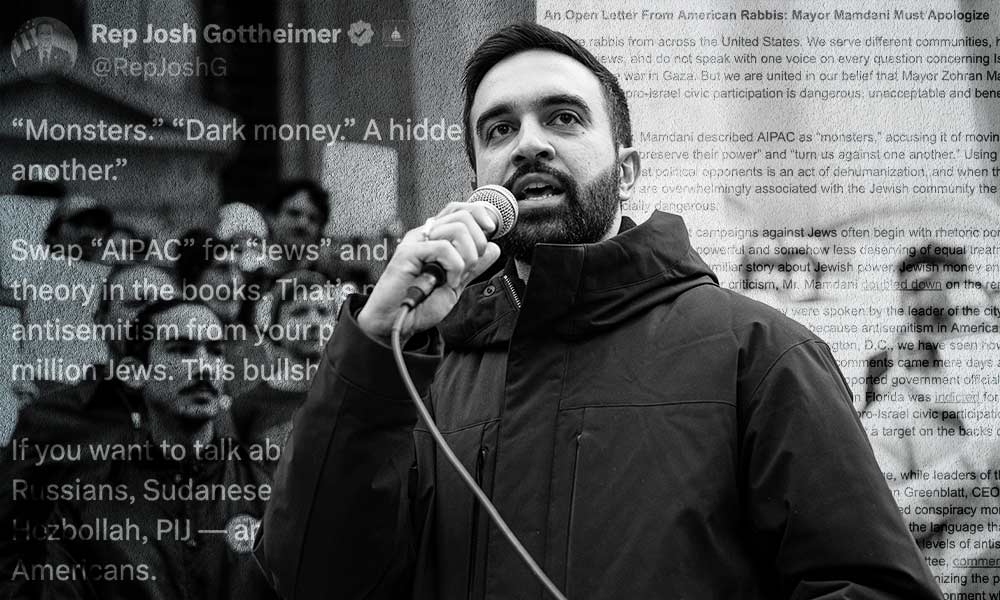


Jewish Politics & Power is published every other week. Sign up for our newsletter for updates.
1. Monsters, Inc.
“We need not live in fear of monsters any longer,” New York City Mayor Zohran Mamdani said during a rally days before the New York Democratic primaries. The monsters he was referring to? “AIPAC, for whom the only thing more frightening than democracy being allowed to run its course is an end to genocide and Netanyahu’s wars.”
The comments, as to be expected, created a stir. The mayor of New York City, who is one of the most prominent figures within the Democratic Party, had just referred to a pro-Israel lobby, made up primarily of Jews advocating for American support for the Jewish state, as “monsters.”
“Swap ‘AIPAC’ for ‘Jews’ and it’s the oldest antisemitic conspiracy theory in the books,” centrist Democratic Rep. Josh Gottheimer, who is Jewish, reacted on X.
“Mayor Zohran Mamdani’s recent speech about pro-Israel civic participation is dangerous, unacceptable and beneath the office he holds,” wrote more than 700 rabbis from all denominations in an open letter organized by a pro-AIPAC group.
Mamdani is, obviously, entitled to his views on the pro-Israel lobby. AIPAC does indeed support almost every action of the Israeli government, and it has fiercely defended Israeli military operations widely described by the international community as war crimes. It fights against any effort by U.S. lawmakers to limit American military aid to Israel or to condition it on restricting certain actions taken by the IDF against Palestinians in Gaza and the West Bank. It is also true that AIPAC pours millions, through its affiliated super-PACs, into Democratic primary races in order to defeat progressive candidates who are critical of Israel.
Mamdani, progressive Democratic candidates, and a huge swath of Democratic voters strongly oppose these actions. But it is worth keeping in mind that AIPAC’s political funding activity is fully in line with U.S. campaign financing laws, as flawed as these laws may be, and that such funding is common practice among many large interest groups. It’s the singling out of AIPAC as “monsters” that has irked even some of Mamdani’s progressive Jewish allies.
Mamdani was given a chance to correct the impression caused by his comments. He chose not to. When asked about the pushback in the Jewish community to his comments, Mamdani explained that he was quoting early 20th century Italian Marxist philosopher Antonio Gramsci and that “when I am speaking about AIPAC, I’m speaking about an organization that has been supportive of the status quo, that has fought any attempt to actually deliver safety to people, not just in Palestine but, frankly, through much of the region, and it is a status quo for immorality.” He also claimed that the problem was “not solely AIPAC but super-PACs at large.” Yet the only one mentioned by the mayor was AIPAC.
There was a visible off-ramp here. Mamdani could have acknowledged that his choice of words offended many, without having to withdraw any of his criticism against Israel, its military actions and the powerful lobby that supports these actions and goes after politicians who disagree.
He instead chose to double down, playing into the hands of his critics who claim that the mayor of the city with the largest Jewish population in the world fails to understand the community’s fears and sensitivities.
2. Has AIPAC-bashing reached its peak?
AIPAC’s campaign funding activities have drawn tremendous attention in progressive circles. Whether to accept funding from AIPAC’s affiliated super-PAC has become a litmus test for Democratic candidates, with those taking money from the lobby automatically disqualified by progressive and liberal voters. This dynamic is now playing out in a heated Michigan Senate race, where progressive Abdul El-Sayed has attacked his centrist rival Haley Stevens for accepting AIPAC’s endorsement and donations.
Truth be told, AIPAC’s conduct is aggressive, and it’s highly effective. Funneling millions into House primary races to buy negative campaign ads aimed at liberal and progressive candidates has proven to be a powerful tool. The fact that much of this money comes from Republican donors, and that the attack ads it buys don’t mention Israel but focus on other issues, makes the lobby look even worse. And again, this is all legal and common practice for interest groups.
But recent language used by Mamdani and others to bash AIPAC is nearing the point of becoming counterproductive. Even Jeremy Ben-Ami, head of J Street, which is AIPAC’s archrival, spoke out in defense of the group. “I’ve spent more than two decades publicly challenging AIPAC. Its politics deserve tough scrutiny. What they don’t justify is demonization,” he wrote, arguing that using such terms, whether against AIPAC or against J Street, which was recently described by Israel’s ambassador to the U.S. as a “cancer” within the Jewish community, “follow the same dangerous logic of replacing argument with dehumanization.”
There’s a real debate going on about America’s attitude toward Israel. It is tearing up the Democratic Party and shows signs of fracturing the GOP as well. Focusing on a lobby that supports a certain side in this debate only stifles the discussion. Americans will eventually decide what kind of a relationship they want to have with Israel, and during this process groups on either side of the debate will do their best to have their position prevail. It’s not about the lobby, it’s about the policy.
(And for those rightly decrying the use of millions in “dark money” to fund campaigns with zero transparency—your problem is with the U.S. laws and with Supreme Court rulings, not with a specific interest group.)
3. Coexistence with DSA—the DC example
Are pro-Israel Jews and progressive Democratic candidates on an unavoidable collision course or is there another path forward?
The nation’s capital may offer an answer.
Janeese Lewis George, endorsed by the Democratic Socialists of America, recently won the Democratic mayoral primary, likely making her the next mayor of Washington, DC.
Some have called her “the next Mamdani,” pointing to, among other issues, her harsh criticism of Israel. During the campaign, Lewis George responded affirmatively to the DSA’s standard questionnaire, which included a pledge to support boycotting Israel and to “refrain from any and all affiliation with the Israeli government or Zionist lobby groups (such as AIPAC, DMFI, Christians United for Israel, J Street)” and to refuse to attend any event “whose content or purpose contravenes DSA’s stated platform and positions on anti-Zionism, apartheid, occupation, or BDS.” This pledge implies a broad boycott on engaging with local Jewish groups and synagogues that are, for the most part, not anti-Zionist and do not support boycotting Israel.
This could have been the beginning of a Mamdani-style clash with the Jewish community. Instead, Lewis George listened to the concerns of DC’s Jews, met privately with communal leaders and eventually issued a statement: “To the Jewish community in DC: I will not be a mayor who includes or excludes you based on your opinions or feelings on matters here and across the world. I will always protect your freedom, safety, and sense of belonging.” Mamdani, in contrast, has stressed his commitment to protect the New York Jewish community and has already increased dramatically the city’s budget for fighting antisemitism. But while engaging with small groups of rabbis and communal leaders, he has made a point of not meeting with mainstream Jewish organizations which support Israel and has famously refused to attend the pro-Israel 5th Avenue parade organized by the city’s JCRC.
This was probably not enough to make Lewis George the top choice for some DC Jews voting in the primaries, but it went a long way in easing tensions and in drawing reasonable boundaries of disagreement. She is still staunchly pro-Palestinian and a harsh critic of Israel; her views are likely at odds with those of the majority of the city’s Jewish community, but there is a clear willingness to work together with no threat of exclusion. This just could be a reasonable blueprint for future relations between pro-Israel American Jews, and anti-Zionist elected officials.
4. Lander’s middle road
Another progressive politician trying to build bridges with the pro-Israel Jewish establishment is Brad Lander, a Mamdani ally who recently defeated incumbent congressman Dan Goldman in a race that centered on the two Jewish candidates’ competing views on Israel.
Goldman, who has accepted funding from AIPAC, describes himself as a “proud Zionist” and has voted against legislative efforts to condition or limit U.S. military aid to Israel. At the same time, he has spoken out against Netanyahu’s policies, called on Israel to take action against violent Jewish settlers in the West Bank, and encouraged Israel to allow humanitarian aid to enter the Gaza Strip.
Lander, in a series of interviews and columns aimed at Jewish and Israeli readers, tried to brand himself as a different kind of Israel critic. He prided himself on urging Mamdani “to keep Jessica Tisch as NYPD Commissioner; to discourage the use of phrases like ‘globalize the intifada’; and to increase funding to combat antisemitism and other forms of hate,” while still maintaining that Israel’s actions in Gaza amount to genocide. In an interview with Haaretz, Lander argued that there is still a space in the Democratic left for liberal Zionists like himself. “I’m willing to be in coalition with anti-Zionists if I’m confident they see American and Israeli Jews as fully human and deserving of safety, just as I believe Palestinians are,” he said.
Lander may not represent all pro-Mamdani progressive Dems. But his views, like those of Lewis George in DC, show that their camp, vilified at times by the mainstream Jewish community, is made up of a spectrum of views and positions and consists of at least some politicians who are seeking to engage and willing to build bridges.


5. Bibi responds
Israel’s Benjamin Netanyahu has been taking heat from both Democrats and Republicans on a variety of issues. In a Sunday interview with Fox News, the Israeli prime minister responded.
On President Trump’s criticism of his actions in Lebanon, Netanyahu said that the two leaders agree “on 99 percent” of the issues.
Responding to a claim by Vice President JD Vance that Israel doesn’t have any friends left in the world except for Trump, Netanyahu pointed to India and argued that Israel has the support of 1.4 billion Indians.
And addressing the mounting criticism from the Democratic left, Bibi said that “there is something unique about these attacks, and that something is that the people who hate Israel end up hating America.”
(Top image credit: Bingjiefu He (CC BY-SA 4.0))
The post Has AIPAC-Bashing Reached its Peak? appeared first on Moment Magazine.