
Glenridge: Broken promises on the hill
Glenridge: Broken promises on the hill examines how a housing cooperative once envisioned as a model of resident control and long-term affordability has become mired in deferred maintenance, governance disputes, financial questions and growing uncertainty. Through interviews with residents, co-founder Fred Butler and current management, the SF Bay View investigates whether Glenridge’s struggles reflect isolated failures—or a broader pattern that threatens Black and working-class communities across San Francisco. The post Glenridge: Broken promises on the hill appeared first on San Francisco Bay View.
 Black News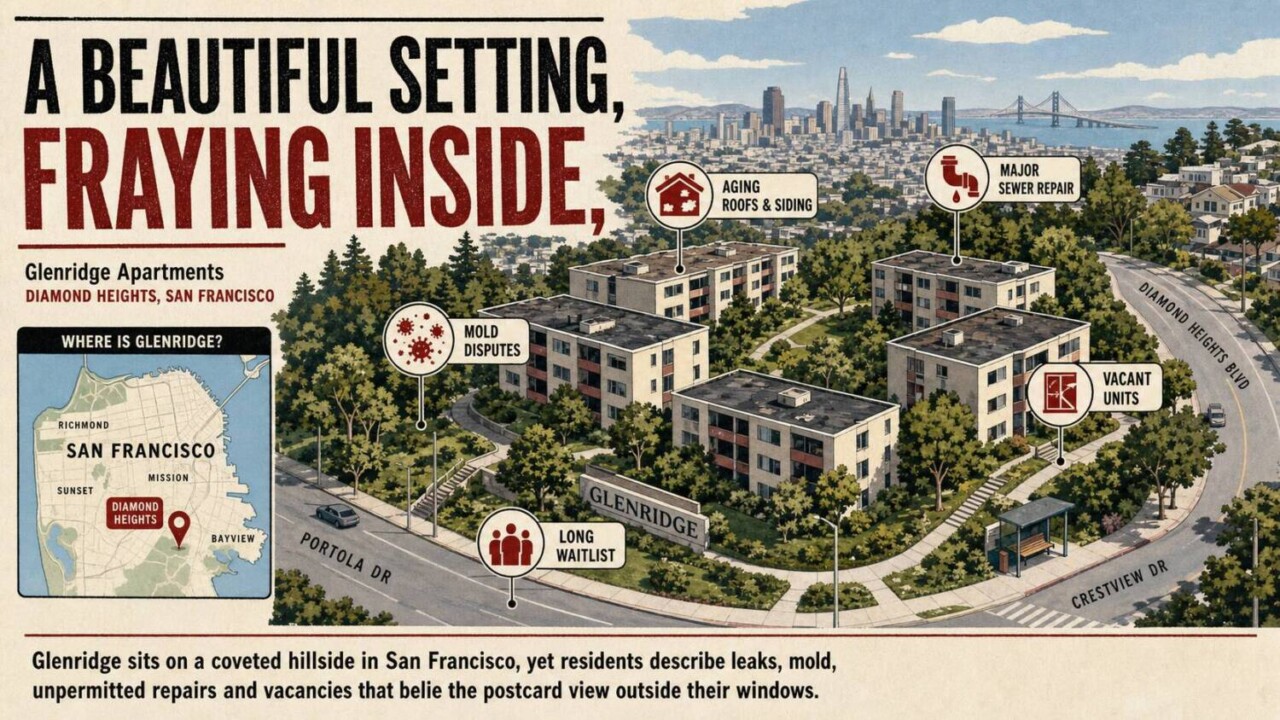
by Tabari Morris
The promise on the hill
Glenridge sits high in Diamond Heights, in one of San Francisco’s most beautiful landscapes. The hillside setting and open sky helped residents believe they had found more than housing. They believed in a model meant to preserve affordability, community control and long-term stability for families already pushed out of the city.
That belief connects Glenridge to the broader “Broken Promises” series. Across San Francisco and beyond, HUD-subsidized and cooperative housing was presented as protection against the same corrupted system that has been responsible for devastating our communities like the Fillmore. But when buildings deteriorate, governance falters and residents are left to struggle among themselves, that promise begins to collapse.

At Glenridge, that collapse is visible on multiple fronts: severe deferred maintenance, questionable receivables, high vacancy, underused vouchers, disputed elections, and unclear lines of control. The breakdown is not just financial. It is physical, legal, administrative and psychological.
A belief that outlived the paperwork
For residents, the issue is deeply personal. Many built their lives around the belief that Glenridge would protect them. Some still describe it as legacy, as something deeper than a lease. That is why the conflict feels larger than management disputes. It is about what happens when a promise outlasts the structures meant to uphold it.
That emotional reality is sharpened by Glenridge’s history. In interviews with the SF Bay View, co-founder Fred Butler said residents began organizing to buy the property in 1989, and closed on it as a cooperative in 1993 after years of resistance from HUD. Butler said Glenridge was created as a California corporation made up of shareholders who were also the occupants of the property, a structure meant to keep the residents themselves in control.

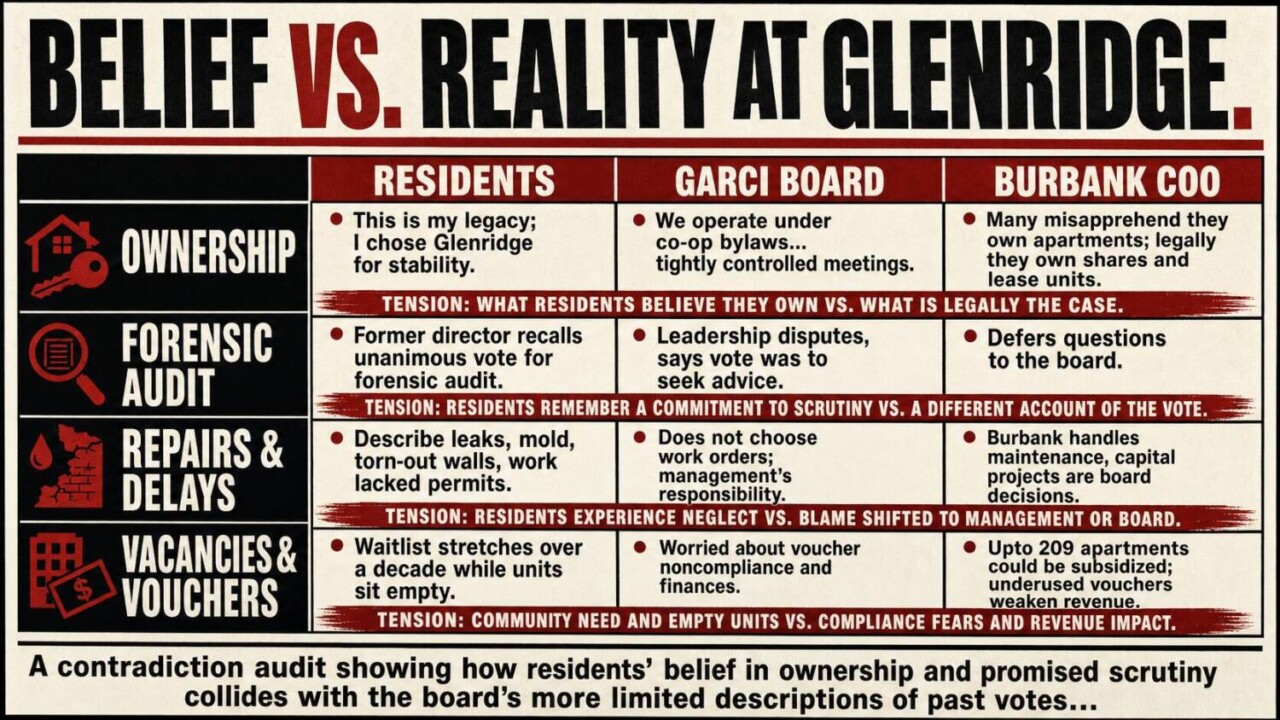
That distinction matters because Glenridge was sold not only as a legal arrangement but as a social and moral promise. When Burbank Housing COO Ben Wickham told the Bay View that many residents are under the “misapprehension” that they own their apartments, he was describing a legal technicality that collides with decades of lived belief. As Butler put it, “The shareholders are the corporation, the owners and the residents all at once, and the right to lease flows from that structure.”
Wickham described a broader structural issue: resident boards are often tasked with governing multimillion-dollar properties without expertise in finance, construction or asset management. The problem is not the residents. It is a system that assigns complex governance without adequate support.
But Butler pushes the critique further. He says “Glenridge’s deepest problem has not been resident inexperience but management companies that ‘dog the property,’ fail to follow through on repairs, overspend on weak improvements and then leave residents with the damage.” He also said HUD repeatedly supported management over residents, even when residents believed the management companies were not doing their jobs.
That is where Glenridge becomes more than one property story. Butler said he has seen the same pattern over and over: management neglect deepens, the property is declared too troubled to save under resident control, and investors appear offering rescue if the cooperative is dissolved. Whether officials describe it that way or not, the effect is the same. The people that the housing was meant to protect are moved closer to removal.
Butler said “Glenridge was designed to serve low, very low and moderate-income households, including working people who often earn too much for Section 8 but not enough to survive San Francisco’s market rents.” He described that mix as intentional: The property was meant to make room for schoolteachers, firefighters, grocery workers and other families who still needed stable, affordable housing.
Butler said, “Glenridge’s affordability agreement required the property to remain affordable for 50 years under terms first tied to the Redevelopment Agency and now administered through the Mayor’s Office of Housing.” Under that structure, he said, residents could pay no more than 30 percent of income for housing costs, a distinction he saw as central to preserving a real foothold in the city.
That history matters because it shows Glenridge was not an accident and not a gift. It was built through resident organizing, political struggle and a deliberate attempt to defend community life against the same forces that had already displaced Black San Franciscans elsewhere.
The accountability maze
Glenridge operates within overlapping layers of authority. Burbank Housing manages the property. HUD oversees vouchers. The city regulates affordability. The board governs. Contractors handle repairs. Residents live with the consequences.
In theory, this structure ensures accountability. In practice, it often produces delay. Management points to the board, the board points to process and residents point to both. Meanwhile, conditions worsen for the people.
Butler described that same maze from the inside. “Board powers are limited by bylaws and state law, yet some boards behave as though shareholder voices are secondary or irrelevant. Under the current leadership, residents have faced restricted participation, limited records access and meetings moved into formats that many cannot realistically use.”
At the Jan. 31 shareholder meeting, disputes over a forensic audit exposed deeper trust issues. An auditor clarified that standard audits are not forensic and noted prior findings tied to unverifiable receivables. Staff described a system of concessions, inaccurate charges and unresolved balances.
Even there, the record splits. Former board member Arnetta Brown said residents believed a forensic audit had been approved. Board leadership said only a preliminary review had been authorized. That gap undermines trust. In a cooperative, credibility is governance.
Butler was more direct. He said the board had approved deeper financial scrutiny and that the purpose was to trace years of spending, contracting and possible abuse across multiple management companies, not just the current one. He now believes resistance to that process reflects fear of what a fuller accounting could reveal about the property’s long decline.
The Feb. 28 board meeting revealed additional concerns. A waitlist appeared to date back to 2012, suggesting applicants may have waited more than a decade. Only three households reportedly moved in over roughly four years, pointing to stagnation in turnover and access.
Voucher utilization is another issue. Wickham stated that up to 209 units could be subsidized, but the system is not fully used, limiting revenue while repair needs grow.
Those needs are substantial. Estimates place required capital work between $15 million and $20 million or more. Roofs, siding, decks and walkways are aging simultaneously. At that stage, delay increases both cost and displacement risk.
Butler added a more immediate warning. He said Glenridge now has 17 vacancies, up from five when the current management company took over, and he believes the vacancies are not just a financial problem but a governance one. He also said residents no longer know which waiting list is controlling admissions, how names are being prioritized or whether the original first-come, first-served structure is still being followed.
Residents describe mold, exposed walls, possible hazardous material issues, unpermitted work and stalled repairs. They also describe meetings where participation feels restricted.
Brown summarized the stakes clearly: “This is my legacy.” Residents are defending more than housing. They are defending history and the right to remain.
Butler gave that same idea a longer history. He said Glenridge became a real community over time, with families, successors and long-term residents tied to the property through relationships as well as rules. In his telling, the present struggle is not only over repairs or procedure. It is over whether a community that built a model of survival will be allowed to keep it.

Governance concerns extend to elections and procedures. At the Feb. 28 meeting, members questioned election handling, committee independence and limits on shareholder input.
These are not minor disputes. In a cooperative, trust in process determines trust in outcomes.
Butler said the problem has deepened through meeting practices that make participation harder, including virtual formats that many residents cannot access, missing records and what he described as efforts to reduce open discussion. He also said residents can be intimidated by fears that speaking up could affect repairs, subsidies or their broader standing in the community.
Not just Glenridge
This cannot be reduced to conflict among residents. Under pressure, communities can fracture. The larger question is who benefits when buildings decline and solidarity breaks down.
Similar patterns have been reported in other cities, including Arizona, Philadelphia and Buffalo. The details vary, but the structure is familiar: Housing promised as stability is allowed to deteriorate and gradually stripped of its original purpose.
Seen this way, Glenridge is not isolated. It reflects a broader struggle over whether Black, poor and working-class residents can remain in the cities they helped build.
Butler sees that struggle in concrete terms. He said he believes Glenridge is being weakened in ways that could later justify investor control, foreclosure pressure or some other restructuring that ends resident ownership in practice if not in name. For the SF Bay View, that is the larger public interest question now emerging: not just whether Glenridge is in trouble, but whether trouble itself is being used as a method.
Questions that still need answers
Key public-interest questions remain:
- What motion was passed regarding a forensic audit, and when?
- How many units are currently vacant, and what has turnover been since 2022?
- Why does the waitlist include names dating back to 2012, and when was it last updated?
- What is the current voucher utilization compared with capacity?
- How many work orders remain open, and for how long?
- What permits exist for major repairs discussed by residents?
- What training has the board received in governance and compliance?
- How many vacancies existed when current management began, and why do residents say the number has grown so sharply?
- What records document how waiting lists are being maintained and which categories of applicants are being prioritized?
Until those questions are answered, Glenridge remains a story of broken promises. Residents were promised stability and control. What they face is deterioration, uncertainty and a system where responsibility is diffused.
They did not design the financing, contracts, or decades of underinvestment. But they are living with the consequences.
Instead of serving as a lifeline after displacement, the system now appears to function as a pathway toward removal. Accountability has begun, and residents continue to demand what was promised.
What the SF Bay View continues to uncover is the “how” and the “what” of that removal. The how is neglect, opacity, vacancy, procedural confusion, investor logic and a structure in which each layer of power can point somewhere else. The “what” is the further erosion of Black presence in San Francisco through institutions that were supposed to preserve it.
Tabari Morris is a City College of San Francisco journalism major and a certified Community Health Worker who is set to complete his Community Mental Health certification in December. He blends community reporting, health justice, investigative journalism, criminal justice coverage and multimedia storytelling to help keep the SF Bay View accountable to Black readers in print, online and on video. He can be reached at tabari@sfbayview.com.
The post Glenridge: Broken promises on the hill appeared first on San Francisco Bay View.