
Bringing Guns and Tanks to a Knife Fight
If you want to understand how protest cycles evolve, look not at the crowds but at the empty streets. On June 25, 2026, Nairobi’s Central Business District was not filled with demonstrators; it was sealed off. Police established roadblocksalong Thika Road, Mombasa Road, Waiyaki Way, and Ngong Road, effectively practising what we call pre-emptive territorial denial—a spatial strategy designed to foreclose the very possibility of assembly. Commuters were stranded, markets shuttered, and public transport paralysed. The state had learned from 2024. Where it once reacted to contention, it now pre-empts it, accepting the collateral economic damage as the price of […] The post Bringing Guns and Tanks to a Knife Fight appeared first on African Arguments.
 Black News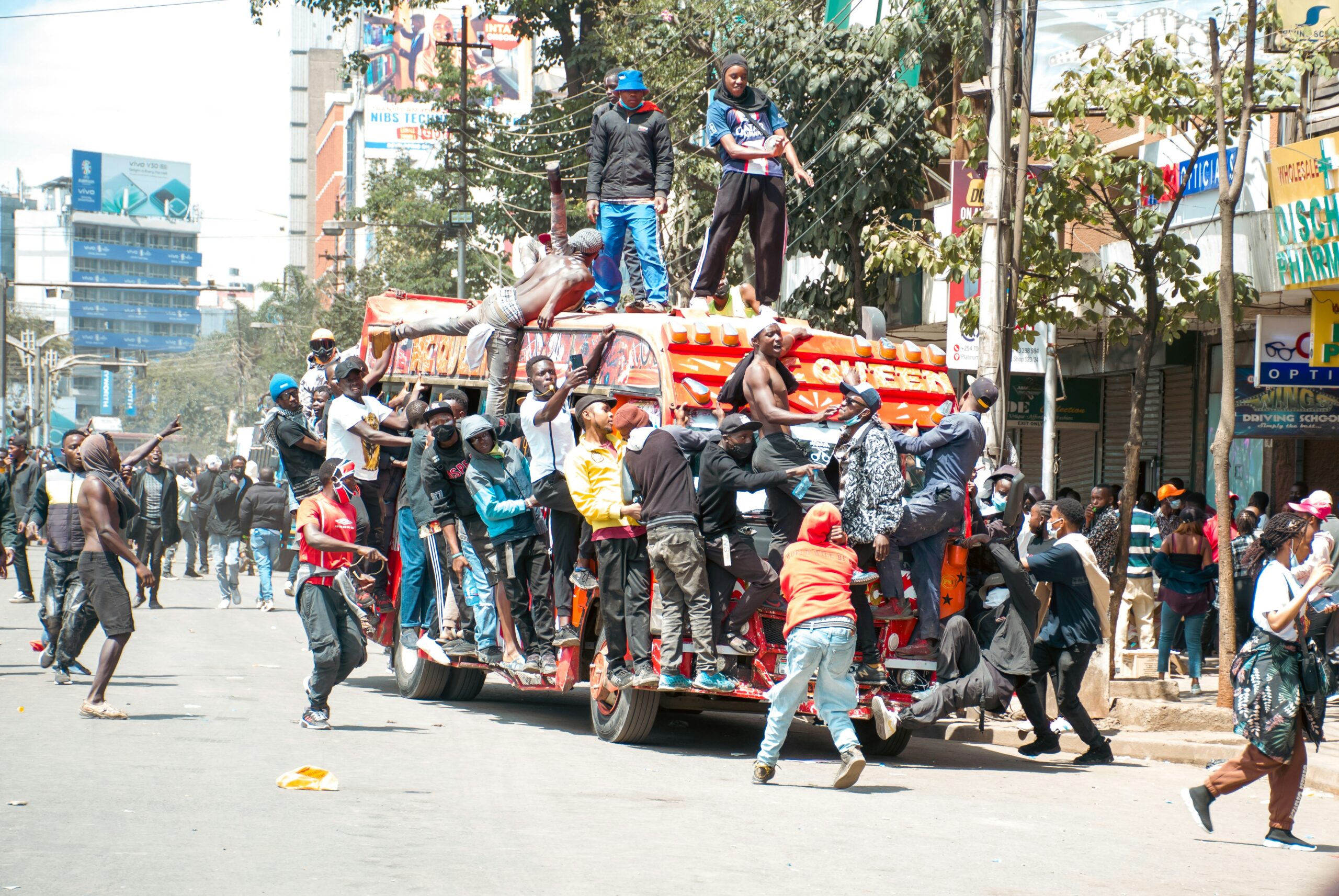
If you want to understand how protest cycles evolve, look not at the crowds but at the empty streets. On June 25, 2026, Nairobi’s Central Business District was not filled with demonstrators; it was sealed off. Police established roadblocksalong Thika Road, Mombasa Road, Waiyaki Way, and Ngong Road, effectively practising what we call pre-emptive territorial denial—a spatial strategy designed to foreclose the very possibility of assembly. Commuters were stranded, markets shuttered, and public transport paralysed. The state had learned from 2024. Where it once reacted to contention, it now pre-empts it, accepting the collateral economic damage as the price of political containment. This shift from reactive crowd control to proactive securitisation tells us something important: the Kenyan state has internalised the logic of contentious politics, and it is refining its repertoire faster than the movement can expand its own.
From Fiscal Grievance to Mnemonic Mobilisation: The Movement’s Repertoire Innovation
The Gen-Z uprising that began in 2024 has undergone what scholars of social movements recognise as grievance expansion and frame transformation. The Finance Bill was the spark but the gasoline was structural – youth unemployment at 67 per cent, a public salary bill that devours disproportionate income, debt servicing that crowds out development and a political elite that is regarded as unresponsive. The movement’s demands had expanded by 2026 beyond the original fiscal trigger to include justice for victims of state brutality, police accountability and opposition to what activists describe as democratic regression.
The anniversary protests were consciously rebranded as a “memorial march” and “flower and flag” demonstration—whatis termed a commemorative mobilisation: the strategic deployment of collective trauma and commemorative ritual to sustain movement coherence across time. An interdenominational service at Nairobi Baptist Church invoked the “blood of young people crying out from the ground,” fusing religious ritual, human rights discourse, and street politics into a form of civic pedagogy. This is the most profound repertoire innovation: the movement has realised that protracted contention requires not only disruption but meaning-making. That the grievances remain, despite the initial withdrawal of the original Finance Bill and political concessions afterwards, suggests that the movement has moved beyond its triggering event to become what the literature of contentious politics would tag a sustained cycle of protest, based on structural rather than conjunctural factors.
The movement’s horizontal, platform-dependent organisation—coordinated through X (formerly Twitter), WhatsApp, TikTok, and Telegram with no fixed leadership—has proven resilient to decapitation strategies, but it has also left the movement ideologically diffuse and vulnerable to misinformation and state infiltration. The absence of formal leadership means there is no one to arrest, but also no one to negotiate with—a leaderless dilemma that complicates the translation of street energy into institutional reform. Activist Bob Njagi’s pre-emptive arrest in Kitengela ahead of the anniversary illustrates the state’s evolving understanding of digital activism: where the 2024 protests caught authorities off-guard by their decentralised nature, the 2026 response demonstrates enhanced capacity to monitor and intercept online organising.
Hybrid Repression and Necropolitical Governance: The State’s Evolving Arsenal

The most worrying trend since 2024 has been the normalisation of hybrid repression, which refers to the use of state forces alongside proxy militias. Civil society groups have reported the alleged use of “hired goons” to infiltrate demonstrations, incite violence and justify escalation of police intervention. It is a classic agent provocateur strategyrecorded across the continent, with a Kenyan twist. The “goons” are said to be armed and protected by the police, creating a fog of accountability in which violence cannot be neatly pinned on the state. By the June 25, 2025 anniversary, the Kenya National Commission on Human Rights reported eight people killed by gunshots alone, more than 400 injured, and 61 arrests.
The gendered dimension is pronounced. Women protesters have been subjected to targeted sexual violence, which is then weaponised to frame them as ‘unruly’ and rob them of political agency – a biopolitical tactic to discipline bodies as much as to suppress dissent. Add to this a 450 percent increase in abductions since 2024, the deployment of rubber bullets and live ammunition, and the surveillance of digital spaces, and what you get is a picture of a form of lethal governance in which the state claims the power to decide who may live and who is expendable for the sake of order. Within the 2026 Finance Bill itself are provisions giving the Kenya Revenue Authority the power to access personal data of citizenswithout their consent, raising the spectre of fiscal surveillance as an instrument of political control.
This represents a qualitative shift in how African states manage dissent. Where once repression was primarily coercive and visible, it is now increasingly diffuse, delegated, and data-driven. The “price of shutdown” borne by ordinary Kenyans unable to reach work or markets reveals a calculus in which economic disruption is accepted as the cost of political containment, blurring the boundary between security governance and economic punishment.
Conclusion: The Asymmetry of Fear.
The protests of June 25, 2026, laid bare an asymmetry. Gen Zs came with flowers, flags, and the moral authority of memory to protest. The State replied with tanks and guns. The size of the response shows that the government sees Kenya’s youth as a danger to internal security rather than a political constituency. A government that is sure of itself doesn’t block off a major street before the first protest sign is put up. The huge response shows worry: the Ruto government knows that the Gen-Z movement is more dangerous than a tax revolt; it’s a generational break with the political order.
But there is a sad irony here. When the government brought guns to a mobilization over memory and meaning, it unintentionally supported the protesters’ main point, which was that Kenya’s democracy is hollow. No one barricades the core of a capital and arrests the citizens to protect a constitution; it is done to protect a government. As Kenya lurches toward the 2027 elections, it is no longer a question of whether young people will return to the streets. It is whether the state has anything left other than escalation. It is whether the government can do anything else besides making things worse. The protests were a way to remember the fallen heroes. But they were also a looking glass. And what stared back was a state so scared of its own citizens that it brought guns and tanks to a funeral memorial.
The post Bringing Guns and Tanks to a Knife Fight appeared first on African Arguments.