
Govt flats become bars, salons and ‘kambashus’
The mismanagement of government flats has turned balconies into “kambashus” (shacks), prompting the works ministry to demand stricter oversight and commercial management of state properties. This comes after works and transport minister Veikko Nekundi ordered the newly appointed interim board of the Public Assets Management Agency of Namibia (Pama) to hit the ground running and […] The post Govt flats become bars, salons and ‘kambashus’ appeared first on The Namibian.
 Black News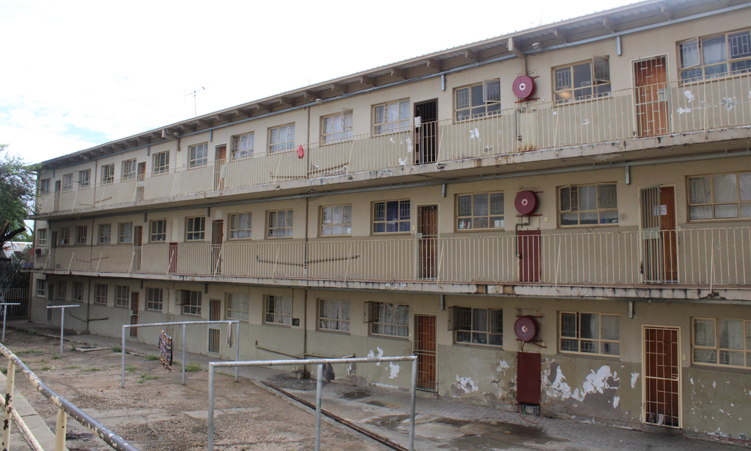

The mismanagement of government flats has turned balconies into “kambashus” (shacks), prompting the works ministry to demand stricter oversight and commercial management of state properties.
This comes after works and transport minister Veikko Nekundi ordered the newly appointed interim board of the Public Assets Management Agency of Namibia (Pama) to hit the ground running and turn non-public service delivery assets into profitable government properties.
These include government houses, flats and nursing homes, but exclude facilities used directly for public service delivery such as government offices.
“If you go to those flats, one room is a barbershop, another one a bar, a cash loan and a balcony is a kambashu. People are renting out garages to their friends and some rent out government flats to friends,” Nekundi says.
Government flats have recently come under scrutiny over their management, occupancy and maintenance.
Nekundi says the management of government flats is chaotic and must be urgently addressed.
He says tenants who have retired must vacate government accommodation within 30 days and settle outstanding municipal bills.
Nekundi has given Pama until the end of August to address asset recovery and registration issues, saying he must report to the Cabinet in the first week of September.
He says Pama represents a strategic reform aimed at moving government asset management from an administrative and custodial approach to one that is professional, commercially driven and accountable.
Pama accounting officer Kristofine Itembu-Naunyango says the agency will manage all commercial properties, including buildings rented to the private sector, residential houses and flats, billboards and vacant land, excluding public service delivery facilities such as hospitals and schools.
She says the agency will be a commercial-driven entity contributing towards government revenue streams.
“We will not privatise the flats but the entity will administer and manage the process internally,” she says.
The government has been moving to tighten control of its housing portfolio amid concerns over unauthorised occupation, subletting, commercial activities and tenants remaining in units after retirement.
Pama’s establishment is said to be part of efforts to improve the management and commercialisation of non-public service delivery properties.
Nekundi appointed the five-member interim board for six months, or until Pama’s registration and policy formulation are finalised.
The board is chaired by property management specialist Irmgard Hamayulu, with finance specialist Leilani Hochobeb as deputy chairperson. Other members are engineer Set-son Shifidi, legal expert Clive Kavendjii and information technology specialist Suama Hamunyela.
Itembu-Naunyang has been appointed accounting officer.
NO PERFORMANCE BONUSES
Nekundi says Pama would operate on a profit-based model, receive start-up capital from the government and would not be bailed out.
“Board management, there is no compromise. One of your key performance indicators is break-even and profit. Anything below that you must bring me your resignation letter, otherwise I will make you resign,” he says.
He also warned that performance bonuses would not be paid to state-owned enterprises (SOEs) under his ministry unless approved by his office.
“If there is no performance, there are no performance bonuses. If you only deliver what is in your job description, there is no need for a bonus,” Nekundi says.
He questioned why companies such as Broll Namibia and FT Du Toit could make profits while TransNamib and the Roads Contractor Company struggled to do the same.
“Performance bonus means you have delivered beyond your normal mandate.”
He warned all SOEs under his ministry that bonuses would only be approved after they prove their performance.
POSITIVE MOVE
McKay Losper, who represents the property sector, says Pama is a positive development for Namibia.
“I mean to say the government holds a substantial portfolio of immovable assets, and placing these assets under professional or rather commercially driven management has the potential to unlock considerable economic value,” he says.
If implemented transparently with support from proper valuations and asset registers, he believes Pama could improve the utilisation of government properties, generate new revenue streams and create meaningful opportunities for investment and private sector participation.
However, the real measure of its success will be whether these assets are managed efficiently while ultimately delivering greater value to the public, he says.
Outjo property officer George Namene yesterday supported the move, saying the profit earned can be used to address other infrastructure needs such as road maintenance and pipe bursts.
“As local authorities are battling housing issues, having government flats and houses bringing in revenue on a monthly basis or as per the contract will help alleviate the housing problem in the country,” he said.
The post Govt flats become bars, salons and ‘kambashus’ appeared first on The Namibian.